leadership

As you know, I have nothing but regrets.

I’m reaching that age where some of my superiors are younger than me. I don’t begrudge them. They all deserves their spots. Some older guys I work with don’t appreciate that they got passed over, but I think it’s our responsibility…as the “elders”…to bestow upon the younger generation what wisdom we have learned (in my case, what little wisdoms I have learned).

I don’t know if this is a regret I have, it’s more like a big “what if”. I spent some time in the military. Even did three years of ROTC in college. It’s laughable to think I could have been an officer now, but it almost happened (before I realized that I loved drinking WAY more than I loved the military). Despite the abysmal failure of that endeavor, a few lessons stuck with me.

“Just make a decision,” I’d always hear, “don’t worry about if it’s the correct one.” I thought that was stupid advice at the time, especially in a military situation where people’s lives might depend on it. But it seems to make a little more sense now.

Who are the three greatest military commanders of all time? It’s obvious: Captain Kirk, Captain Picard, and Captain Sisko.

The three guys in the middle

“But they aren’t real,” you might say.

So? Real life isn’t real.

I remember Mike Stoklasa praising Bill Shatner’s acting capabilities (in a video discussing Shatner’s hatred of Mike Stoklasa). You can laugh all you want, but it’s true: Shatner is an extraordinarily effective actor. And, for better or worse, Captain Kirk is Bill Shatner and Bill Shatner is Captain Kirk.

Kirk understands that he is playing a part as Captain of the Enterprise. He has to project confidence as its leader because the survival of his ship might depend on it. Shatner, I think, understands that Kirk himself is playing a part, which might explain some of the strange speech patterns he exhibits throughout the series and films.

That’s why I think it’s great that the handlers of Star Trek (at least back then) cast classically trained thespians for the role of the Captain. Just the ability to “play the role” is necessary for the crew to rally behind, even when the leader isn’t completely confident in his (or her) decisions.

Obviously Picard is the superior Captain. No disrespect to Shatner, but Patrick Stewart knows when to dial up the acting and when to hold back (even if, in my belief, Stewart didn’t completely understand the appeal of his character or Star Trek). But what Picard does better than anyone is embrace his mission: “explore strange new worlds”. He seeks out moral quandaries and mysteries because he understands that these hold the secrets of the universe. He’s an explorer but not in the usual sense of the term.

I think to be a leader, one has to be open to that sort of exploration.

Of course, Sisko was far more grounded than either Kirk or Picard. He had a life outside of Starfleet and his job was to navigate the political complexities of a particular section of the galaxy. While Kirk and Picard were explorers, Sisko’s mission was different: he was an ambassador attempting to bring together warring factions. But just like everyone else, he had to “play the part.”

“But those were actors that had scripts,” you might say. “Real life doesn’t have a script.”

True that, but if you understand the more technical aspects of your work, in a sense you kinda already do have a script. You can’t just willy nilly your way through a job, you are confined and in many aspects you have direction. It’s just making the best decision with the options you have.

So I think it’s interesting that the three best Captains in Star Trek history each explore the three most important aspects of leadership: confidence (or the projection of), eagerness to accept challenges, and being the middle man between conflicting parties. But most importantly, “just play the part.”

i’ll never write a book

I tried to do one of those challenges where people write a book in a month. It didn’t work.

It’s a good story too: about some dumbass that works at a toilet factory whose boss gets kidnapped. All of this causes uproar in this small town. As the situation grows more absurd and contrived, our dumbass has to rescue his boss. I was exploring my contempt for politics and storytelling in general.

While I think about it, contempt is actually the driving force behind all of my writing. Whenever I begin to write, I have to hold back my urge to say “im gay suck my penis lolz.”

If I did ever write a finished work, it would go something like this:

“Chapter 1: Fuck you

Chapter 2: my dick is small

Chapter 3: my balls are too

Chapter 4: I’ve definitely had sex before

The eND“

Now if I read that, I’d think “that’s a damn good book.” But it would have an audience of exactly one person. Most people expect a novel to be “good”, and “have a story”, or whatever.

My style just doesn’t transfer into long form, immersive storytelling.

Nor into short form really. My way into writing a story consists of how many times I can say “penis”, “gay sex”, “cum”, and have people actually read it. That’s why “A Shot at the Title” is my finest short story. Honestly it’s a banger. Someone should probably give me an award for it. But most times, when the author doesn’t give a shit and hates their audience, the work’s just not gonna be good. Ya know?

That’s why I’ll probably never go back to writing on Medium or any other platform for that matter. I don’t think the shit I want to do would transfer over there. I have complete creative control over here. If I want to post a video of me spreading my ass and saying “this is what I think of Denmark”, no one can tell me no.

I’m a blogger. That’s all I’ll ever be.

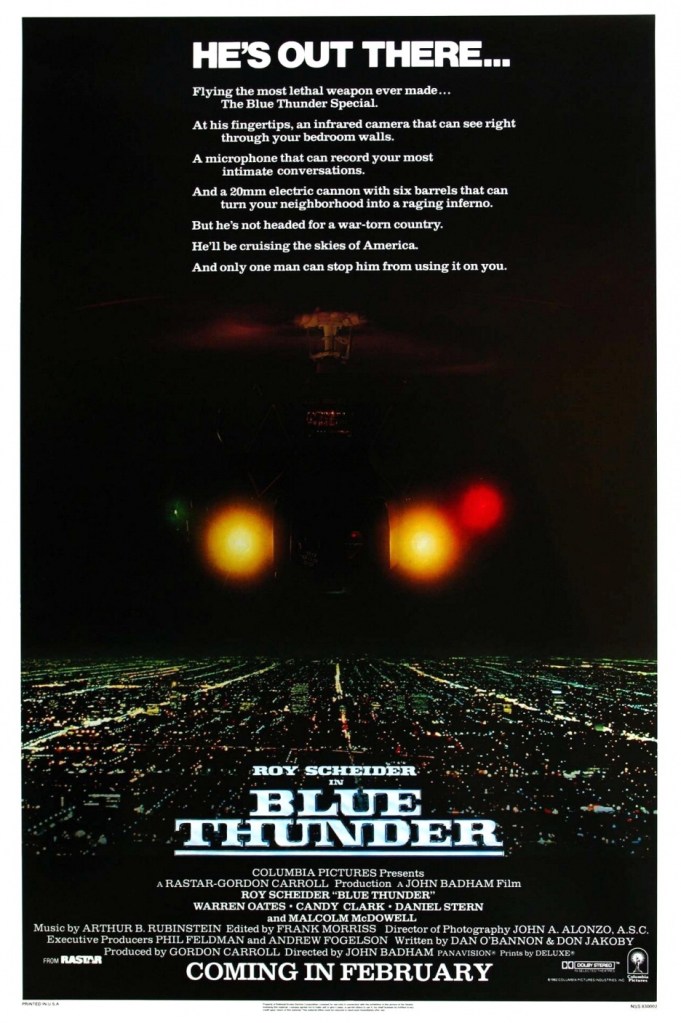
“blue thunder” and “backtrack” (aka Catchfire”)

I watched two movies back-to-back (unintentionally) that had helicopter chases.

The first was Blue Thunder, staring the greatest leading man of all time…Roy Scheider. It is also the greatest movie that Paul Verhoeven never made.

No disrespect to the highly competent John Badham, but Verhoeven would have crushed the shit out of this material. The film takes place in 1980s LA and is about a police pilot and Vietnam vet, played by Scheider, who gets introduced to a military-style helicopter that the city wants to use for patrol. The villain is Malcolm McDowell, a British man that somehow became a Lt. Colonel in the US Army, who for some contrived reason wants to kill Scheider. The fascistic overtones are right up Verhoeven’s alley, and even some of the story beats would be echoed in Robocop four years later.

But the movie looks incredible. John A. Alonzo is really an unsung hero in the field of cinematography. The handheld work is really ahead of its time, and masterfully done. After watching the first scene of Scheider walking out to his helicopter, I was shocked that this came out in 1983. It’s a natural look that even films today have trouble emulating.

And that final helicopter chase was incredible. All of the concerns that Scheider’s character had regarding public safety goes out the window once when he gets hunted by fighter jets and Malcolm McDowell. Chicken factories and buildings get blown up while debris falls on the people below. Meanwhile, Candy Clark drives like a bat out of hell down the streets of LA. As far as 80s action movies go, I’m not saying that it’s up there with the Schwarzenegger, Verhoeven, and John McTiernan classics, but it is very good. In fact, I would say it was a prototype for subsequent 80s flicks.

The other film was less of a banger but no less interesting (for various reasons). It was Dennis Hopper’s Backtrack (or Catchfire, idk). There are apparently two versions: theatrical cut and a directors cut. I guess I watched the director’s cut.

Hopper himself was apparently dissatisfied with the original version and had his “directed by” credit given to Alan Smithee. Honestly, he should have taken his name off the director’s cut as well.

What’s it about? Not sure.

I think Jodie Foster accidentally sees a mob hit by Joe Pesci and Pesci tries to track her down by hiring Hopper and Hopper falls in love with her (and she with him).

Now I’ll say this because I’ve said enough about dude’s bodies in this blog and it’s time women get their due: Jodie Foster is fiiiiiiiiiiiine as hell in this movie. You could say that I was “sexually attracted” to her. It made me uncomfortable (in my pants specifically). I could understand why Hopper didn’t want to kill her.

But the problem with this movie (one of many) is that Dennis Hopper is, I’m sorry to say, not fit for the role. Hopper is at least 25 years older than Foster. There’s nothing romantic about their scenes together. They’re downright creepy. It’s a role that someone like Nicholas Cage, Mickey Rourke, or Sean Penn could have aced at that time.

That being said, Hopper REALLY makes some decisions in this movie, both in front of and behind the camera. To be honest, I don’t even know what he’s trying to do. Is that accent New York or Cajun? Does he know his lines or is he just making shit up? Now no one on God’s green earth could have saved this screenplay, but Hopper’s visual flair and strange acting decisions steal the show…almost to the point where you forget that heavy hitters like Joe Pesci and Vincent Price are also in the movie.

RIP Dennis Hopper and Roy Scheider 😔

happenis

When I realize that there’s other people that are more miserable than me, that makes me happy.

In truth, I don’t know what happiness is.

I assume that it’s a state of contentment. This, as opposed to a constant state of euphoria. Presumably, many people would think that waking up with a blowjob while mainlining pure heroin then driving your Ferrari 95mph through a school zone would be peak happiness. But I don’t know, if someone lived a true carefree existence, that would breed some degree of resentment. Contentment wouldn’t necessarily only entail “being happy” all of the time, but it would be a place where daily struggles don’t cause a sense of existential dread.

Work, family, belonging, or having a sense of purpose in general, would be necessary to achieve this state of happiness.

Contrary to what you might believe about me, I actually have a good career, a loving family, and live in a place that I don’t necessarily love, but it doesn’t annoy the shit out of me. It wasn’t always this way, I just sort of stumbled into it (one of the amazing things that happen when you stop drinking). I’m not “happy” all of the time, but I would say that I’m in a general state of contentment.

My ideal state of pure bliss would be to own a cottage in the English countryside, wear a tweed jacket and monocle, and say “lovely” and “jolly good” all of the time. It’s not fame and fortune. I’m convinced that the only person that has found fame and fortune rewarding is Mark Wahlberg. Everyone else resents it.

So the secret to being happy is to be British.

the injustice

Posted this before and I’m posting it again 🤷‍♂️

Gotta get this blog back on track, ya know?

So I was totally smashing a milf when I said “hey baby, gotta take a shit.”

“Go use the McDonalds down the street,” she said.

So I walked down the road at 1:30am, dick still hard. I clogged the toilet and ordered some hash browns.

“That’ll be $5.50 sir,” the server said.

“$5.50?! What is this….Hardee’s?!”

cynics and stoics

The post-Socratics get a bad rap for being not nearly as good as Socrates, Plato, and Aristotle.

Stoicism in particular has been much maligned over the last few years. It reentered the public consciousness recently, which irked some in the philosophical community. I guess in our post-Enlightenment era, there’s a resistance to schools of thought that seemingly promote individuals to rise above their political realities. This makes sense to a certain extent, especially given our reality after the Great Recession. However, this in turn irks me because the intellectual community is unwilling to divorce the bad from the good in these philosophies, but they’ll gladly do so for Plato and Aristotle (and as I mentioned in an earlier post, for Marx).

Many claim to find stoicism to be too rigid in its determinism, which in turn means we should almost remain passive or unattached to the obstacles we find in our daily lives. But that’s an over simplistic reading, in my view. To be honest, I don’t know if this was the intention of noted stoic thinkers like Epictetus, Seneca, and Marcus Aurelius, but I think we can infer from them that we have to exercise our best judgments and restraint to remain above the madness in everyday life. If we fail to do so, then we are no better than that madness. Through logic and reasoning, we actually find our free will, then subsequently, our happiness. Through this interpretation, Stoicism actually isn’t deterministic at all (though this might run contrary to actual Stoic metaphysics. I don’t know 🤷‍♂️).

I understand why Stoicism would have had detractors in its heyday as it seemed to have caught on with the Roman elite, who had the security to explore such lofty idealism while the proles weren’t afforded that luxury. But that seems like a lazy, bad faith criticism of it today, which comes across like an attempt to deflect personal responsibility and agency (especially given that proletarian-centered philosophies like Marxism is way more complicated, lofty, and at times hypocritical).

But I’ve always been more partial to Cynicism. Not that I condone it, it’s just way more in-your-face. It’s impossible to be a Cynic today (you’d be arrested for a being a public nuisance), but it does ask you to question common sense. Diogenes of Sinope was its most prominent thinker. He apparently jacked off and relieved himself in public, gave no shit about social status, and extolled the virtues of what amounted to homelessness. I agree with the leftist critics of Diogenes’ form of Cynicism in that his fetishism of poverty undermines how dehumanizing it actually is. But the real reason why I think Cynicism is unpalatable to modern thinking is it’s rejection of material wealth and its promotion of “cosmopolitanism”. While I find the Cynicism of Diogenes to be somewhat individualistic, his form of individualism runs completely contrary to its modern form.

While I wouldn’t call Cynicism’s version of cosmopolitanism to be sophisticated, it was rather forward thinking in its rejection of “imagined communities” (see Benedict Anderson). Diogenes allegedly called himself a “citizen of the world”, this coming at a time when the city state dominated political thinking. Cosmopolitanism is widely rejected by ideologies across the spectrum, from Nazi’s, traditional conservatism, and even Marxism (depending on your interpretation), despite its inevitability.

So I don’t know, maybe I’m asking you to reassess these schools of thought because they piss off the right people.

what dreams may come

I’m a hard sleeper.

Nothing can, nothing will, wake me up. Construction, gun shots, home invasions, house fires, nuclear holocausts…nothing.

So I get to have incredible dreams. Last night, for example, I dreamt that I was a football player buried deep down the depth chart. The team boarded a plane en route to a game with the pilot both coked up and drunk. The pilot thought it would be cool to do a barrel roll in a passenger plane which caused some concern. I brushed it off and took a nap. When I awoke, the plane had to make an emergency landing onto a road but ended up crashing into an apartment building. No one was killed,miraculously, and the people in the building didn’t think anything unusual about it because it was in Mississippi and apparently things like that happen all the time. Nevertheless, one player thought this was the perfect opportunity to exact revenge…for whatever reasons…on the head coach and a few other players. So it was up to me, some nobody, to save the team.

Once when that was done, I had to book a flight home but chose to fly to London, England instead. The price came to $20,000 and I didn’t have the money. Then the dream ended.

There were dreams on the periphery, one which includes me fighting a rabbit in Monument Valley and sending it to a highly mechanized version of hell.

I guess dreams are just a hodgepodge of shit stored in our heads and when we sleep, our brains randomly throw things together which we later attempt to make sense of (or in my case, project a story onto). Does it ever mean anything? Probably not.

At least not most of the time.

But I do have recurring dreams. Not dreams where the exact same things happen, but they share similar themes, people, places, etc. I suppose that there are shreds of truth in these kinds of dreams: a revelation of regret, dread, loss, and so on.

I find the subject of dreams fascinating. It reveals the chaos that exists in our own minds. Even the purest of people will experience a gruesome nightmare. Despite their outward practices in real life, even in their minds they will produce true horror. That emanates completely from them. We try to project some sense onto our dreams, but the fact is that there isn’t any whatsoever.

We do the same thing to our reality.

contra Marx (and politics in general)

I should apologize first off. A lot of this won’t make sense, but I need to get it off my chest.

Anywho, good luck reading this ✋

For most of history, there was no delineation between religion and politics. While it’s common to separate them currently, that’s really a false assumption.

Maybe I think it’s foolish to think so because of how I view religion. It’s common to associate it with thoughts on the supernatural, afterlife, etc. Meanwhile, politics is thought of as being policies directed at the governance of a population. But the social/psychological dimensions of these two realms can’t be ignored.

Politics and religion operate in unison. Religion is not just the worship of God or gods, it’s a methodology of perceiving reality. It’s validity of truth is irrelevant. If a significant amount of other people perceive this reality in the same way, then perception becomes truth. I’m not saying that truth is not real. It is. Human perception is, however, malleable and easily distorted. Religion is commonly thought of as being the most prevalent social force in this distortion, but political ideology works in identical fashion. In short, to this very day, the religious is political and the political is religious.

(This is why I say the only sensible position to take is the apolitical one. Political philosophy and science has not advanced one iota since Plato and Aristotle)

Take for example the two Right/Left extremes in QAnon and the resurgence of Marxism. Enough ink has been spilled over the insanity of QAnon, but not enough of it towards Marxists/Left/Left-adjacent Populism.

Part of the reason why Marxism has seen a resurgence…at least in the United States…I think, is because it was all but prohibited in the mainstream during the Cold War period. Additionally, it’s detractors made all sort of wrong assumptions about it or never read Marx, or any Marxist thinker at all. This had allowed it to fly under the radar for decades, with Marxists going unchallenged in good faith debate. Then the Great Recession and the pandemic primed the public for its popularity.

But despite its scientific and sociological pretensions, Marxism (and much of leftism/anti-liberalism as a result) functions no differently than Q-Anon: even when it’s allegations are proven false, it doesn’t matter. It’s critique is way of viewing reality, and no amount of data can contradict it (the explanation usually being that “the data” is bourgeois propaganda designed to undermine class consciousness…or some variation thereof)

As any Marxist/Leftist will tell you, they are not “liberals”. As most know, they are opposed to capitalism, now in its neoliberal form. While neoliberalism has an actual definition in the realm of economics, it takes on a nebulous form with the Left, making it useful as a boogeyman that can describe anything they disagree with. Therefore Marxists, like the Conservatives that once opposed them, fail to understand their opposition and how neoliberalism and global economics have fundamentally changed class dynamics since Marx’s death (or some acknowledge that there’s an opposition to Marx’s class analysis, but mock it. i.e by saying “Marx never considered…” or “Marxism works in theory”). They can’t agree on a “working class” definition (is it income? “Relationship with production”? What?) or where the demarcations are for any class structure, which is odd considering Marxism thinks of itself as a “material” based analysis. Therefore it’s class-based analysis comes to mean nothing. Additionally, Marxists/Leftists wish to take a post-moral approach to politics, but they’ll make a value judgment on the working class over the bourgeoisie (which again, are terms that mean nothing, or ill-defined in the current state of economics/politics). So they engage in the same friend/enemy distinction that they accuse the liberals of doing (and what all political tribes do).

Many, though not all, Marxists/Leftists oppose “identity politics” because they believe it undermines their “class politics”. But they’re functionally no different. In addition to keeping the “working class” divided, Marxists claim that proponents of identity politics are actually cynical actors that portray the various identities as completely monolithic or lacking agency. But the Left does the exact same same with its class politics. It works in their favor to portray the working class as brutish, uneducated, and needing guidance from those that know better. And their “enemy” can be anyone, because again, the “bourgeoisie” can mean anything. Marxists can claim that identity politics undermines class consciousness, but proponents of identity politics can accuse the Marxists of undermining the unique struggles of various groups.

Every political faction has its problems. What I’ve said about Marxism I can say about everyone else. What I’ve always found confusing is what do the Marxist Left and anti-capitalists want? I’m not talking about some egalitarian revolution to make a better world. We all want that. I’m talking about “what happens after the revolution”? A classless society? Sure it may be possible to create material equality for all…but does that eliminate “class”? The need for management of affairs (or politics) would still be necessary. What would we do if an elite “political class” takes control? I’m just skeptical about a “classless society”…especially one that has to be achieved through violent revolution. I could be wrong, but self-conception is heavily linked to cultural and societal structures, this includes structures of power. It is my assertion that since the dawn of complex language, there has been no widespread non-caste(ified) society. Not even in the hordes of pre-history (that usually numbered about 100 people). There were elders, priests, big men, warriors, hunters, gatherers, etc. There were men at the top calling the shots and men at the bottom carrying out the orders. Sure these societal structures varied greatly, but some people definitely carried more power than others, even in the smallest of groups. As power paradigms shifted, from priests, monarchies, military dictatorships, and democratically elected officials, so did the class structures. And these paradigm shifts cannot be predicted, at least not with any complete accuracy. Will capitalism last forever? No. What will replace it is anyone’s guess. The fact is you don’t know, and trying to predict the future is a fool’s errand. Even if you do get your communist dream, it’s days are limited, and a new paradigm will take its place.

I’ve gone into detail on how Marxism mirrors Christianity perfectly (class consciousness=salvation in Jesus Christ, etc.) so I won’t go into detail on that here. This isn’t to say that some tenets of Marxism aren’t without their merit. It’s historical method sounds reasonable enough. But I treat the works of Karl Marx as I would any thinker of the past: remain critical, some ideas work, but a lot of it is outdated. We do that with every other philosopher/economist, why must we treat Marx any different? It’s not like God directly inspired Das Kapital, but that’s how it’s treated (along with Luxenburg,Gramsci, etc.)

Not gonna lie, I’ve spent four years steeped in this shit and I feel mindfucked and robbed. However, studying this stuff has informed me that I need to be skeptical of ideologies proclaiming “truth”. The universe is seeming infinite while we’re laughably finite. The only thing we can be certain of is that we certainly know nothing.