“blue thunder” and “backtrack” (aka Catchfire”)

I watched two movies back-to-back (unintentionally) that had helicopter chases.

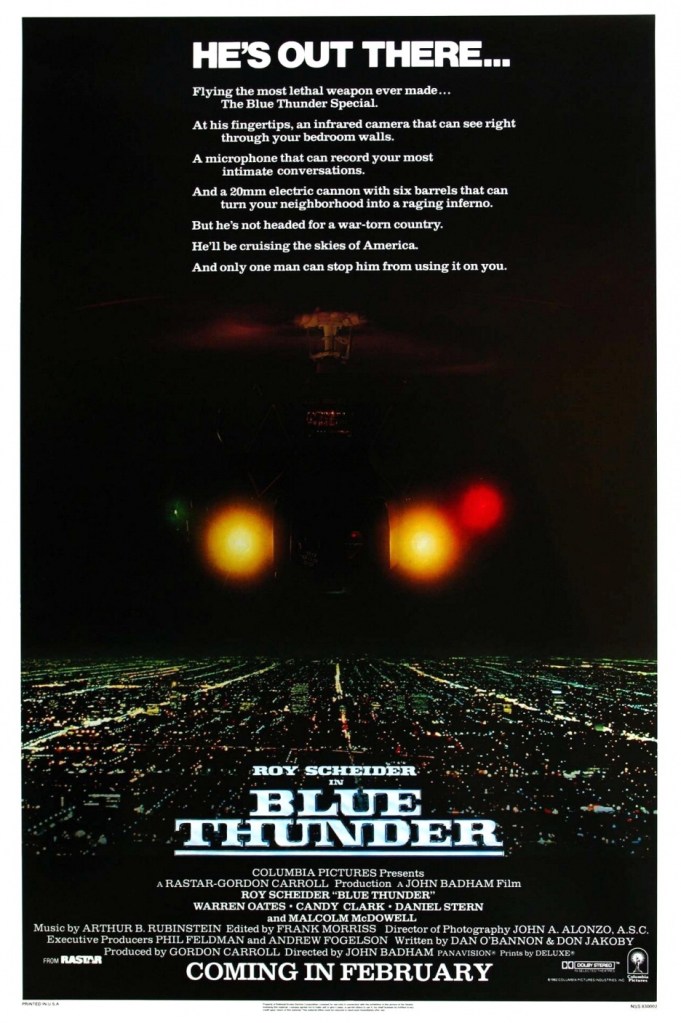
The first was Blue Thunder, staring the greatest leading man of all time…Roy Scheider. It is also the greatest movie that Paul Verhoeven never made.

No disrespect to the highly competent John Badham, but Verhoeven would have crushed the shit out of this material. The film takes place in 1980s LA and is about a police pilot and Vietnam vet, played by Scheider, who gets introduced to a military-style helicopter that the city wants to use for patrol. The villain is Malcolm McDowell, a British man that somehow became a Lt. Colonel in the US Army, who for some contrived reason wants to kill Scheider. The fascistic overtones are right up Verhoeven’s alley, and even some of the story beats would be echoed in Robocop four years later.

But the movie looks incredible. John A. Alonzo is really an unsung hero in the field of cinematography. The handheld work is really ahead of its time, and masterfully done. After watching the first scene of Scheider walking out to his helicopter, I was shocked that this came out in 1983. It’s a natural look that even films today have trouble emulating.

And that final helicopter chase was incredible. All of the concerns that Scheider’s character had regarding public safety goes out the window once when he gets hunted by fighter jets and Malcolm McDowell. Chicken factories and buildings get blown up while debris falls on the people below. Meanwhile, Candy Clark drives like a bat out of hell down the streets of LA. As far as 80s action movies go, I’m not saying that it’s up there with the Schwarzenegger, Verhoeven, and John McTiernan classics, but it is very good. In fact, I would say it was a prototype for subsequent 80s flicks.

The other film was less of a banger but no less interesting (for various reasons). It was Dennis Hopper’s Backtrack (or Catchfire, idk). There are apparently two versions: theatrical cut and a directors cut. I guess I watched the director’s cut.

Hopper himself was apparently dissatisfied with the original version and had his “directed by” credit given to Alan Smithee. Honestly, he should have taken his name off the director’s cut as well.

What’s it about? Not sure.

I think Jodie Foster accidentally sees a mob hit by Joe Pesci and Pesci tries to track her down by hiring Hopper and Hopper falls in love with her (and she with him).

Now I’ll say this because I’ve said enough about dude’s bodies in this blog and it’s time women get their due: Jodie Foster is fiiiiiiiiiiiine as hell in this movie. You could say that I was “sexually attracted” to her. It made me uncomfortable (in my pants specifically). I could understand why Hopper didn’t want to kill her.

But the problem with this movie (one of many) is that Dennis Hopper is, I’m sorry to say, not fit for the role. Hopper is at least 25 years older than Foster. There’s nothing romantic about their scenes together. They’re downright creepy. It’s a role that someone like Nicholas Cage, Mickey Rourke, or Sean Penn could have aced at that time.

That being said, Hopper REALLY makes some decisions in this movie, both in front of and behind the camera. To be honest, I don’t even know what he’s trying to do. Is that accent New York or Cajun? Does he know his lines or is he just making shit up? Now no one on God’s green earth could have saved this screenplay, but Hopper’s visual flair and strange acting decisions steal the show…almost to the point where you forget that heavy hitters like Joe Pesci and Vincent Price are also in the movie.

RIP Dennis Hopper and Roy Scheider 😔
😎Midsommar 😎

I like to talk about movies that people usually know but have somewhat forgotten about.

That being said, Midsommar is relatively recent and probably still discussed.

Oh well 🤷‍♂️

I’m not really a horror fan, so I haven’t seen Hereditary, Ari Aster’s other film. But Midsommar caught my attention because someone mentioned that it was a horror film that lacked any of the tropes found in such movies.

People aren’t as big of a fan of Midsommar as they are of Hereditary. Was Hereditary really that good?

Many have said that the subtext of this movie is dissolution of the relationship between the two leads. If that was the case, then I hardly noticed (or cared). For me, what was terrifying about the movie was how it kinda reminded me of Salo: Or the 120 Days of Sodom, albeit far more emotionally engaging. In fact, if Midsommer is a “horror” film, then Salo is as well.

But Aster uses the “horror” elements wisely. Much of the film is actually pleasant to look at: pleasant locations, pleasant faces. Naturally, this pleasantness is used to lower your guard.

Except for one dream sequence, all of the horror takes place during the day. The most noted example is the suicide scene with the two elderly people. If you watch a lot of movies, you’ve definitely seen gorier shit, but this one hits different. It’s a beautiful scene juxtaposed against two old people getting their faces smashed in. Additionally, for the two groups present for this ritual, one finds the scene beautiful while the other is utterly horrified.

And it happens relatively late in the film, long after you get adapted to the tone. Usually horror films do something like that early, just to tell the audience what it’s capable of.

Many have discussed why this movie is terrifying, and none of it works as an explanation for me. The most common is “it’s an American perspective on a foreign culture and how we find them terrifying “ blah blah blah. That never once occurred to me. What I found terrifying is the passiveness of the characters and the bullshit myths that the cult had to justify itself.

And the film does call bullshit on it (some guy argued that the film has a neutral take on the cult, which is partly why some find it scary. But that’s definitely not true).

Case in point is in the euthanasia scene, after the old man jumps off the cliff, breaks his leg, and lays there in pain. After the scene, the male lead tries to justify it by saying something like the “community might find our methods of elderly care barbaric”, but that old man met a truly barbaric end (his face later gets smashed in). I’d take a nursing home any day of the week.

The other example is at the end when the temple gets set on fire. Two members of the cult volunteer for the burning and are given a drug so that they won’t feel the pain of burning. However, one guy watches his friend, the last image he’ll ever see, scream in horror as he burns alive! All the drugs and nonsense clearly did him no good.

So to me, this film was kinda a commentary on the cult mindset and how people can be persuaded to do unusual things in the name of nonsense (and a lot of drugs). OR how people use these rituals to mask truly horrific things. That explains Florence Pugh’s smile at the end: she was an emotionally unbalanced person that’s suddenly found her place.

To me, the most terrifying thing was the brief moment when the male lead opens his eyes and sees a smiling face telling him that he is drugged, can’t move, can’t talk, and that’s that. Bye!

But what this film also does effectively is give you a solid sense of geography. You get used to the nice setting and that’s when bad things start happening. It plays out like a dream that suddenly turns into a helpless nightmare. Just as in a dream, the actors don’t know what’s going on but they play along nonetheless.

Ideology works the same way.

bill friedkin

The career of William Friedkin is a reminder of how hard it is to make a good film.

He hit two films out of the fuckin park with The French Connection and The Exorcist then kinda floundered from there (he did have a few notable films afterwards, namely Sorcerer and To Live and Die in LA, the latter of which I haven’t seen).

Sure Friedkin won his accolades here and there, but he is truly the maestro of one specific thing: directing car chases.

Everyone remembers Gene Hackman just plowing through cars and walls while Friedkin neglected to obtain permits to film such a thing in the French Connection (and apparently there’s a good chase sequence in To Live and Die in LA), but Friedkin’s crowning achievement, in my view, is in Jade.

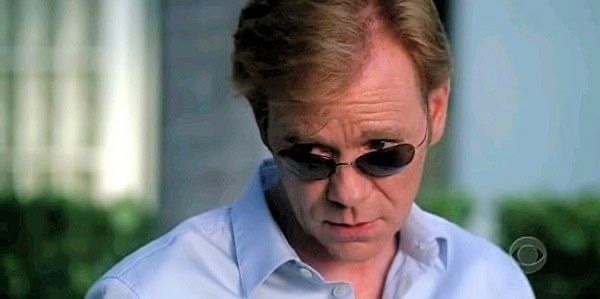
Before David Caruso was spitting out one liners while rocking a pair of sunglasses in CSI: Miami, he tried his hand at being a film star. Jade was the absolute highlight of this period.

In the film, after Angie Everhart gets totally destroyed by a Ford Thunderbird, Caruso pursuits the vehicle in his POS Ford during a delightful chase where vehicles fly through the air down the streets of San Francisco (and Caruso does his best Gene Hackman impersonation).

The best part is when the chase goes through some parade and pedestrians attack the vehicles using martial arts. I guess that would make sense if you learn about other cultures while binging on cocaine.

Take a look:

poop (and crap)

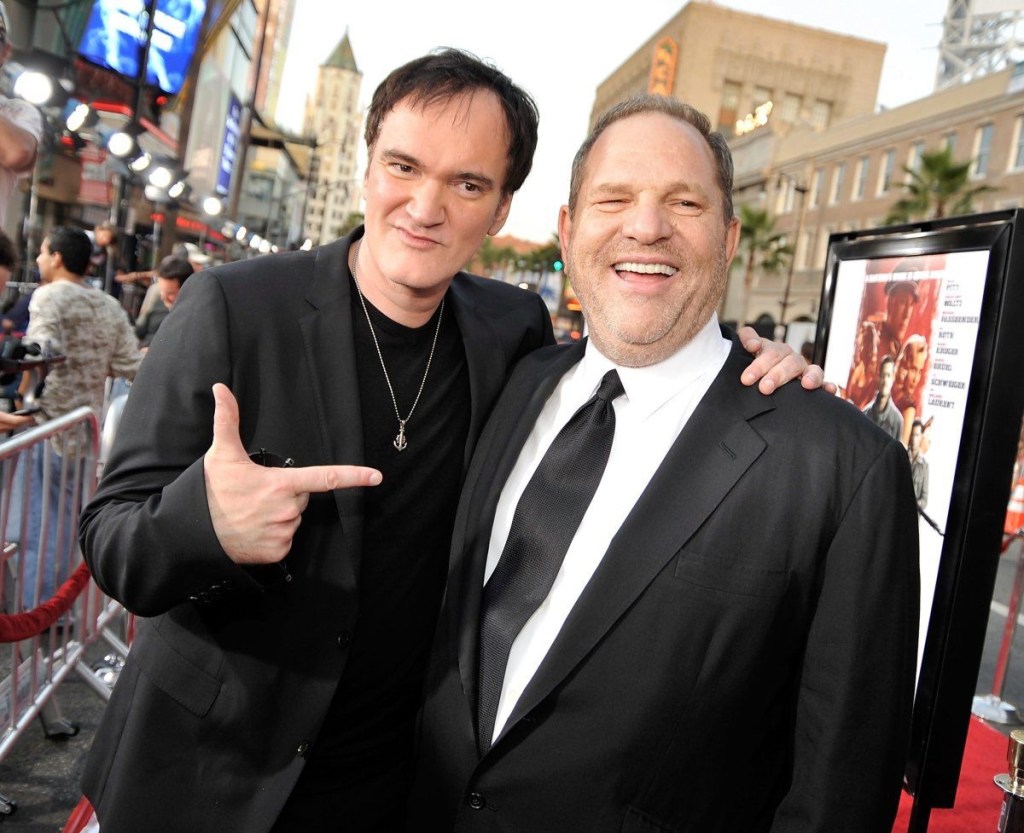
I’m glad that the films of Quentin Tarantino and Christopher Nolan are still considered events. Auteurism is dying in Hollywood but there are still remnants.

I’m not a fan of their films, but it’s still nice.

I know it’s heresy for film buffs to dislike Tarantino, but like Alabama in college football, his movies get evaluated by a different standard for better or worse. Even when it’s obvious that he didn’t put his best foot forward, like every movie he’s made in the last 15 years, Tarantino’s films get praised as if the film industry is about to go under. If you remove his name from most of his movies, you’d probably be wondering what the fuck you just watched.

Mind you, Pulp Fiction will stand the test of time. Jackie Brown should be better appreciated. Kill Bill Vol. I and II are what they are. But go back and watch Reservoir Dogs. It didn’t age well. Could this be the fate for all his retrospective reviews once when Tarantino retires from the biz (after he allegedly makes his “10th film”)?

Probably not, but I can hope.

I admit, Tarantino just isn’t my flavor. A perfect film, for me, transcends the medium. It’s gotta stick with me…reveal something about myself, about the universe, that I never realized. Tarantino the man, as reflected in his films, lacks that insight. He’s a film geek. Not that there’s anything wrong with that, but that’s all that he’s capable of being.

I expect more out of films, not constantly getting nudged throughout a viewing, being reminded of some shitty Italian film from 40 years ago. Now I love schlock as much as the next guy, but art and schlock do not…cannot…mix.

Tarantino however wants to have it both ways. And that is a pipe dream.

He made a cool film once 30 years ago, most directors will never achieve that. But that doesn’t mean everything he’s made since has been a home run.

Really the same thing is true for Nolan. I personally think his success rate is greater than Tarantino’s. But Nolan probably thinks of himself as the Stanley Kubrick of mainstream blockbusters. That also screams trying to have it both ways.

But whatever dude, at least Insomnia, The Prestige, and The Dark Knight…the only superhero film I’ve ever liked…were damn good.

sudden impact yur ass!

We should all be thankful that we still have Clint Eastwood. The man’s been working for close to 70 years. He’s an absolute legend.

The Hollywood GOAT?

Seriously, think about that. He’s an accomplished actor AND director. It’s a career that will never be topped. Ever.

Many have tried, notably Sylvester Stallone, but it’s just not possible. (To be fair to Stallone though, Eastwood was in much more competent hands earlier in his career between Sergio Leone and Don Siegel).

This being said, Eastwood isn’t the most innovative director. In fact, when he does make a great film, it’s as though he accidentally did so. His two universally acclaimed films, Unforgiven and Million Dollar Baby, are mostly great because of their scripts (same with The Outlaw Josey Wales). Gran Torino appears to be a film with a lasting cultural impact, and while I wouldn’t say it had an outstanding script or direction, the movie works because of Eastwood’s personality, not because of anything he did behind the camera. But I’d say that Eastwood is to filmmaking what Steve Kerr is to the NBA…he’s extraordinarily competent.

Of course, when you go through a stretch where you’re making a movie ever 20 minutes, it’s hard to maintain quality.

Sudden Impact is one of the million Eastwood movies that gets lost in the shuffle. With a story from pioneering independent filmmaker and Arkansas legend Chuck B Pierce, this Dirty Harry sequel has our favorite 44 Magnum carrying San Francisco investigator being more dirty than usual. Eastwood’s then-wife Sandra Locke costars as woman exacting revenge against men who raped her 10 years earlier. I’d say that this is the best Dirty Harry sequel. Nay, this sequel is better than Dirty Harry, a film that defined raw 70s cop dramas.

What makes Sudden Impact so memorable is not the plot, I don’t remember if there was one, or character development or any of that bullshit. No, what makes this film great is watching Eastwood stumble from one scene to the next just absolutely beating the shit out of and shooting everyone. EVERYONE. To top it off, he runs around with a farting bulldog. He also kills a guy by just giving him a heart attack for fucks sake. Eastwood is just a straight up asshole, more so than usual for Dirty Harry. It’s probably that greatest Cannon film not produced by Cannon.

The film feels as though Eastwood didn’t want to return to the role and the only way they could convince him is if they allowed him to direct. And it payed off. Some of the best films made from this period were done when no one gave a shit. But Eastwood’s direction gave this entry an added edge, which is probably why Sudden Impact feels so different from the other Dirty Harry films.

While we still have him, I wish Eastwood would do ONE MORE Dirty Harry film. It’s what we need now more than ever: a 90 year old bastard just blasting the fuck out of bad guys with a 44 Magnum.

Do it Clint!