

…Robert Ginty (1948-2009) 😩
…Robert Ginty (1948-2009) 😩
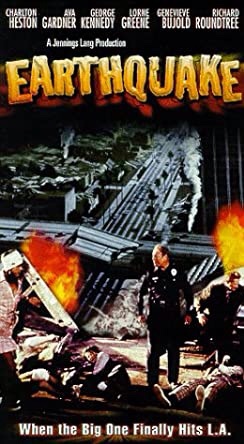
Los Angeles in the 1970s was a magical time. Actors quit caring about their physique. Producers were blasting cocaine into their brains. George Kennedy was a star. It’s a time that’s never been topped and it never will be.
Out of this era came Earthquake (1974) starring Charlton Heston and a bunch of actors in need of a paycheck (and co-written by Mario Puzo).
As disaster films go, there’s a long buildup to the “disaster”: Heston is bangin Genevieve Bujold, George Kennedy is an absolute asshole, Walter Matthau is a pimp drunk, and so on. It’s all standard stuff. Then comes the 4 hour earthquake where cardboard houses crumble and the people of LA forget how to handle such an event as they fall several stories out of high rises to their violent deaths. It’s delightful.
My only complaint about this sequence is that they didn’t do enough with Richard Roundtree’s part as a daredevil. It would have been pimp if he CRUSHED that obstacle course on his motorbike while buildings crumbled and people died all around him. Oh well.
Honestly, there’s a few good matte paintings here and there. But the standout is Marjoe Gortner’s performance as the sexually confused grocer/wannabe karate instructor/National Guardsman. It’s a performance that was ahead of its time.
The ending is good too: the city is in ruins and none of the personal drama gets resolved (of course, I was barely paying attention at this point).
I think this film provides a good insight into an era where Hollywood quit giving a shit, just as long as everyone made a fuck ton of money.
Still can’t believe he’s gone 😔

🪦 Rick Majerus (1948-2012) 🪦

The Last Temptation of Christ unsurprisingly stuck with me. Usually when I complete a novel, I think “hmm, that was nice” and I move on to the next thing. But Kazantzakis’s interpretation of “the Greatest Story Ever Told” is rewarding and leaves a lot to think about, especially if you’re obsessed with early Christian history.
I mean, obviously it’s not historically accurate. That’s not the point. The point is that the book brings these familiar characters to life. Jesus begins the book as a sickly carpenter before transforming into the messianic figure we’ve come to know and love. However, his humanity is emphasized. At times, Jesus comes across as a jerk with megalomaniac fantasies. This helps contextualize Jesus the man and the era he lived in.
This is best demonstrated by his relationship with Judas Iscariot. Judas is a true revolutionary with a hatred for the Romans and is often frustrated by Jesus and his message of love. Jesus feels that Judas’s revolutionary ideals don’t go far enough: the concerns for the body are temporary, Jesus wants to bring salvation to the world…Jew and gentile alike.
The various characters are often puzzled by this. This universalism is too lofty, too radical to ever be realized.
And this sort of remains true today. I’ve expressed my admiration for John Dominic Crossan views: Jesus was responding to the imperial authority of the Romans. Jesus and his followers might not thought of it in that way, but that was effectively what he was doing. I don’t think enough scholars, both Christian and secular, stop to appreciate this. Not even Bart Ehrman.
I think this is best demonstrated by the cross as the official symbol of Christianity. Jesus unquestionably died by crucifixion, perhaps the most ruthless form of punishment by the Romans. And none of the early Christian apologists deny that it happened. Stop and think about that: their very leader got “owned” by the Romans. In fact, it HAD to have happened so that he could be resurrected. So Christians took this event and chalked it up as a win for their beliefs, and a loss for the ruthless rule of the Romans.
Scholars often wonder how Paul was able to convince so many pagans to convert to Christianity (or, to be more historically accurate, his form of Christian Judaism, as Paul still thought of himself as a Jew), well maybe here’s an answer: Roman rule under the Pax Romana pissed off enough people that when they heard of a man who was resurrected after a crucifixion, conversion was a way to subtly stick it to the Romans. This could be why Paul put so much emphasis on death and resurrection in his theology.
Yes, I know there are plenty of problems with this theory, chief among these is how little the Romans are criticized in the New Testament. In fact, the Gospels explicitly blame the Jews for Jesus’s death and not the Romans, even though the Romans certainly DID execute Jesus. My response to this is that you don’t have to spend more than two minutes following populist/leftist politics before realizing that they hate each other more than they hate their opposition. It is my opinion (maybe more on that at another time) that this is fundamentally rooted in these kinds of movements. Even though the Romans were THE existential threat to life in the Mediterranean world, it would have been mainstream Judaism that were the primary theological/ideological opponents of early Christianity…even if the Jews were as much under the thumb of Roman rule as they were. This is heresy in the world of radical movements, what leftists might call “class traitors” today, and it wouldn’t take much for Christian writers to switch out Romans for the Jews in regards to who was guilty for Jesus’s death.
It is this narcissism of small differences that plague radical movements, religious and political alike, and I doubt early Christianity was any different. (See Monty Python’s Life of Brian)
It is difficult to tell if the real Jesus actually preached this message of universalism, or a peaceful coexistence of all people under one God. Crossan might, but it’s more likely this was extracted by later thinkers and is now considered the ethical message of Christianity IF people could move past their short-sightedness (maybe not under “one god”, but you get the idea).
Anyways, I’ve spent too much time on this post, forgot where I was going. The end.

Obviously I’m going through a Bart D Ehrman phase. It’s not because I agree with him most of the time or that I find him a master debater (sorry, had to say it). It’s because he’s the only public intellectual that I can think of at the top of my head that has a genuine passion for teaching.
Because Ehrman’s area of expertise is the Bible, specifically the New Testament and early Christianity, people naturally have strong opinions about the subject. Some people, specifically atheists but a few Christians aren’t exempt, like to use this subject as a way to “trigger” their opponents.
This is a fad on YouTube. The “Intellectual Dark Web” (IDW), or guys that found fame on the internet during the “alt-Right” hay day (people like Sam Harris, Jordan Peterson, Ben Shapiro, etc.) perfected the science of “triggering” (also known as “owning the libs”) and many online personalities have attempted to emulate it, including leftists with varying degrees of success. It’s a way of weaponizing information.
This phenomenon is not exclusive to discussions on the Bible, religion, and politics, but even movies and fucking geography!
Because “owning the line” is currency on YouTube, this has led to many quaks pretending to be experts littering the platform and distracting us away from those trying to present information in good faith.
Just because an opinion triggers someone, that doesn’t give it more credence. But that appears to be sound logic in some circles. Even if the opinion is true, if presented in a way that’s designed to give offense, that doesn’t make the one with the opinion more noble or virtuous…it makes you an asshole.
Thankfully my man Ehrman avoids that.

“Narcissistic personality disorder” is HOT right now. I think it’s surpassed “borderline personality disorder” as the cool thing to have.
In all seriousness though, I think there’s been a turn in the psychological community. “Pop psychology” has turned disorders into badges of honor, or an identity, to the point where individuals no longer concern themselves with improvement and instead use their “disorder” as an excuse to continue shitty behavior then expect society to deal with it.
Of course, I’m speaking from personal experience. Obviously I’m an insane person that’s maladapted to society and require the services of doctors and therapists to help me. That has been the case since I was a teenager. When I first started seeking medical attention for my behavioral ailments, psychiatrists and therapists were in a mad dash to “diagnose” me into a neat category. Now, 93 years later, they don’t give a shit about that. It doesn’t matter. They just want to make sure that I don’t jump into traffic whenever I’m out in the public. That’s the important thing.
Anyways, personal anecdote aside, I’m fascinated by narcissism and the nature of mental disorders. I won’t get into that because it’s a lot of armchair philosophizing on my part, but is the prevalence of “narcissism” and “narcissistic personality disorder” a reflection of societal shifts?
I reckon that “narcissism” and “narcissistic personality disorder” are not synonymous, but I do think they share a link with the rise of radical individualism and consumer culture.
I’m not a psychologist. Thank god. But I can say with near certainty that I’ve been blessed with having not one, but two people very close to me have NPD. Crazy people have a tendency to attract other crazy people. Go figure. (I may say more about this at another time)
One was charismatic and the other a complete fucking moron, but they shared this commonality: when most people have an interaction with somebody, say someone they just met, all sorts of assumptions are being made. Most of these assumptions, by both parties, are not expressed and are usually rationalized as being just ASSUMPTIONS. Nothing more. There’s a wall of rationality between perception and reality, and most people are good at distinguishing between the two. A narcissist, at least the ones I’ve met, don’t have that ability.
The narcissist’s perceptions get projected onto the reality at hand, and they’re not able to tell where their emotions end and where objective reality begins. In my instances, both individuals reacted harshly against being labeled a liar. It was obvious that they had difficulty with the truth, but in their mind, they weren’t lying.
What this has to do with society at large, I don’t know. It’s merely conjecture on my part.
No I will not explain further.

The YouTube algorithm sucks sometimes. When you search certain people, you can’t rid their videos from your recommendations.
Bart D Ehrman, the distinguished James Gray professor of religious studies at the University of North Carolina at Chapel Hill, is one such person. Not that I hate Ehrman, quite the contrary. The man knows the Bible better than anyone. But I don’t find the subject of “God’s existence” to be particularly interesting.
Nevertheless, I watched him debate this with a professional snake oil salesman named Kyle Butt. The subject they were specifically debating was “God and suffering”. Ehrman’s fans swear up and down that he won the debate, but no one “wins” a debate. Everyone loses (and, sorry to say Christians, but agnostics/atheists have the much easier argument).
But I’m always intrigued by how the “problem of morality” gets tossed around like a hot potato in a debate. Maybe I’ve spent too much time of Twitter and Reddit forums, but it feels that in our political climate that all sides wish to enter into a “post moral” phase where one can gain points by accusing their opponent of “moralizing”. However, I have never once found this to be convincing.
Mostly because it makes no fucking sense. Even if we move past “good and evil”, new social mores become established which sets up a whole other paradigm of morality.
When viewed in this political climate, the Ehrman/Butt debate seems outdated (it took place in 2014). Butt believed that there are objective platonic forms of morality established by God of the Bible, while Ehrman simply took a sublime, “know right/wrong when I see it” approach. Naturally, I agreed with Ehrman (even though I didn’t find it philosophically consistent).
But I think what Ehrman was trying (or should have) focused on was the power of empathy in understanding the conditions of our fellow humans. From my understanding, empathy is a real scientifically falsifiable phenomenon that everyone (except psychopaths) feels. HOWEVER, the power of ideology does everything it can to undermine this.
Ideology can take many forms, from personal, to political, to religious.
In my view, individualist ideology, propagated by consumer culture, is the most prevalent. In fact, it even lays the foundation for current political/religious ideologies. When viewed in this light, it makes sense why online atheists and the Christian Right are suddenly bedfellows: Christians can rest easy knowing that God is invested in their individual lives, and the fate and suffering of everyone else is in His hands. And atheists become unburdened in believing that there’s a moralistic force binding the universe together, and can instead focus on their own truths.
Either way, they don’t have to show concern over the suffering of their fellow humans.
I guess that’s another reason why everyone wants to jump on the “post moral” train.

For whatever reasons, I’ve recently went through a David Fincher binge. And it occurred to me: I’m not a fan of his work.
That being said, The Game and Panic Room are his two best movies. Alien 3 is probably better than you remember. Se7en is alright.
Everything else is overrated. This includes Fight Club.
But The Game surprised me. It reminded me of one of my other favorite films: Roman Polanski’s Frantic. It’s hard to pull off these kinds of movies…watching a character descend into madness while information about what’s actually going on slowly leaks out.
Honestly, The Game doesn’t completely pull it off. Fincher’s visual style and Michael Douglas’s performance carry the film. But to completely enjoy it, one must ignore large plot holes and read more into subtext than what was probably intended (I assume).
I thought that Douglas’ character was suffering from the same madness that his father had and the ending indicated that “the game” was still being played. But I have the suspicion that this open ended interpretation bails out the script. In other words, Fincher’s direction saves the day.
As for everything else on Fincher’s resume, he seems to suffer from the same problem that Ridley Scott has: all style and the substance is overstated.

I don’t know man, I wasn’t there.
I’ll say this though: Jesus at least dabbled in asceticism. Any hard evidence for this? No. And none will ever turn up. BUT the two earliest accounts of Jesus’s life, the Gospel of Mark and the hypothetical “Q source” (which survives in the Gospels of Luke and Matthew) mention Jesus turning to the wilderness after his baptism from John the Baptist.
John the Baptist’s existence can be independently confirmed by Josephus, a first century Jewish historian. This is partly why it is universally agreed upon that the baptism of Jesus by John is a real historical event. The other reason why historians believe this is due to the criterion of embarrassment, which simply means that Jesus’s associations with John the Baptist would have been well known enough that it had to of been accounted for by early Christian writers, despite Jesus’s superiority to John.
It’s difficult to establish any degree of certainty from this period. Was John the Baptist an ascetic? It certainly appears that he had those tendencies from the surviving texts. It’s has even been suggested that he was an Essene, a “semi-ascetic” Jewish sect from the first century. Could Jesus have been a follower of John? We know that they met at least once, and the Gospels (whatever their historical worth) say that Jesus immediately did something ascetic-like after that meeting.
I like questions like these because it helps contextualize this era. I personally think that Jesus did ascetic-like things and might’ve ran with a few ascetic groups. But I don’t think he thought of himself ascetic or even monastic. Like I said, the historical information contained in the Gospels are dubious and hard facts will likely never appear, but I think it’s important to look at the language of the Gospels.
Mark and the “Q” source (or possible sources) seem to address a rural audience, meaning that Jesus likely focused his mission on the poor or “working class”. There are obvious problems with this assumption, the main one being that the entire New Testament is written in Koine Greek while the poor in Galilee and Judea, including Jesus, spoke Aramaic (plus the Gospels are written 40 years after the crucifixion of Jesus). How much of Jesus’s message was changed between his death and the written accounts is impossible to determine. Despite these problems though, I do think that Mark and Q are more than likely correct in Jesus’s focus.
So as I’ve said before, I think that Jesus was a religious-populist figure, and as we often find in populist movements, leaders often take a “postmodern” turn by becoming (as Apostle Paul later found out) “all things to all people”. This is why so many people can have so many different interpretations on what happened.

xXx is a film that came out 10 years too late. Bruce Willis would have fucking CRUSHED the role of Xander Cage.
Think about it: what if it xXx was directed by Renny Harlin or John McTiernan. Now those guys understand what action schlock is all about.
I don’t know why xXx sucks so much. Is it the script? The direction? Is it it’s leading actor?
Vin Diesel is proof that just because you look the part, doesn’t mean that you can play the part. Honestly, he is quietly one of the worst action stars I’ve ever seen. And it’s difficult to pinpoint why that is.
Is it because he’s not traditionally “good looking”? There are plenty of action stars that aren’t considered “good looking.”
Is it because he can’t act? To be a Hollywood leading man, having the ability to “act” is surprisingly low on the must-have list.
Is it because he doesn’t have a sense of humor? I think there’s something to this. I mean, Vin Diesel does have a sense of humor, but the joke is always on someone else and never on the absurdity of his character or the situation he’s in.
Being the butt of a joke is for other characters. Not for him.
Some action stars can get away with this. Steven Seagal for example. But the thing is that Seagal lacks the awareness to understand that he is the joke. Diesel is too smart for that.
So in xXx, Diesel comes across as a fucking asshole that I’m constantly rooting against.
Fuck this movie
 The Internet Ruined Everything