Moreover…

It just suddenly hit me.

“Fuck!” I shouted at a New Orleans gas station while getting a bowl of delicious boiled peanuts, “maybe Harve Bennett did write a good screenplay!”

“Yes suh,” an old Cajun man said as he patted me on the back. “Ah Ben sayun tah fo 40 ye-ahs. Dat ol Harve Bennett a dat udder boy Nicholas Meyer sho re-vived dat der Star Trek wit The Wrath of Khan n The Search for Spock. Yessuh. Dat there turd movie is definy da bes un do. A’ve been waitin yeahs fo summon to say so.”

“The fuck did you just say?” I asked. “What are you? A stupid moron?! I’m talking about Star Trek. What would you know about that you fuckin hillbilly?!”

So anyway, my vacation was ruined because I couldn’t help think that maybe I was wrong. Maybe Harve Bennett didn’t write a bad screenplay for Star Trek III; maybe he wrote a pretty decent one. It has its flaws, sure. But then I remember Kirk surrendering to Kruge at the Battle of Genesis. This is a great scene on multiple levels: the Enterprise is being held together by duct tape when it goes into battle with a fully armed Klingon Bird of Prey. Naturally the Enterprise is knocked out. But instead of surrendering, Kirk attempts a bluff; and a pretty good one at that. Yet the ever intuitive and aggressive Kruge sees right through it. Moreover, the Klingon commander shoots down the high minded morality of the Federation and accuses Kirk and company of being the true aggressors with the development of the Genesis Device.

That last point might seem minor but it occurred to me that that might be the first time the Federation is criticized in Star Trek. What’s shocking is that the audience is sort of expected to agree with Kruge. But this is also a great scene when viewing the film as a character study of James T. Kirk. While Kirk faced his ultimate foe in the previous film, Khan doesn’t appear to be the space-faring tactical and strategic genius that Kruge is. No doubt Kirk made plenty of gambles (all of which paid off) throughout the series up to that point, but when Kruge calls his bluff, it felt like Kirk was finally beaten at his own game…perhaps for the first time ever.

So now that I got all that out of my system, my apologies to Harve Bennett (RIP). And I can finally enjoy bar hopping blind drunk across New Orleans.
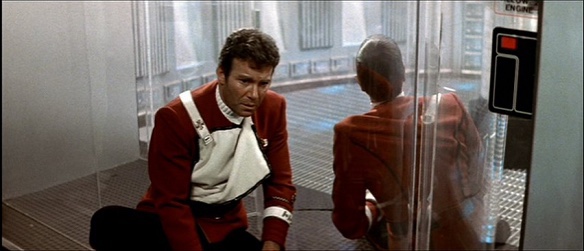
I’ve reached a radical conclusion

I often bother people in line at the post office about the complexities and nuances of Star Trek II: The Wrath of Khan. “Won’t any of you listen to reason!” I scream as I’m being dragged out by security. I’ve always said that Star Trek II is the best screenplay in science fiction history.

But after rewatching Star Trek III: The Search for Spock, I’ve reached a startling conclusion: maybe we’ve had it all wrong. Sure Harve Bennett’s screenplay for the third film isn’t as strong as it is in the second. It’s not that it’s bad per se. It’s just too economical. Case in point is the phenomenal “stealing the Enterprise” scene. That sequence is saved by the acting, Leonard Nimoy’s direction, and James Horner’s score. And it’s really a simple scene of the main characters backing up the Enterprise out of space dock and being lightly perused by another ship. If it were written today, it would be far more complex. But what III does better than II is in its staging. Nimoy directs the film like it’s a stage play. When news reaches Kirk that his son has been killed, it is quietly the most tragic moment in Star Trek history. Of course, Nimoy is careful to not let it outshine Spock’s death in II, but the doesn’t minimize how much it stings. Kirk is able to quickly recover because he had a job to do, but you can see that pain linger. And this pain is only made more tragic by the destruction of the Enterprise moments later. In short, in just a matter of a few minutes, Kirk lost his ship and son to save his friend. While the film is about “the search for Spock”, it’s really a character study of Admiral James T. Kirk. Nimoy’s direction expertly balances out the scope that a big screen science fiction film requires and the little moments that make us bond with the characters. So while III might have a relatively weak script, it might be the best directed movie in the Trek franchise. And as I result, I say it’s the best Star Trek movie.

It’s just a shame that Nimoy didn’t direct more pictures 😔

Dissecting A Scene: Emotional Climax Moments in Star Trek Films (Part I)

So over the Thanksgiving weekend, I made my family watch arguably the worst Star Trek film, Star Trek V: The Final Frontier. When the Sybok interrogation scene of Kirk, Spock, and McCoy came up, it occurred to me: “Star Trek is REALLY good at doing this.”

Doing what exactly?

They’re good at creating emotional climax scenes where character arcs come full circle. Trek films may not be the flashiest of the science fiction genre, but that’s not really their intention. Star Trek is at its best when it’s theatrical, or allowing the actors to fully explore their characters. Two of the franchise’s most notable faces, William Shatner and Patrick Stewart, are quite effective stage actors and that’s where Star Trek is at its strongest: being character driven.

So you have to let the actors ACT.

Star Trek II: The Wrath of Khan: Mutara Battle/Death of Spock

This is probably one of the most famous and most parodied death scene in all of film. But this sequence is quite remarkable on multiple levels.

It’s a shame that William Shatner didn’t get any accolades for his performance in Star Trek II. His portrayal of Captain/Admiral Kirk is often viewed as hammy, but in truth, Shatner was quite nuanced in his approach. Director Nicholas Meyer figured out that his leading man was far more effective when doing more takes, which caused the actor to slowly dial back his performance. In short, Meyer wore out Shatner, which perfectly suited a beat down and aging Kirk at the beginning of the film. Obviously, Meyer let Shatner return to form at the end which had a huge emotional payoff.

Not only does the villain Khan get his comeuppance by succumbing to his own wrath but…in pursuit of vengeance…he ends up becoming a force for creation. Spock, of course, delivers the ultimate sacrifice, but Kirk finally faces the very thing he’s cheated his way out of throughout his illustrious career: a no-win scenario.

Thus, everything comes full circle.

Of course, it also helps that there’s exceptional editing and the score that made James Horner a sought after composer is playing in the background.

Star Trek III: The Search for Spock: Stealing the Enterprise

James Horner is typically given credit for the success of this scene. But you have to tip your hat to the editing and, again, the performances.

While we can criticize Shatner’s acting choices all we want, he always makes it perfectly clear what his characters are feeling. And James B Sikking’s arrogant-ass performance almost makes you forget how shitty the Excelsior bridge set is.

It’s a shame that Leonard Nimoy didn’t direct more movies. While he directed some television before, it’s hard to believe that this was his first motion picture because he REALLY elevated this scene. If you pay attention, not much happens here: the Enterprise slowly backs up to the space doors before they magically open and then the Excelsior begins its failed pursuit. But it’s fucking intense! The hairs on my neck always stand when the Enterprise clears space doors and Kirk orders warp speed. That’s a testament to Nimoy’s superb direction of an otherwise ‘meh’ script.

While this isn’t the “emotional climax” to the film, it is an emotional highlight for the Original Series crew; they’re sacrificing EVERYTHING to save Spock. Now Star Trek III isn’t the best Trek film, but the “stealing the Enterprise” scene is one of the best in the franchise.