The world’s a better place because of The Adam Friedland Show. The worst member of the hugely influential Cumtown podcast has made quite a name for himself. Since its inception, TFS has had such notable guest like Neil DeGrasse Tyson and Chris Cuomo grace its halls.
Now it’s Paul Schrader’s turn in the chair.
I’ve long stated that Schrader is probably the greatest screenwriter of all time. To see him essentially do an episode of Cumtown sans Nick Mullen and Stavros Halkias is a bit much for my mind to handle. The episode begins with Friedland remaking Taxi Driver to a montage of a song called “Fuck me in my ass” and then showing the film to a Jewish producer from Louisiana named Gary Pennis Fagot. And while Schrader attempts to wax philosophical in his interview, Friedland steers the conversation towards the size of Willem Dafoe’s penis. The episode ends on an eyebrow raising discussion on pedophilia and Schrader announcing his need to take a shit/piss. It was everything that I hoped it would be.
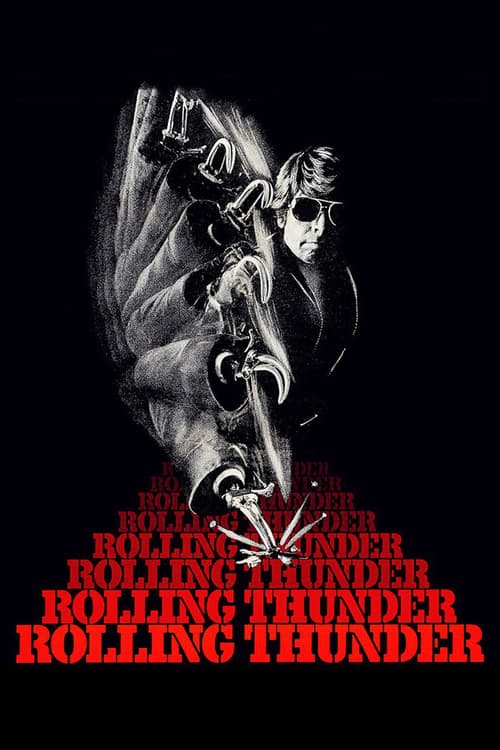
I’m surprised that Rolling Thunder has the following it does. It’s not good enough to be a classic and not bad enough to be a cult classic. But it did have potential, yet somewhere along the way someone dropped the ball.
It’s based on an original story by Paul Schrader. While the final product does have many of the markings of a Schrader-written feature (like the shooting up of a brothel during the film’s climax), it seems that many of its most interesting elements were stripped away.
William Devane plays a released Vietnam POW whose hometown rewards him with a valuable coin collection. A group of bandits steal the collection, killing his wife and child and maiming his hand in the process. Armed with his new hook hand, Devane enlists the help of friend Tommy Lee Jones to seek revenge.
It sounds like pretty standard 70s grit in the same vein as Death Wish, Dirty Harry, etc. And for the most part, it is. Thankfully, the Schrader-influenced elements that survive slightly elevate the film above that genre. Unfortunately, because the filmmakers decided to dial back on the gore and melodrama, Rolling Thunder’s impact is entirely negated.
And after 38 seconds of research, I came across the interesting tidbit on IMDB:
Goddamn, what a movie that would have been. Unfortunately the studio didn’t have the balls to do that kind of picture so we’re stuck with something that’s unfulfilling.
William Devane is a respectable actor and I’m sure his friends would say he’s a nice guy. But he was miscast in this part. From the moment we see him, he doesn’t come across as a guy that’s been scarred from years of torture. He feels a little bit too cool for that.
But you know who would have been perfect for the role?
Co-star Tommy Lee Jones.
I’m just gonna say it, Jones was fine AF in the 70s. And he doesn’t emote too much in his performance. He doesn’t have to. From the moment we’re introduced to him, we know exactly what he’s feeling. Had Schrader been able to make the picture he wanted, Tommy Lee Jones would have made the perfect white trash version of Travis Bickle.
Additionally, there’s no payoff with many of the Schraderian elements. At one point, Devane explains that he learned to love torture because that’s how “you beat your enemies” (paraphrasing). That came in handy when his home was invaded, but this attempt at a theme was never fully established.
Plus, the protagonist was given a hook hand. You’d think that that device would play a larger role in the story, but only twice does Devane use it against his enemies. I mean what the fuck? You’re given a hook for a hand. Kill everybody with it!
I hope that every network television show employs AI to generate its shitty content. And, if Paul “Shredder” Schrader is correct, I hope those network producers pay me to take credit for writing it.
But more importantly, if an artist is serious about creating something, the competition from AI will force us to lean into originality. So I say accept the challenge (and the free labor) presented by AI.
Of course I worship the ground Paul Schrader walks on but our writing methods couldn’t be farther apart. I would be interested though in seeing if I’d make the cut for his screenwriting class. I’d think he’d let me in if I disclosed my insecurities over having an average penis. That would make a fascinating discussion over 10 weeks.
But Paul’s method is a little too structured. Naturally, writing 101 tells you to utilize metaphor in place of a real world problem. As Schrader said, fiction allows us to see all the drama and complexities play out through the filter of metaphor. I also agree that we need limitations in art (Nicholas Meyer has echoed a similar sentiment). But I think that’s where our philosophies diverge.
To me, I approach art, or writing, as an ongoing activity. It very much exits in the present. That’s why I rarely take time to develop a story. If I have a concept, I run with it. Of course, like Schrader, I filter my own concerns, thoughts, and insecurities into the story and watch it play out. But the spontaneity is where the fun is.
That’s why I wish I was a television writer. Give me a story and a deadline and let’s see what happens. I’m not saying that it will be any good, but I’d certainly have a good time!
Maybe my writing suffers because of this “method”. I don’t know. But this was an interesting lecture by Schrader.
I’ve always said that the greatest movie ever made is The Deer Hunter. And it’s no secret that I experience the most insane dreams possible.
So last night, I dreamt that The Deer Hunter was never produced at all and instead, in its place, the original script titled The Man Who Came to Play was made. I know nothing of this apparently “spec” script, other than it involves friends going to Las Vegas to play Russian Roulette. Michael Cimino and Deric Washburn later repurposed this screenplay into The Deer Hunter, switching out Vegas for Vietnam.
In fact, as far as I know, only the Russian Roulette scenes survived in the final draft from the original treatment. There’s no telling what The Man Who Came To Play would have looked like, but if my dream is any indication, it would have fit in well with the dark 70s canon.
This script, written by Louis A Garfinkle and soap opera actor Quinn Redeker, is apparently for sale online. There’s no telling how much it costs and I couldn’t find any of its story details, but my main question is why did this friend or friends go to Vegas to play Russian Roulette?
Did they do it willfully?
Were they coerced?!
I understand why Cimino and Washburn repurposed it. It made sense for the time and it absolutely worked. But I like to play this game of “what if”. Nowadays, I find the original concept to be far more darker and nihilistic, especially if the friends were written to be Vietnam vets.
I can’t help but think that The Man Who Came To Play would have made a terrific spiritual sequel to Taxi Driver. Think about it: Bobby DeNiro as Travis Bickle. We’ll pretend that the ending to Taxi Driver wasn’t the dying dream of a mass shooter. Instead, Bickle survives and goes to Vegas where’s he’s once again disgusted with the crime and decadence of Sin City. One way or another, he finds himself reliving the nightmares of Vietnam; he begins entertaining depraved businessmen by hitting the underground Russian Roulette circuit.
I see a lot of Paul Schrader’s “God’s lonely man” in Garfinkle and Redeker’s concept. But oh well. We got The Deer Hunter instead and we should all be thankful for that.
But if anyone knows anything about this script, please reach out to me.
I like the idea of a non-children’s movie about an animal. What little I know about EO, I guess it approaches the human subject from the perspective of a donkey. Whatever emotions, thoughts, ambitions, etc that we see in the donkey is merely a projection. That’s interesting.
I’ve stated somewhere on this blog before that it’s this very perspective that made me appreciate David Cronenberg. Since we’re humans, we tend to take for granted the nature of our bodies and behavior. But from a non-human perspective, we are probably very disgusting and perplexing creatures. And, perhaps, that’s why body horror plays a significant role in some of Cronenberg’s films.
But Schrader states that “the impulse to anthropomorphize defines us.” I’m not sure where he’s coming from with this, but that’s a hard disagree from me. For example, my cat probably assumes that I’m just a larger cat, so in a way, he’s simply “felinemorphizing” me. In short, “anthropomorphizing” is not a unique phenomenon to humans.
Another commenter suggested that, to humans, animals are innocent because they are “untouched by original sin.” It should be noted that Schrader was a noted Calvinist who, despite maintaining progressive ideals, still identifies as Christian. Now this suggestion is obviously incorrect, BUT…insofar as I’m aware…only humans practice religion. This can mean one of only two things: humans ARE touched by some supernatural reality, OR we are not as intelligent as we believe ourselves to be. You be the judge (I think you know where I stand). Nevertheless, to conceptualize religion broadly, speculating on things that cannot be observed IS a unique human phenomenon (insofar as we can tell).
This impulse led humans into a religious paradigm and, subsequently, into a scientific one. Moreover, this impulse was spearheaded by the ultimate unique cognitive capacity: complex language.
THAT’S what makes humans humans.
But, I think Schrader hits on an important point: why do we empathize more with the pain of an animal than that of a human? Obviously (in my view, at least) evolutionary psychology plays a significant role in this. But Schrader is correct. In fact, our contemptuous and flippant attitude towards one another makes us nothing more but animals.
Actually, I’ll go a step further: we are the WORST animal there is.
I’m a little under the weather so I’m just gonna phone this one in.
But I was doing my annual Paul Schrader marathon when I got to Dominion: Prequel to the Exorcist. A few thoughts: 1.) it’s a shitty movie but 2.) Vittorio Stararo was the DP?!!! How did that get past me?
And it’s such a shame that this film didn’t work because it is very much in line with the themes that occur throughout Schrader’s work. I haven’t bothered with the retooled Exorcist: The Beginning, but I’m glad Schrader stuck to his guns and at least attempted to make a cerebral film rather than make a run-of-the-mill horror. That’s what made the original Exorcist so interesting: director William Friedkin stated that it never occurred to him that he was making a “horror film” (he could be bullshitting though).
Schrader probably should have had a bigger say in the screenplay. Much of the introspective philosophical back-and-forth that, in my opinion, slightly bogged down The Last Temptation of Christ (which clashed with Martin Scorsese’s rather “extroverted” direction) would have been quite effective for Dominion. Additionally, the event that caused Father Merrin’s lack of faith should have been revealed later in the movie. And while there was some good stuff with the British colonial troops, I felt that there was no payoff for any of it.
(Plus the special effects REALLY sucked ass)
I also saw Touch for the first time. I don’t remember a damn thing about it other than Skeet Ulrich was in it.
Whatever happened to that guy? That dude was like, super fucking hot. Shouldn’t he have had a bigger career?
Were people disappointed to find out that he wasn’t Danish?
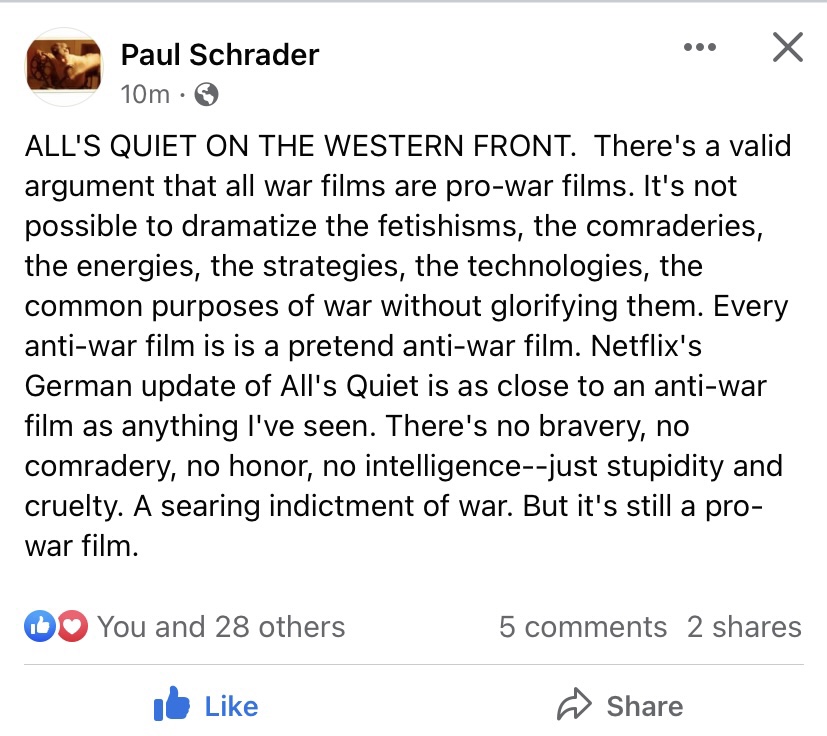
While I haven’t watched the latest iteration of All Quiet on the Western Front, based on what I’ve seen from other war films, I largely agree with his assessment.
In fact, the only REAL anti-war WAR film I can think of is The Deer Hunter. While it does depict Robert DeNiro torching a guy with a flame thrower (in what I think is it’s most out of place scene), replacing the horror of war with several rounds of Russian Roulette is about the only time I’ve seen filmmakers deprive the audience of the spectacle of battle. The ending, I think, should be taken ironically; we use patriotism to mask our grief.
(I’d also say that Stanley Kubrick’s Paths of Glory might be a true example of an “anti-war WAR film)
In my view, the reasons why movies have trouble maintaining the guise of “anti-war” is because film is fundamentally a visual medium. When movies are confined to “showing and not telling”, it’s almost impossible to not become spectacle.
And war is the ultimate human spectacle.
Understanding this, the only time a film can become truly anti-war…while simultaneously depicting war…is if it becomes a dark, dark comedy; almost to the point where it goes over the heads of the less sophisticated.
At least this is how I’ve always interpreted Apocalypse Now.
I make no secret of my love for Paul Schrader. As far as being a screenwriter, he’s the GOAT.
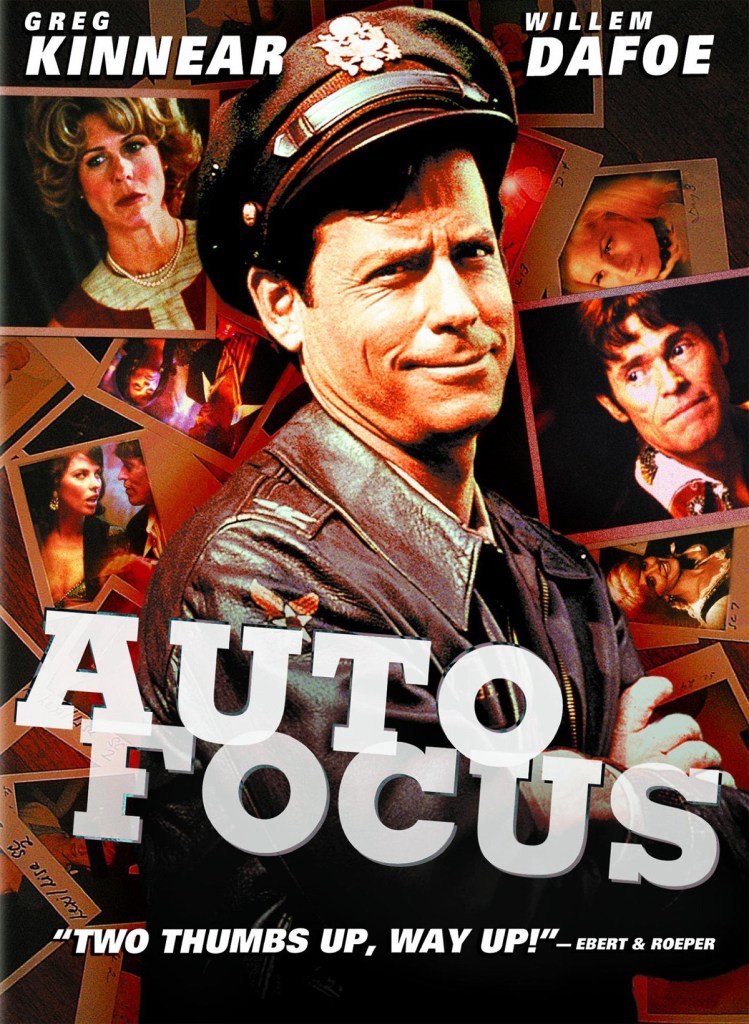
Unfortunately he didn’t write Auto Focus, he only directed. Still though, it’s familiar territory for him: sexual obsession, loneliness, religious struggle, etc etc.
Watching Willem Dafoe and Greg Kinnear beat off together while they watch their own sex tapes is cinematic gold. My only complaint about this movie is that it should have been LONGER.
Honestly, this hit a little too close to home. If you’ve never been in a friendship like the one between Bob Crane and John Carpenter you might not understand. But these kinds of relationships exist among two (mostly heterosexual) men who are cocksmiths.
In sum, this film exposes the dark side of “bromance”.
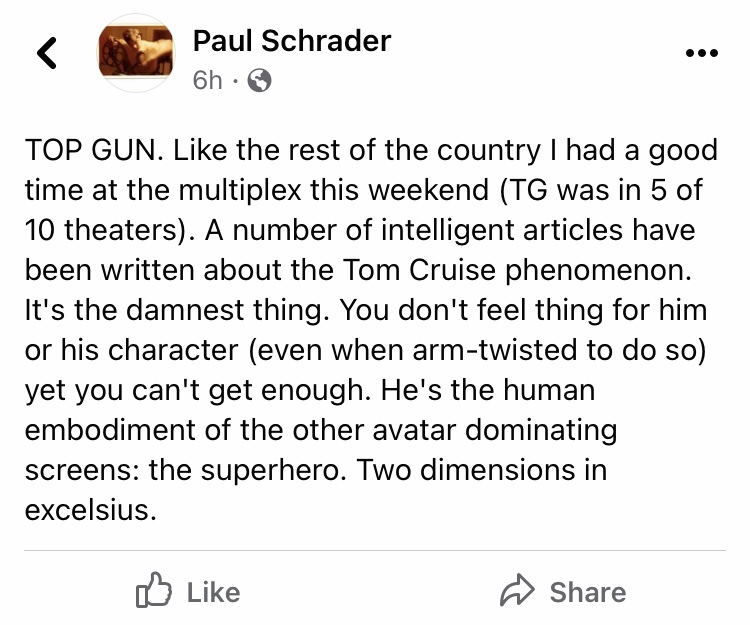
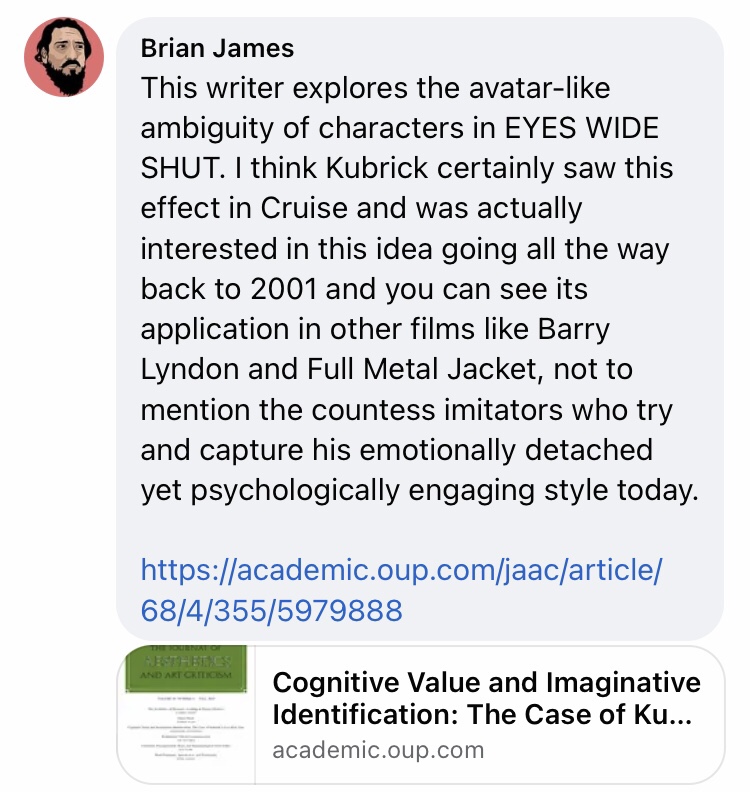
Of course I didn’t read the article. I don’t know how to read. I’m sure it’s interesting.
But I don’t know what it is about Cruise. I remember becoming aware of this phenomenon while watching Mission:Impossible II. I was absolutely creeped out when he told Thandie Newton “damn you’re beautiful.”
Tom Cruise should never EVER be that intimate with someone. No one wants to see that shit.
I suppose Cruise is the last of the old-fashioned male Hollywood hero. We don’t want any sort of emotional connection with him. He’s a blank canvas on which we can project our fantasies onto.
The moment he breaks that facade, we’re grossed out…like I was while watching MI:2.
I kinda explored this concept with the stupid ass “John Cannon” character from The Last Coming (or the First Coming, whatever the fuck it’s called): an over-the-top manly man, but once when you peek behind the machismo, you wish he’d kept that shit to himself. (Of course that’s probably a deeper analysis than what that story deserves)
It’s an archetype that’s almost gone out of vogue.
But I suppose we should appreciate Tom Cruise for what he is: essentially a relic from a bygone era. He’s been doing his thing for the last 40 years. And at this rate, he’ll probably be doing it for 40 more.



 The Internet Ruined Everything