

Ernest Borgnine (1917-2012) 😔
Ernest Borgnine (1917-2012) 😔

I once knew a psychopath that loved saying “why do tomorrow what can be done today?”
Nah.
More like “why do today what can be done tomorrow?”
As my father always said: “if you want something done right, get someone else to do it.”
Allegedly William James said “act as if what you do makes a difference.” But the truth is you should “act as if what you do makes absolutely NO difference.” Because it doesn’t.
You’re only here for a small blip in humanity’s history. And humans will only be around for a very short time in comparison to the immensity of the universe. So don’t worry about it, nothing we do here matters 😎
Even the history books will return to dust.
“Falling down is an accident. Staying down is a choice.”
And a good choice 👍

We should all be thankful that we still have Clint Eastwood. The man’s been working for close to 70 years. He’s an absolute legend.
The Hollywood GOAT?
Seriously, think about that. He’s an accomplished actor AND director. It’s a career that will never be topped. Ever.
Many have tried, notably Sylvester Stallone, but it’s just not possible. (To be fair to Stallone though, Eastwood was in much more competent hands earlier in his career between Sergio Leone and Don Siegel).
This being said, Eastwood isn’t the most innovative director. In fact, when he does make a great film, it’s as though he accidentally did so. His two universally acclaimed films, Unforgiven and Million Dollar Baby, are mostly great because of their scripts (same with The Outlaw Josey Wales). Gran Torino appears to be a film with a lasting cultural impact, and while I wouldn’t say it had an outstanding script or direction, the movie works because of Eastwood’s personality, not because of anything he did behind the camera. But I’d say that Eastwood is to filmmaking what Steve Kerr is to the NBA…he’s extraordinarily competent.
Of course, when you go through a stretch where you’re making a movie ever 20 minutes, it’s hard to maintain quality.
Sudden Impact is one of the million Eastwood movies that gets lost in the shuffle. With a story from pioneering independent filmmaker and Arkansas legend Chuck B Pierce, this Dirty Harry sequel has our favorite 44 Magnum carrying San Francisco investigator being more dirty than usual. Eastwood’s then-wife Sandra Locke costars as woman exacting revenge against men who raped her 10 years earlier. I’d say that this is the best Dirty Harry sequel. Nay, this sequel is better than Dirty Harry, a film that defined raw 70s cop dramas.
What makes Sudden Impact so memorable is not the plot, I don’t remember if there was one, or character development or any of that bullshit. No, what makes this film great is watching Eastwood stumble from one scene to the next just absolutely beating the shit out of and shooting everyone. EVERYONE. To top it off, he runs around with a farting bulldog. He also kills a guy by just giving him a heart attack for fucks sake. Eastwood is just a straight up asshole, more so than usual for Dirty Harry. It’s probably that greatest Cannon film not produced by Cannon.
The film feels as though Eastwood didn’t want to return to the role and the only way they could convince him is if they allowed him to direct. And it payed off. Some of the best films made from this period were done when no one gave a shit. But Eastwood’s direction gave this entry an added edge, which is probably why Sudden Impact feels so different from the other Dirty Harry films.
While we still have him, I wish Eastwood would do ONE MORE Dirty Harry film. It’s what we need now more than ever: a 90 year old bastard just blasting the fuck out of bad guys with a 44 Magnum.
Do it Clint!

…Robert Ginty (1948-2009) 😩
Still can’t believe he’s gone 😔

🪦 Rick Majerus (1948-2012) 🪦

The Last Temptation of Christ unsurprisingly stuck with me. Usually when I complete a novel, I think “hmm, that was nice” and I move on to the next thing. But Kazantzakis’s interpretation of “the Greatest Story Ever Told” is rewarding and leaves a lot to think about, especially if you’re obsessed with early Christian history.
I mean, obviously it’s not historically accurate. That’s not the point. The point is that the book brings these familiar characters to life. Jesus begins the book as a sickly carpenter before transforming into the messianic figure we’ve come to know and love. However, his humanity is emphasized. At times, Jesus comes across as a jerk with megalomaniac fantasies. This helps contextualize Jesus the man and the era he lived in.
This is best demonstrated by his relationship with Judas Iscariot. Judas is a true revolutionary with a hatred for the Romans and is often frustrated by Jesus and his message of love. Jesus feels that Judas’s revolutionary ideals don’t go far enough: the concerns for the body are temporary, Jesus wants to bring salvation to the world…Jew and gentile alike.
The various characters are often puzzled by this. This universalism is too lofty, too radical to ever be realized.
And this sort of remains true today. I’ve expressed my admiration for John Dominic Crossan views: Jesus was responding to the imperial authority of the Romans. Jesus and his followers might not thought of it in that way, but that was effectively what he was doing. I don’t think enough scholars, both Christian and secular, stop to appreciate this. Not even Bart Ehrman.
I think this is best demonstrated by the cross as the official symbol of Christianity. Jesus unquestionably died by crucifixion, perhaps the most ruthless form of punishment by the Romans. And none of the early Christian apologists deny that it happened. Stop and think about that: their very leader got “owned” by the Romans. In fact, it HAD to have happened so that he could be resurrected. So Christians took this event and chalked it up as a win for their beliefs, and a loss for the ruthless rule of the Romans.
Scholars often wonder how Paul was able to convince so many pagans to convert to Christianity (or, to be more historically accurate, his form of Christian Judaism, as Paul still thought of himself as a Jew), well maybe here’s an answer: Roman rule under the Pax Romana pissed off enough people that when they heard of a man who was resurrected after a crucifixion, conversion was a way to subtly stick it to the Romans. This could be why Paul put so much emphasis on death and resurrection in his theology.
Yes, I know there are plenty of problems with this theory, chief among these is how little the Romans are criticized in the New Testament. In fact, the Gospels explicitly blame the Jews for Jesus’s death and not the Romans, even though the Romans certainly DID execute Jesus. My response to this is that you don’t have to spend more than two minutes following populist/leftist politics before realizing that they hate each other more than they hate their opposition. It is my opinion (maybe more on that at another time) that this is fundamentally rooted in these kinds of movements. Even though the Romans were THE existential threat to life in the Mediterranean world, it would have been mainstream Judaism that were the primary theological/ideological opponents of early Christianity…even if the Jews were as much under the thumb of Roman rule as they were. This is heresy in the world of radical movements, what leftists might call “class traitors” today, and it wouldn’t take much for Christian writers to switch out Romans for the Jews in regards to who was guilty for Jesus’s death.
It is this narcissism of small differences that plague radical movements, religious and political alike, and I doubt early Christianity was any different. (See Monty Python’s Life of Brian)
It is difficult to tell if the real Jesus actually preached this message of universalism, or a peaceful coexistence of all people under one God. Crossan might, but it’s more likely this was extracted by later thinkers and is now considered the ethical message of Christianity IF people could move past their short-sightedness (maybe not under “one god”, but you get the idea).
Anyways, I’ve spent too much time on this post, forgot where I was going. The end.

I was watching Bart Ehrman debate some dude, forgot who, and he mentioned the non-canonical early Christian text, Apocalypse of Peter (never read it). The text describes heaven and hell, with descriptions of hell being far more creative than those of heaven. Point being, as Ehrman explains (paraphrasing): “there are only so many ways to describe eternal bliss”, while the imagination on eternal damnation knows no bounds.
It’s not really a revolutionary observation, I know, but that’s true in all our storytelling: “heaven” is a place of temporary stability before “hell” comes along and propels the plot forward. Therefore much of the creative energy behind a story lies in the “hell” of it all.
In other words, story is conflict.
But I think Ehrman’s statement is also a reflection on the nature of language. I’ve always found that imaginative descriptions of dread, anger, depression, anxiety, etc. to be far more creative and rewarding than depictions of bliss. Heaven, beauty, bliss, etc lie in the realm of the sublime, and therefore transcend the possibilities of language.
However, that might just be a reflection of my own deranged mind.
Whatever dude, shit’s boring.
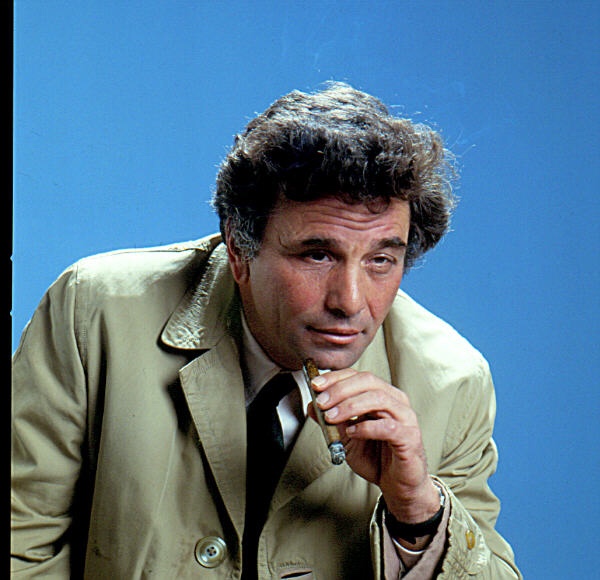
So I was eating a bag of skittles when the phone rang.
“What do you want?” I asked.
The woman over the phone spoke. “Hi, this is Arianna. We talked last week. Just want to know that I’ve been fantasizing about you. I’m really, REALLY horny. I want to come over, sit you down, take you in my mouth then ride you as you slide in and out. I want to taste you. I want to feel you inside me. Just the thought of your cock makes me quiver with excitement. Please let me come over. Please PLEASE have your way with me.”
“Sorry, watching Columbo,” I said. Then hung up.

Roy Scheider 1932-2008

I couldn’t hit shit with my six shooter. I missed every target.
J Robert Oppenheimer’s 10 year old son, Malachi, watched and nodded his head. “Did you really know my father from the war?” he asked.
“Sure, why not?” I replied.
“Whose side did you fight for?”
“Uh, Abraham Lincoln’s?”
“Which detachment?”
“963rd, 9th battalion, 4th infantry, uhmmm, at the Battle of Waterloo?”
“Did you get injured?”
“Oh yeah. All over.”
Malachi scratched his head. He knew I was full of shit. “Are you sure that you didn’t know my father from the future?” he asked.
“How do you know about that?”
“He has a time machine in the barn.”
Malachi took me into the barn and lifted a large tarp off a time weapon—a similar looking time weapon that sent Mr. Ree, Oppenheimer, and myself back to 1879.
“Does it work?” I asked Malachi.
“Of course. My father built it. He can make anything work.”
Oppenheimer stood at the entryway of the barn. “That’s enough Malachi,” he said. “You run along now.”
Malachi shook his head. “Yes father,” he said and went back to tending to his chores.
“Why didn’t you tell me about this, Bob?” I asked Oppenheimer.
“It doesn’t work.”
“Malachi says it does.”
Oppenheimer paced back and forth, rubbing his hand across his face. “Look,” he said, “we can go over this all day. Sure, I can send you to the future, the past, whatever. But it’s almost impossible to get you back to YOUR timeline. I’m sorry James. But we need to look at the present. You’re here. Mr. Ree is here. I need help. This community needs your help. Please help me. I can’t fight Dickleburg on my own.”
I thought through his words. “You love Malachi,” I said. “But did you know that I have a child back in that timeline? If there is a chance, however slim, to get back there, I have to take it. Wouldn’t you do the same if you were me?”
Oppenheimer nodded. “If I’m going to help you,” he said, “then we have to secure these goldmines. There’s a property in gold that makes these time weapons work. To secure the mines, we have to defeat Dickleburg.”
I pulled out my Korth 357.
“I’m no good with those six shooters,” I replied. “But I can shoot a fly’s dick off with this 357. Can you help me make more bullets?”
“That I can do.”
TO BE CONTINUED
 The Internet Ruined Everything