
The most goddamnedest thing happened to me the other day. So I was minding my own business walking along the Korean DMZ when suddenly I was captured, tortured, and subjected to Steven Soderbergh’s The Informant! on repeat by Kim Jung Un’s thugs. I don’t want to get bogged down in the details about why I was the there. The important thing is that I escaped by impaling the guards with a long makeshift shiv. Before killing the last one, he informed me that the plan was to clone me, brainwash my clone, then send him back to the US to infiltrate the government in some elaborate plan or some bullshit. I didn’t listen that closely because it was all very boring. So I killed the last guard by drowning him in the sink.
Thankfully I caught up with my clone at the top of Pyongyang Hotel. Before strangling him and throwing his body off the roof, he said that there are many clones of me that are fully brainwashed and are preparing to infiltrate governments around the world. So long story short, I’ll be globetrotting for awhile to seek and kill all my clones.
“Isn’t that murder? 😭😭😭” you might ask.
You’re goddamn right it is!
So if you see any posts where I tell my readers to “vote for Trump” or “invest in Ethereum” or “the moon landings are faked”, just know that wasn’t me (probably) and I’ll keep you updated on my whereabouts.
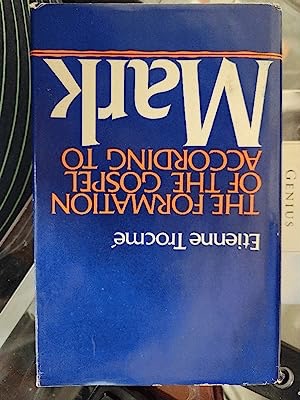
So in the meantime, here’s a post from last year where I discuss Etienne Trocme’s The formation of the Gospel According to Mark. I forgot how excited I was to find a copy of this rarity only to discover that an academic work translated from French makes poor reading. Additionally it kinda goes off the rails about halfway. I haven’t finished reading it to this day.
From June of last year, here Etienne Trocme’s “The formation of the Gospel According to Mark”
“Aren’t you an atheist?”
“Don’t you have anything better to do?”
“Have you considered professional counseling?”
These are just some of the questions I receive when others learn of my obsession with the Gospel According to Mark. Indeed, it’s hard to this passion of mine into words. In short, it’s one of the great mysteries of history. We don’t know who wrote it. And while we have some pretty safe assumptions about why it was written, even that is debated. Hell, we can’t even agree what genre Mark is.
Moreover, there’s an aspect to it that I almost find comical. While Mark clearly has some artistic intentions behind it, it is not particularly well written. Additionally, due to the politics of its era, there is likely a polemical aspect to it that has been largely lost on modern audiences. So I find it funny that one of the most important texts in ancient history was written by some moderately educated dude trying to piss off his opponents over petty theological differences. Because in doing so, the author basically invented the story of Jesus which is the most important story in Western civilization.
While I think the Gospel has kernels of historical truth regarding Jesus the man, it’s almost impossible to tell which one of them are facts which further confounds modern scholars. But honestly, I find the Gospel of Mark to be far more interesting than the historical Jesus due to its impact. So Jesus was an apocalyptic preacher who was nailed to the cross by the Romans. Big whoop. But, according to “Mark”, what if Jesus was the Son of God who died on the cross and rose again to save us from our sins? Now that’s show business!
But regarding the political dimensions of the early Jesus Movement, I find this aspect to be largely ignored by modern scholars. I think Monty Python’s Life of Brian is a bit more accurate than we care to admit. While this analogy is far from perfect, the Jesus Movement…specifically the one prior to Paul’s prevalence…was, in part, a response to the dominant Pax-Romana. In sum, this movement could be deemed a “left-populist” one in modern eyes. And if you’ve spent any amount of time with political radicals, you quickly learn that they HATE each other. While the main thrust behind Mark is to provide an unknown (but likely Greek-influenced) early church a coherent theological message, it’s who it’s aimed against that I find interesting.
This matter caught my attention while reading Etienne Trocme’s The Formation of the Gospel According to Mark. It’s a tough read, largely because it was written in French and doesn’t translate well into English, so I haven’t gotten very far. Additionally, I believe that Trocme’s controversial assertion in the work is that Mark originally ended at chapter 13. I do not accept that conclusion and it has been almost universally rejected by all scholars. Nevertheless, I picked up the book hoping to find some insight into Mark’s intentions.
According to tradition, “Mark” was an interpreter of the Peter, arguably the most important of Jesus’s apostles. But unless you’re a Christian, there’s absolutely no reason to believe this is true. Not only that, but Mark kinda portrays Jesus’s inner-circle as a bunch of idiots that have no understanding what their leader is trying to say and do. Because of this portrayal, preachers today want us to believe that the Apostles were a bunch of well-meaning knuckleheads, but it is possible (in fact, more likely) that Mark had polemical angle here: he was undermining Apostolic authority. In fact, in Mark, the only people that seem to understand Jesus’s mission are just randos. If memory serves, the only person (other than the author and some demons) in the narrative to identify Jesus as “the Son of God” is a Roman centurion after Jesus died on the cross. Additionally, Mark ends at 16:8, when Mary Magdalene, Jesus’s mother Mary (simply referred to as “mother of James”) and Salome find Jesus’s tomb empty with a stranger inside telling them Jesus has risen. Instead of rejoicing at the news, the women fled in terror and told no one.
In short, according to Mark, Jesus’s followers during his time on earth didn’t understand his message and when confronted with the truth, they fled.
As Trocme indicates, Mark doesn’t downplay Peter’s significance to Jesus but his authority is more or less stripped away. And James the brother of Jesus, who along with Paul and Peter was one of the most important figures in early church history, is essentially non-existent in the text.
Using my understanding of radical movements, a different interpretation of Mark comes clear: the author was asserting his own theology (possibly influenced by Paul who had his own run-ins with the Apostles) while simultaneously extending the middle finger to Apostolic authority.
 The Internet Ruined Everything