The death of Peter and Paul at the hands of Christians

First off, I just wanna say that I’m glad nothing else bad happened yesterday. So I hope that the world and the internet can resume a place or normality for the next few days 🙏

And look, I know that my biblical “scholarship” comes totally out of left field when compared to the rest of my blog. But I’m just gonna say it: this stuff gets hits. And I’m not claiming to be the next Bart Ehrman. But I’ve always said that at my core I’m a historian. And that’s what this blog is. It’s not never ending shitposting or deranged ramblings. It’s history. And when I die, which I stated yesterday will probably be by firing squad, this is how people will remember me.

So let’s explore the topic at hand: the death of Peter and Paul by the hands of Christians in the first century CE. I’m not saying that that’s what happened. I’m saying that’s a claim. And I’m not saying it’s a good claim, but it does provide a few interesting points.

The passage often pointed to as evidence is in Ist Clement chapter 5. For those who don’t know, 1st Clement is one of the earliest Christian texts not found in the New Testament. It was written in the late first century. Because I’m a proud graduate of Reddit University, I often rely on the scholarly work of my peers. So this excerpt is pulled directly from Reddit in both the original Greek and English translation:

διὰ ζῆλον καὶ φθόνον οἱ μέγιστοι καὶ δικαιότατοι στύλοι ἐδώχθησαν καὶ ἕως θανάτου ἤθλησαν λάβωμεν πρὸ ὀφθαλμῶν ἡμῶν τοὺς ἀγαθοὺς ἀποστόλους· Πέτρον, ὃς διὰ ζῆλον ἄδικον οὐχ ἕνα οὐδὲ δύο ἀλλὰ πλείονας ὑπήνεγκεν πόνους, καὶ οὕτω μαρτυρήσας ἐπορεύθη εἰς τὸν ὀφειλόμενον τόπον τῆς δόξης. διὰ ζῆλον καὶ ἔριν Παῦλος ὑπομονῆς βραβεῖον ὑπέδειξεν, ἑπτάκις δεσμὰ φορέσας, φυγαδευθείς, λιθασθείς, κήρυξ γενόμενος ἔν τε τῇ ἀνατολῇ καὶ ἐν τῇ δύσει, τὸ γενναῖον τῆς πίστεως αὐτοῦ κλέος ἔλαβεν, δικαιοσύνην διδάξας ὅλον τὸν κόσμον καὶ ἐπὶ τὸ τέρμα τῆς δύσεως ἐλθὼν· καὶ μαρτυρήσας ἐπὶ τῶν ἡγουμένων, οὥτως ἀπηλλάγη τοῦ κόσμου καὶ εἰς τὸν ἅγιον τόπον ἀνελήμφθη ὑπομονῆς γενόμενος μέγιστος ὑπογραμμός“.

Because of envy and jealousy, the greatest and most righteous pillars have been persecuted and contended unto death. Let us set the good apostles before our eyes. Peter, who because of unrighteous envy, not once or twice but endured many afflictions and having borne witness went to the due glorious place. Because of envy and rivalries, steadfast Paul pointed to the prize. Seven times chained, exiled, stoned, having become a preacher both in the East and in the West, he received honor fitting of his faith, having taught righteousness to the whole world, unto the boundary on which the sun sets; having testified in the presence of the leaders. Thus he was freed from the world and went to the holy place. He became a great example of steadfastness.”

Agreed that if Peter and Paul’s deaths were a result of state persecution from the Romans, as is often believed, this would be an odd way to describe it. Additionally, you can read a larger explanation of this theory here from Chrissy Hansen and there’s an academic paper floating around from a guy named David Eastman (that I didn’t read).

There’s a few reasons why I find this theory interesting. First off, in my view,, it provides a greater insight into early Christianity as socio/political movement which mainstream scholars often fail to explore. I agree with JD Crossan that the Jesus movement was a response to Roman power and authority. While there was little distinction between religion and politics in the ancient world, I still think when movements spring up against power…and there were many in Judea where the Jesus movement hailed from…that factions come along and turn on themselves, sometimes with violent consequences. That’s the nature of radical politics and I think first century Christianity would have been no different. Secondly, as Hansen pointed out, this solves a great mystery in the New Testament as to why there’s no account of the death of Paul (or Peter) from the author of Luke-Acts, with the implication being that in order to portray Christianity as a unified front, the author omitted the story altogether.

If true, then this puts the nail in the coffin of Jonathon Bernier’s earlier dating of the Gospels. If you recall, I reviewed Bernier’s book Rethinking the Dates of the New Testament a few years ago. I think I was intrigued by his arguments but felt that too much of it hinged on Luke-Acts being completed BEFORE the death of Paul which is Bernier’s explanation for why there’s no account in the New Testament. Today, I think Luke-Acts was certainly aware of Josephus, which would date it post-90CE, presumably well after Paul’s death. BUT, as Bernier’s arguments highlighted, the omission of Paul’s death (as well as the first person passages in Acts) need explanation from scholars, none of which I have found totally convincing.

But before I get on board with the explanation that Peter and Paul were killed by competing Christians, I require more evidence. An opaque passage in Ist Clement and a few omissions only hints at something. It doesn’t explain it. Which leads us to a huge problem in biblical studies particularly regarding the New Testament era: there’s too much we don’t know. The people leading this movement weren’t educated. Outside of Josephus and the NT itself, there’s little chronological account. Regarding the Jesus movement and archeological evidence, there’s been little slam dunk discoveries, if any. And the sad part is that there probably never will be. If any does appear, it would take at least a decade to authenticate and it would still be subject to controversy and debate. In short, none of this will be settled in our lifetimes.

So all of this is open to interpretation and speculation. The possibilities are endless. We know Paul was itinerant. Perhaps his ship sunk and all of his remains have been consumed the Mediterranean Sea. Maybe that’s why there’s no account; because no one knows what the fuck happened to him! Maybe Peter dropped dead of a heart attack in the middle of the desert? We just don’t know folks 🤷‍♂️

Probably never will.
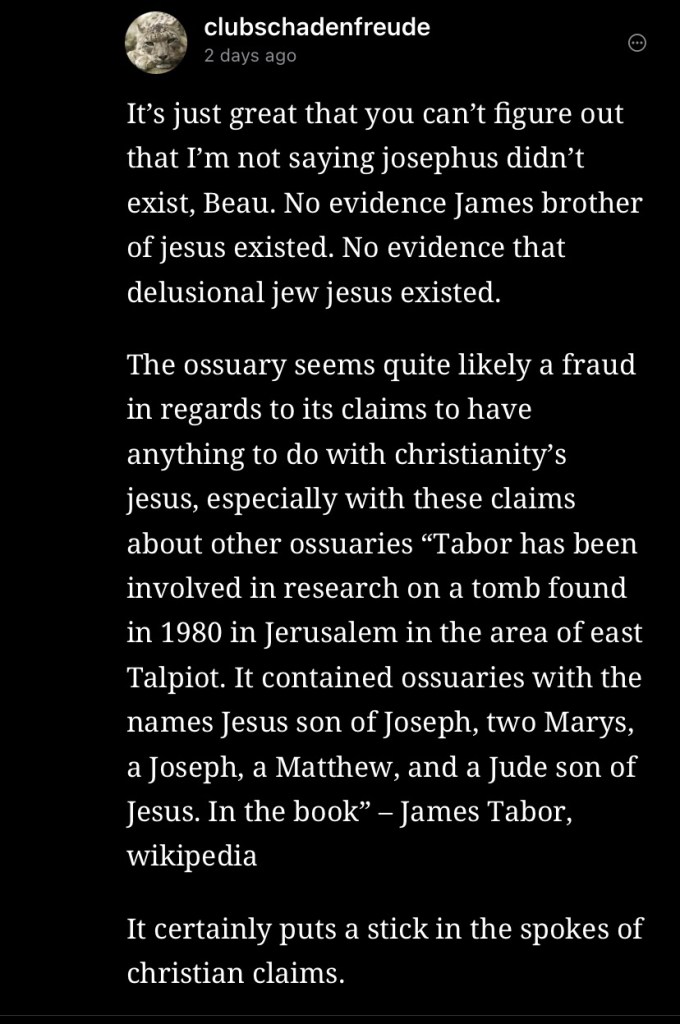
More hate mail 👍

The art of being a good internet troll is playing the part your haters want you to play. So thanks to clubschadenfreude, I am coming out of the closet to admit that yes…I am fully indeed a proud goddamn Christian and that I simultaneously deny the historical existence of our Lord Jesus Christ.

Clubschadenfreude clearly understood all the arguments and the nature of historical investigation. I should state that he/she totally wasn’t drive-by commenting on a post about a subject they had a knee-jerk reaction towards. It was a very enlightening and respectful conversation that you can read below.

And why stop at denying the historical existence of Jesus? Fuck it, I’m doing a step further…Julius Caesar didn’t exist!

Prove me wrong!

As you can tell, this was a meeting of the two minds. Hopefully this serves as an example of true scholarly debate.

Jesus: Disciple of John the Baptist

According to the two oldest sources on the life of Jesus…the Gospel of Mark and the hypothetical Q Source(s) theoretically preserved in the Gospels of Matthew and Luke…the very first thing that happens is Jesus’s baptism by John the Baptist. The existence of this apocalyptic preacher, often thought of as the forerunner of Jesus, is independently confirmed by Josephus later in the first century.

This has led many scholars to believe that Jesus was a disciple of the Baptizer before starting his own ministry. The baptism by John is also considered one of only two events that nearly every scholar believes actually happened in Jesus’s life (the other being the crucifixion). Reasons for believing this is simple: if followers of Jesus really believed he was god, why would early Christians have included stories that made him appear subservient to John?

However, if the synoptic Gospels are any indication, Jesus’s theology would have differed significantly from John’s. John seemingly advocated for an ascetic lifestyle that lacked any hint of universalism that characterized Jesus’s ministry. At some point, it would appear, there was a philosophical break between John and Jesus, possibly caused by John’s execution by Herod Antipas (an event also recorded by Josephus). This break could have been the impetus for Jesus’s ministry.

In my view, Jesus’s connections to John’s movement would have been too well known for early Christian writers to conceal. Therefore (much like the crucifixion) John the Baptist was integrated into Christian theology…as a “forerunner” to Jesus…to cover up what would have otherwise been an embarrassment.

https://jamestabor.com/was-jesus-a-follower-of-john-the-baptist-an-ancient-hebrew-matthew-offers-new-evidence/

The above link is from biblical scholar James Tabor, formerly of UNC Charlotte. I’ve mentioned previously that I sometimes find him a little gullible, but he usually makes interesting arguments. In the article, looking at a Hebrew translation of the Gospel of Matthew, Tabor observes that Jesus is, in fact, seen as lesser than John the Baptist. While ancient historians did state that Matthew was originally composed in Hebrew, insofar as I am aware, the Gospels that we have today were seemingly written entirely in Greek, meaning that these historians were mistaken in their belief. For this reason, I don’t put too much weight into Tabor’s claims. BUT, I add it here to highlight how early Christianity was far from uniform in its theology. In fact, it would look quite alien compared to contemporary Christianity.

was Jesus an ascetic?

I don’t know man, I wasn’t there.

I’ll say this though: Jesus at least dabbled in asceticism. Any hard evidence for this? No. And none will ever turn up. BUT the two earliest accounts of Jesus’s life, the Gospel of Mark and the hypothetical “Q source” (which survives in the Gospels of Luke and Matthew) mention Jesus turning to the wilderness after his baptism from John the Baptist.

John the Baptist’s existence can be independently confirmed by Josephus, a first century Jewish historian. This is partly why it is universally agreed upon that the baptism of Jesus by John is a real historical event. The other reason why historians believe this is due to the criterion of embarrassment, which simply means that Jesus’s associations with John the Baptist would have been well known enough that it had to of been accounted for by early Christian writers, despite Jesus’s superiority to John.

It’s difficult to establish any degree of certainty from this period. Was John the Baptist an ascetic? It certainly appears that he had those tendencies from the surviving texts. It’s has even been suggested that he was an Essene, a “semi-ascetic” Jewish sect from the first century. Could Jesus have been a follower of John? We know that they met at least once, and the Gospels (whatever their historical worth) say that Jesus immediately did something ascetic-like after that meeting.

I like questions like these because it helps contextualize this era. I personally think that Jesus did ascetic-like things and might’ve ran with a few ascetic groups. But I don’t think he thought of himself ascetic or even monastic. Like I said, the historical information contained in the Gospels are dubious and hard facts will likely never appear, but I think it’s important to look at the language of the Gospels.

Mark and the “Q” source (or possible sources) seem to address a rural audience, meaning that Jesus likely focused his mission on the poor or “working class”. There are obvious problems with this assumption, the main one being that the entire New Testament is written in Koine Greek while the poor in Galilee and Judea, including Jesus, spoke Aramaic (plus the Gospels are written 40 years after the crucifixion of Jesus). How much of Jesus’s message was changed between his death and the written accounts is impossible to determine. Despite these problems though, I do think that Mark and Q are more than likely correct in Jesus’s focus.

So as I’ve said before, I think that Jesus was a religious-populist figure, and as we often find in populist movements, leaders often take a “postmodern” turn by becoming (as Apostle Paul later found out) “all things to all people”. This is why so many people can have so many different interpretations on what happened.