You know like how Christians think everything happening in the world is the sign of the end times? I’m starting to understand that now. Not that I think the world is coming to an end. It was here long before us and will be here long after us. But the absurd kidnapping of a foreign leader reminds me that things have to get worse before they get better. So in other words, the relief I feel feels less like Christian vindication and more like seeing signs of a long running TV series “jumping the shark” before getting its well deserved cancellation. With any luck, the era of Trump is entering its red supergiant phase before the final supernova and thus leaving a deep, dark black hole on the soul of America forever and ever. Amen.
We all knew that there was only one way this could have ended.
Of course, with a probable end in sight, it’s easy for an American to feel a sense of zen. I don’t live in Venezuela, Iran, Nigeria, Palestine, Yemen, or any other country that the US claims dominion over. For people there, one administration is no different from the other. Meet the new boss. Same as the old boss.
I think I ate too many pizza rolls yesterday so I was busy shitting out my doo doo ass to write anything. But a dark cloud is hovering over the real world right now. It’s like the feeble dam that separates the eccentricities of the internet has broken down and now all the groypers, paranoia, and post-irony is bleeding out into reality. It’s really hurting my brain. And as a so called “writer”, it sucks. The moment you put pen to paper, it’s too late. Reality has jumped 10 steps ahead of you and you’re left scratching your ass wondering what to do next.
How is it possible to have a reality where everyone is out of touch? There is no center of gravity. Whatever anchored a shared basis of perception for thousands of years has withered away. We’re all raving lunatics in a boundless asylum. But I have to remind myself that the world has always been shit for the vast majority of people. Which doesn’t make me feel better if I’m being honest. But it does remind me that progress and regression are historical constructions.
The truth is humanity is stuck in perpetual purgatory.
Big day today. We’ve got military parades. Protests. War. Political assassinations. It feels like a lot. But there’s one quote that’s been floating around the internet lately that both haunts me and comforts me: nothing ever happens. We live in an anti-climactic world.
Of course in a normal world, things like a military parade and war and protests and political assassinations would be pretty big climaxes in and of themselves. But those days are long gone.
And I mean LONG gone.
There could be a nuclear holocaust tomorrow AND an alien invasion and we’d still go to work on Monday and think “goddamn. Things are crazy huh?”. But that won’t stop you from clocking in and riding the clock by sitting on the toilet for five hours. People are tired and worn out.
I certainly am.
But I don’t think we live in unprecedented times. The times are always precedented. If you think that this is the first time humanity has ever faced a societal collapse then I’ve got some bad news for you buddy. Eric Cline might want to have a few words with you.
The Bronze Age collapse is one that immediately comes to mind; maybe the fall of the Roman Empire which led Europe from antiquity into the Medieval period. But we’ve seen this shit before. The latest iteration is the Digital Age collapse.
But the good news is that with the end of every epoch comes a new paradigm shift. The bad news is that we probably won’t live to see it.
The most goddamnedest thing happened to me the other day. So I was minding my own business walking along the Korean DMZ when suddenly I was captured, tortured, and subjected to Steven Soderbergh’s The Informant! on repeat by Kim Jung Un’s thugs. I don’t want to get bogged down in the details about why I was the there. The important thing is that I escaped by impaling the guards with a long makeshift shiv. Before killing the last one, he informed me that the plan was to clone me, brainwash my clone, then send him back to the US to infiltrate the government in some elaborate plan or some bullshit. I didn’t listen that closely because it was all very boring. So I killed the last guard by drowning him in the sink.
Thankfully I caught up with my clone at the top of Pyongyang Hotel. Before strangling him and throwing his body off the roof, he said that there are many clones of me that are fully brainwashed and are preparing to infiltrate governments around the world. So long story short, I’ll be globetrotting for awhile to seek and kill all my clones.
“Isn’t that murder? 😭😭😭” you might ask.
You’re goddamn right it is!
So if you see any posts where I tell my readers to “vote for Trump” or “invest in Ethereum” or “the moon landings are faked”, just know that wasn’t me (probably) and I’ll keep you updated on my whereabouts.
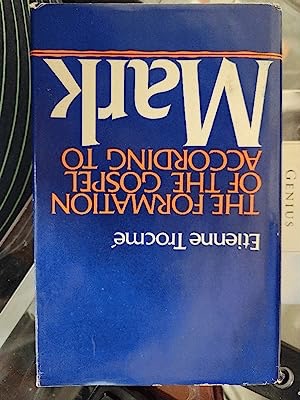
So in the meantime, here’s a post from last year where I discuss Etienne Trocme’s The formation of the Gospel According to Mark. I forgot how excited I was to find a copy of this rarity only to discover that an academic work translated from French makes poor reading. Additionally it kinda goes off the rails about halfway. I haven’t finished reading it to this day.
From June of last year, here Etienne Trocme’s “The formation of the Gospel According to Mark”
“Aren’t you an atheist?”
“Don’t you have anything better to do?”
“Have you considered professional counseling?”
These are just some of the questions I receive when others learn of my obsession with the Gospel According to Mark. Indeed, it’s hard to this passion of mine into words. In short, it’s one of the great mysteries of history. We don’t know who wrote it. And while we have some pretty safe assumptions about why it was written, even that is debated. Hell, we can’t even agree what genre Mark is.
Moreover, there’s an aspect to it that I almost find comical. While Mark clearly has some artistic intentions behind it, it is not particularly well written. Additionally, due to the politics of its era, there is likely a polemical aspect to it that has been largely lost on modern audiences. So I find it funny that one of the most important texts in ancient history was written by some moderately educated dude trying to piss off his opponents over petty theological differences. Because in doing so, the author basically invented the story of Jesus which is the most important story in Western civilization.
While I think the Gospel has kernels of historical truth regarding Jesus the man, it’s almost impossible to tell which one of them are facts which further confounds modern scholars. But honestly, I find the Gospel of Mark to be far more interesting than the historical Jesus due to its impact. So Jesus was an apocalyptic preacher who was nailed to the cross by the Romans. Big whoop. But, according to “Mark”, what if Jesus was the Son of God who died on the cross and rose again to save us from our sins? Now that’s show business!
But regarding the political dimensions of the early Jesus Movement, I find this aspect to be largely ignored by modern scholars. I think Monty Python’s Life of Brian is a bit more accurate than we care to admit. While this analogy is far from perfect, the Jesus Movement…specifically the one prior to Paul’s prevalence…was, in part, a response to the dominant Pax-Romana. In sum, this movement could be deemed a “left-populist” one in modern eyes. And if you’ve spent any amount of time with political radicals, you quickly learn that they HATE each other. While the main thrust behind Mark is to provide an unknown (but likely Greek-influenced) early church a coherent theological message, it’s who it’s aimed against that I find interesting.
This matter caught my attention while reading Etienne Trocme’s The Formation of the Gospel According to Mark. It’s a tough read, largely because it was written in French and doesn’t translate well into English, so I haven’t gotten very far. Additionally, I believe that Trocme’s controversial assertion in the work is that Mark originally ended at chapter 13. I do not accept that conclusion and it has been almost universally rejected by all scholars. Nevertheless, I picked up the book hoping to find some insight into Mark’s intentions.
According to tradition, “Mark” was an interpreter of the Peter, arguably the most important of Jesus’s apostles. But unless you’re a Christian, there’s absolutely no reason to believe this is true. Not only that, but Mark kinda portrays Jesus’s inner-circle as a bunch of idiots that have no understanding what their leader is trying to say and do. Because of this portrayal, preachers today want us to believe that the Apostles were a bunch of well-meaning knuckleheads, but it is possible (in fact, more likely) that Mark had polemical angle here: he was undermining Apostolic authority. In fact, in Mark, the only people that seem to understand Jesus’s mission are just randos. If memory serves, the only person (other than the author and some demons) in the narrative to identify Jesus as “the Son of God” is a Roman centurion after Jesus died on the cross. Additionally, Mark ends at 16:8, when Mary Magdalene, Jesus’s mother Mary (simply referred to as “mother of James”) and Salome find Jesus’s tomb empty with a stranger inside telling them Jesus has risen. Instead of rejoicing at the news, the women fled in terror and told no one.
In short, according to Mark, Jesus’s followers during his time on earth didn’t understand his message and when confronted with the truth, they fled.
As Trocme indicates, Mark doesn’t downplay Peter’s significance to Jesus but his authority is more or less stripped away. And James the brother of Jesus, who along with Paul and Peter was one of the most important figures in early church history, is essentially non-existent in the text.
Using my understanding of radical movements, a different interpretation of Mark comes clear: the author was asserting his own theology (possibly influenced by Paul who had his own run-ins with the Apostles) while simultaneously extending the middle finger to Apostolic authority.
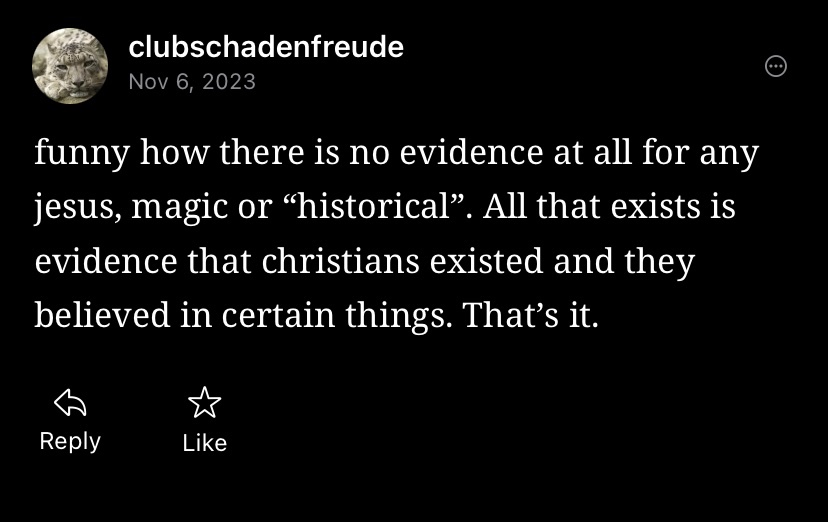
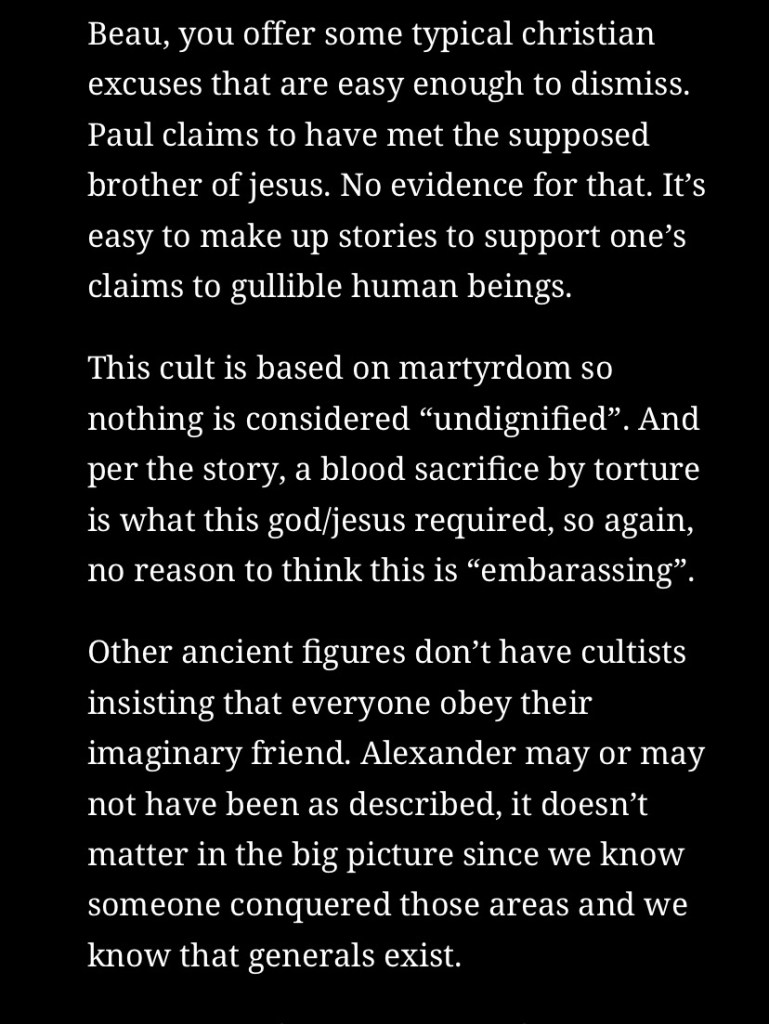
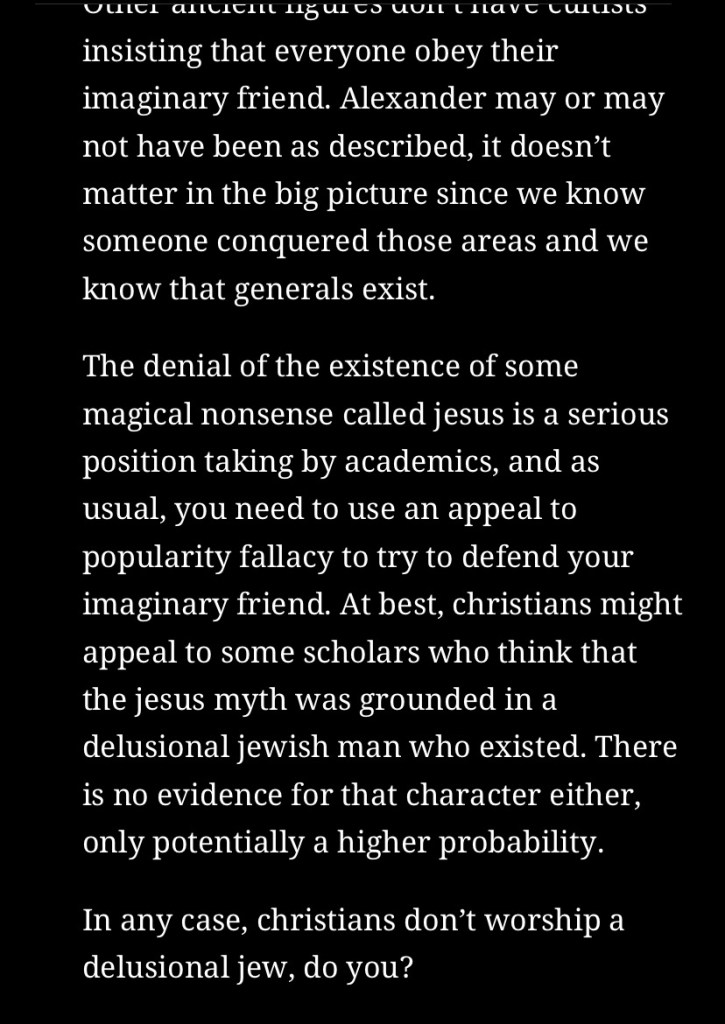
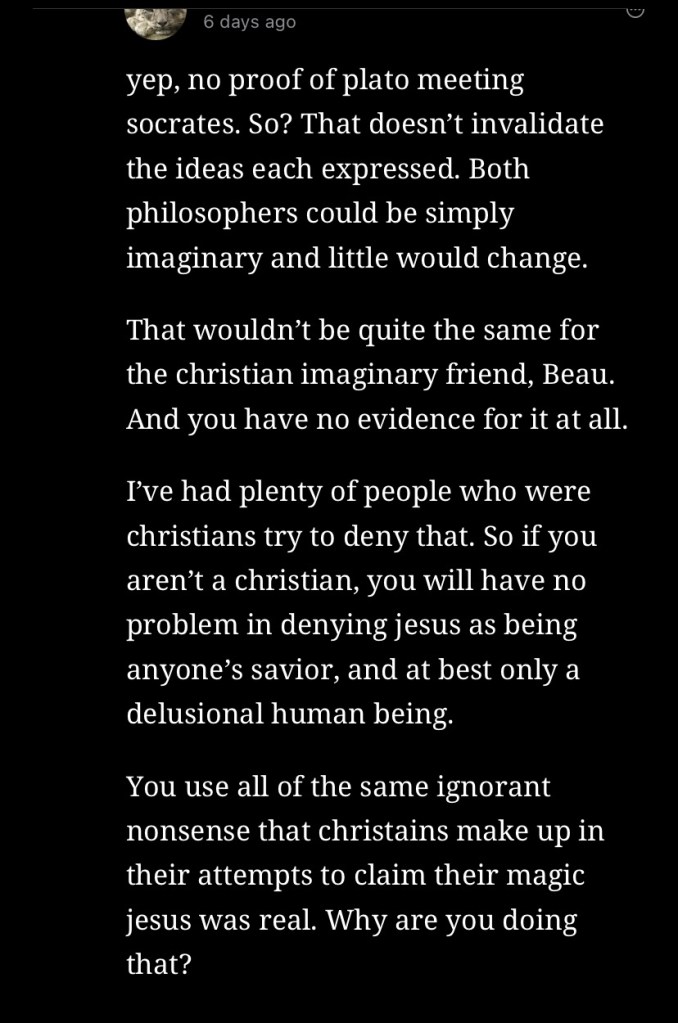
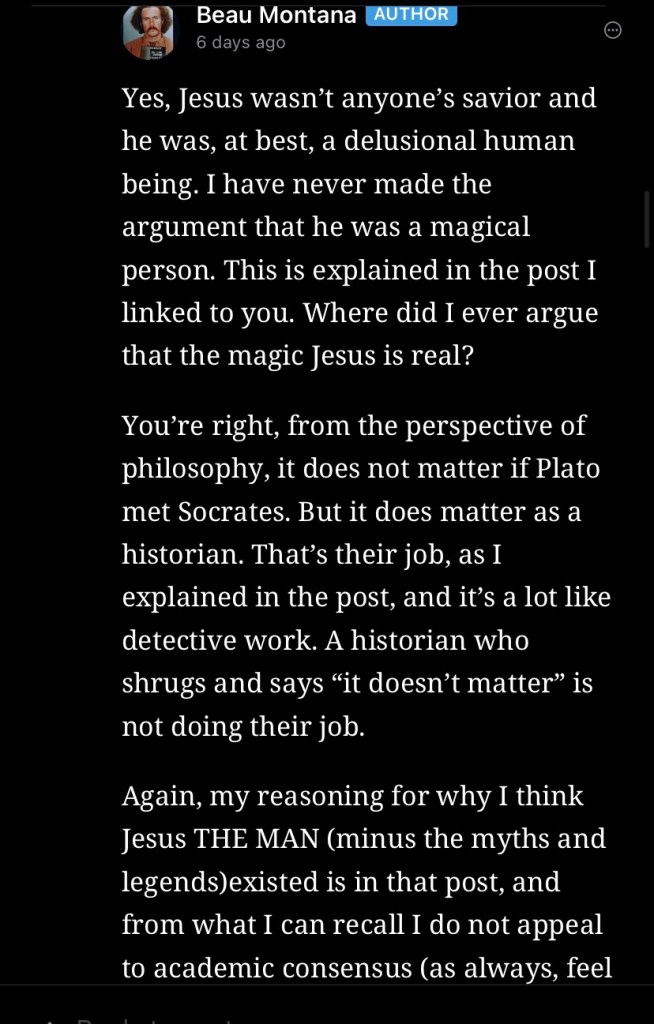
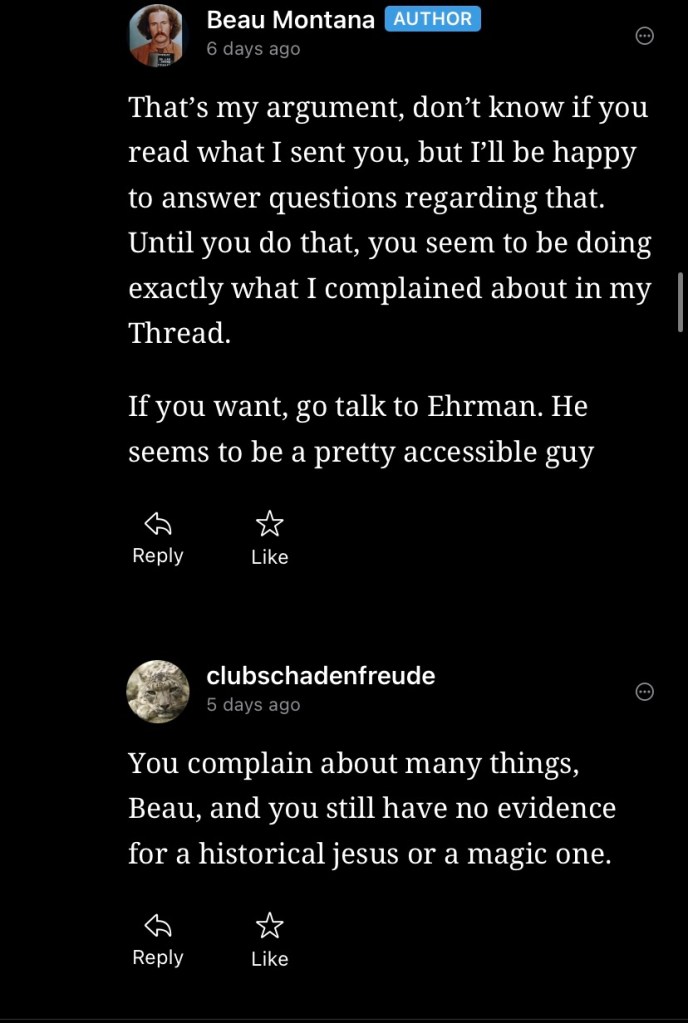
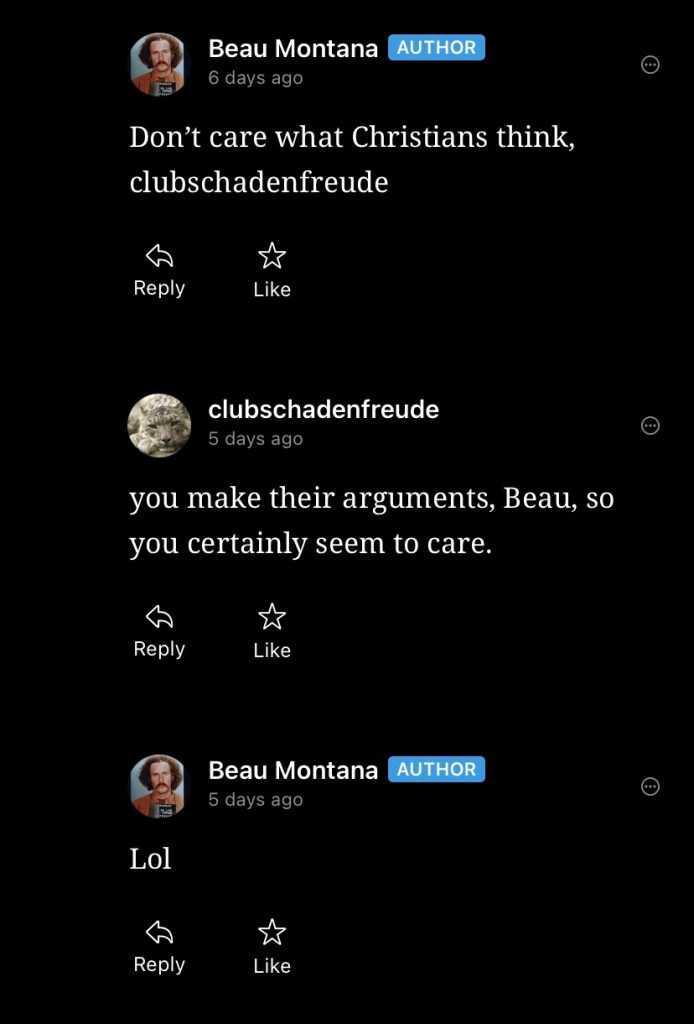
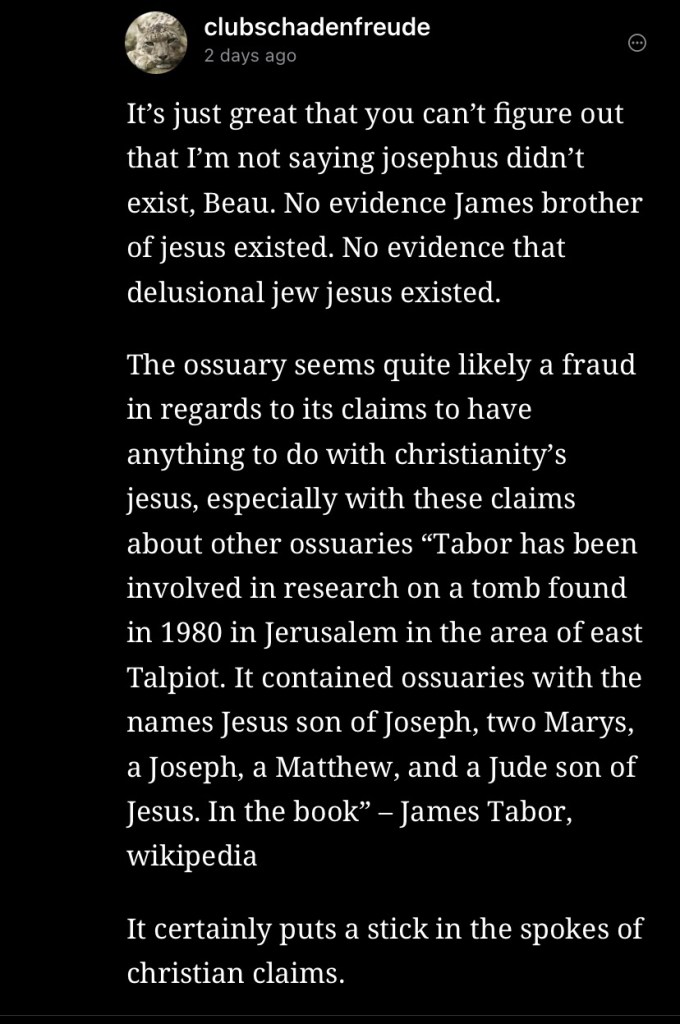
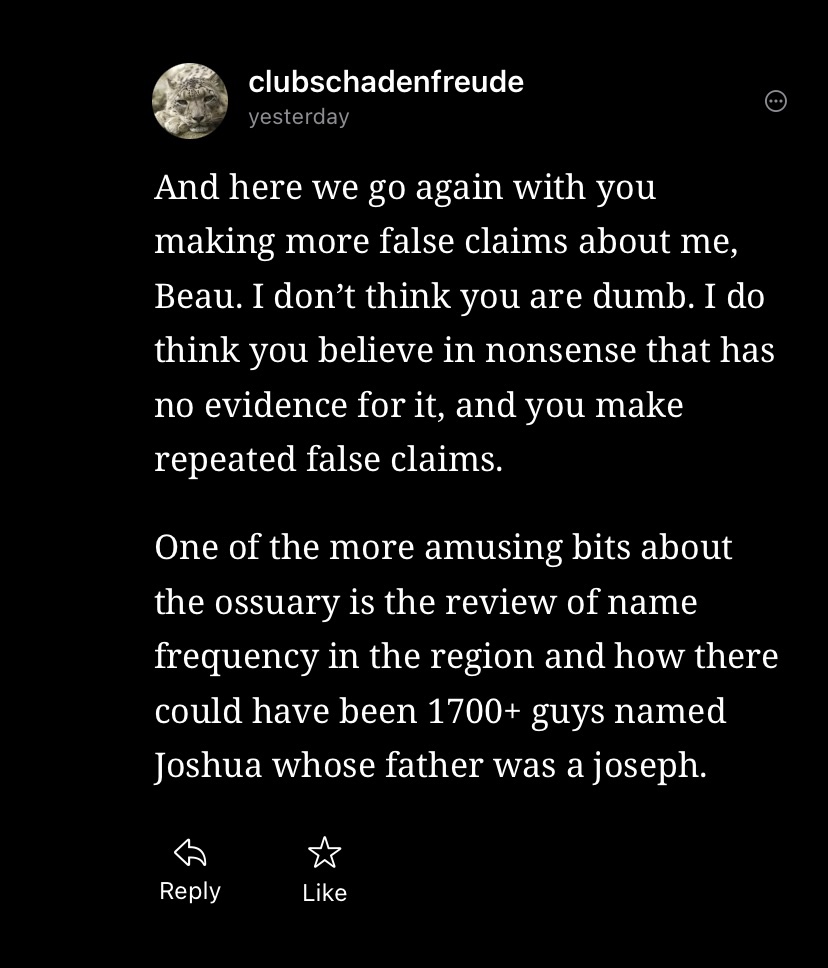
The art of being a good internet troll is playing the part your haters want you to play. So thanks to clubschadenfreude, I am coming out of the closet to admit that yes…I am fully indeed a proud goddamn Christian and that I simultaneously deny the historical existence of our Lord Jesus Christ.
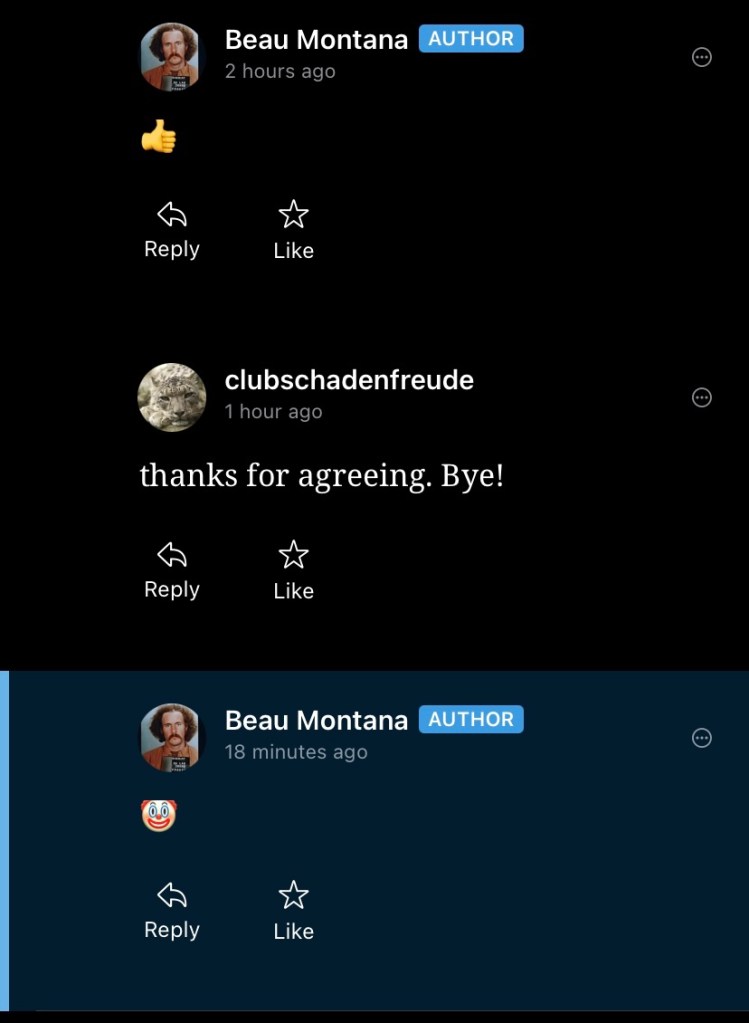
Clubschadenfreude clearly understood all the arguments and the nature of historical investigation. I should state that he/she totally wasn’t drive-by commenting on a post about a subject they had a knee-jerk reaction towards. It was a very enlightening and respectful conversation that you can read below.
And why stop at denying the historical existence of Jesus? Fuck it, I’m doing a step further…Julius Caesar didn’t exist!
Prove me wrong!
As you can tell, this was a meeting of the two minds. Hopefully this serves as an example of true scholarly debate.
But as everyone knows: I’m an internet hardass. If you cross my path, I will spank your ass cheeks blood red. And I’ve been doing a lot of spanking in overtime.
Ask anyone on the streets, “what do you think of when world renowned shitposter Beau Montana comes to mind?”. And every last one of them will say, VERBATIM: “he’s one of the premier armchair historians of our age in the field of the historical Jesus and early Christianity, particularly in regards to the Gospel of Mark.”
So when such an honor is bestowed upon you, you can’t let transgressions like this go unpunished:
Bart Ehrman…noted atheist and academic…vehemently argues for the existence of the historical Jesus.
Perhaps the Instagram poster thought: “it’s common knowledge that Bart Ehrman argues for the historical existence of Jesus, so maybe my audience will think this meme will be ATTACKING Ehrman by using his own words against his claims.”
OR, as is most likely, the poster has no idea what Bart Ehrman actually argues, and lazily reposted this image which makes Ehrman look like he’s arguing against the historical Jesus.
That’s intellectual laziness and I’m not having it, especially since the public places their trust in me to provide valuable information and analysis.
To vent my frustrations, I took to the newest invention from our Lord and Savior Mark Zuckerberg, THREADS.
The result has been my most interacted with content I have ever posted to social media. Unfortunately I can’t link to it because it appears that Threads is still only in app form. But I’m proud of myself for adequately defending mine and Ehrman’s position with such gems as:
And
So rest assured that in this age of misinformation you still have people like me defending the truth with all the intellectual rigor required of a true scholar
These are just some of the questions I receive when others learn of my obsession with the Gospel According to Mark. Indeed, it’s hard to this passion of mine into words. In short, it’s one of the great mysteries of history. We don’t know who wrote it. And while we have some pretty safe assumptions about why it was written, even that is debated. Hell, we can’t even agree what genre Mark is.
Moreover, there’s an aspect to it that I almost find comical. While Mark clearly has some artistic intentions behind it, it is not particularly well written. Additionally, due to the politics of its era, there is likely a polemical aspect to it that has been largely lost on modern audiences. So I find it funny that one of the most important texts in ancient history was written by some moderately educated dude trying to piss off his opponents over petty theological differences. Because in doing so, the author basically invented the story of Jesus which is the most important story in Western civilization.
While I think the Gospel has kernels of historical truth regarding Jesus the man, it’s almost impossible to tell which one of them are facts which further confounds modern scholars. But honestly, I find the Gospel of Mark to be far more interesting than the historical Jesus due to its impact. So Jesus was an apocalyptic preacher who was nailed to the cross by the Romans. Big whoop. But, according to “Mark”, what if Jesus was the Son of God who died on the cross and rose again to save us from our sins? Now that’s show business!
But regarding the political dimensions of the early Jesus Movement, I find this aspect to be largely ignored by modern scholars. I think Monty Python’s Life of Brian is a bit more accurate than we care to admit. While this analogy is far from perfect, the Jesus Movement…specifically the one prior to Paul’s prevalence…was, in part, a response to the dominant Pax-Romana. In sum, this movement could be deemed a “left-populist” one in modern eyes. And if you’ve spent any amount of time with political radicals, you quickly learn that they HATE each other. While the main thrust behind Mark is to provide an unknown (but likely Greek-influenced) early church a coherent theological message, it’s who it’s aimed against that I find interesting.
This matter caught my attention while reading Etienne Trocme’s The Formation of the Gospel According to Mark. It’s a tough read, largely because it was written in French and doesn’t translate well into English, so I haven’t gotten very far. Additionally, I believe that Trocme’s controversial assertion in the work is that Mark originally ended at chapter 13. I do not accept that conclusion and it has been almost universally rejected by all scholars. Nevertheless, I picked up the book hoping to find some insight into Mark’s intentions.
According to tradition, “Mark” was an interpreter of the Peter, arguably the most important of Jesus’s apostles. But unless you’re a Christian, there’s absolutely no reason to believe this is true. Not only that, but Mark kinda portrays Jesus’s inner-circle as a bunch of idiots that have no understanding what their leader is trying to say and do. Because of this portrayal, preachers today want us to believe that the Apostles were a bunch of well-meaning knuckleheads, but it is possible (in fact, more likely) that Mark had polemical angle here: he was undermining Apostolic authority. In fact, in Mark, the only people that seem to understand Jesus’s mission are just randos. If memory serves, the only person (other than the author and some demons) in the narrative to identify Jesus as “the Son of God” is a Roman centurion after Jesus died on the cross. Additionally, Mark ends at 16:8, when Mary Magdalene, Jesus’s mother Mary (simply referred to as “mother of James”) and Salome find Jesus’s tomb empty with a stranger inside telling them Jesus has risen. Instead of rejoicing at the news, the women fled in terror and told no one.
In short, according to Mark, Jesus’s followers during his time on earth didn’t understand his message and when confronted with the truth, they fled.
As Trocme indicates, Mark doesn’t downplay Peter’s significance to Jesus but his authority is more or less stripped away. And James the brother of Jesus, who along with Paul and Peter was one of the most important figures in early church history, is essentially non-existent in the text.
Using my understanding of radical movements, a different interpretation of Mark comes clear: the author was asserting his own theology (possibly influenced by Paul who had his own run-ins with the Apostles) while simultaneously extending the middle finger to Apostolic authority.
“No wonder Mr. Dickleburg’s pissed,” I said to Oppenheimer after we galloped into town, “you didn’t give his man a fair trial!”
“That’s the thing about this timeline,” he replied, “they have no concept of judge and jury. Yet we still come to the same conclusions without them. It’s the damndest thing.”
Sheriff J. Robert Oppenheimer was about to hang one of Dickleburg’s company men on the streets of Elkhorn when word got to him that Dickleburg was riding into town with some hired guns. Oppenheimer and myself, along with Mr. Ree, we’re standing around in the sheriff’s office with the prisoner, Billy Friedkin, behind bars.
“You boys don’t know what’s comin,” Billy said, taunting us.
“I say we hang the son of a bitch right now and send a message,” Mr. Ree opined.
“We can’t do that,” Oppenheimer said, “Mr. Dickleburg will burn this town down.”
“Then why did you arrest Billy Friedkin to begin with?” I asked.
“Because,” Oppenheimer paused, “Mr. Friedkin shot and killed several of Mr. Rockwell’s cattle. The law plainly states that’s an offense punishable by death.”
“Then wouldn’t the government have your back?”
“No,” he replied, “Mr. Dickleburg owns the Montana government. But I had to arrest and hang Billy or else the townspeople would have hung me. You see, I’m between a rock and a hard place.”
Billy began guffawing in his cell. “Shut up,” I ordered, “I could kill you now and get away with it.”
“Relax gentlemen,” Oppenheimer said, “we need to think. Other than the time in that dormant volcano in Hawaii, have you ever been in a gun fight?”
I chuckled in response. “Bob, seriously?” I asked, “I saved Mexico City from a nuclear attack and massacred the entire West Coast mafia up in Big Bear. The FBI was pissed. So I think I know my way around a fire fight.”
“Good,” he said, “because Dickleburg and his merry men will be here in a matter of minutes. We need to set up a defensive parameter. It’s only going to be the three of us.”
I looked over to Mr. Ree. “I think I’m gonna need that opium pipe now,” I said.
Mr. Ree shook his head and dug out the pipe from his satchel. “I don’t think I’ve ever killed a man sober,” I said to him as I took it from his hand.
“Hopefully it will improve your aim,” he added.
“Don’t worry about it,” I replied, “I’ve got this shotgun. Are you any good with that Winchester rifle?”
Mr. Ree held up the weapon and smiled. “I’m no Lee Harvey Oswald,” he replied, “but I think I can handle myself.”
After watching nonstop Paul Giamatti commercials on Tubi I’ve realized two things: I don’t like Paul Giamatti and I hated the miniseries John Adams.
I read the popular biography by David McCullough on the first US Vice-President and influential Founding Father back in high school. It was fine. I don’t remember much about it to be honest, but that’s what prompted me to watch the miniseries.
The problem with the show is the same problem every dramatized account of a real historical event faces: there’s no surprises and every character is one dimensional. Unfortunately American history is largely mythologized. We all know it’s bullshit but we fall for it anyway.
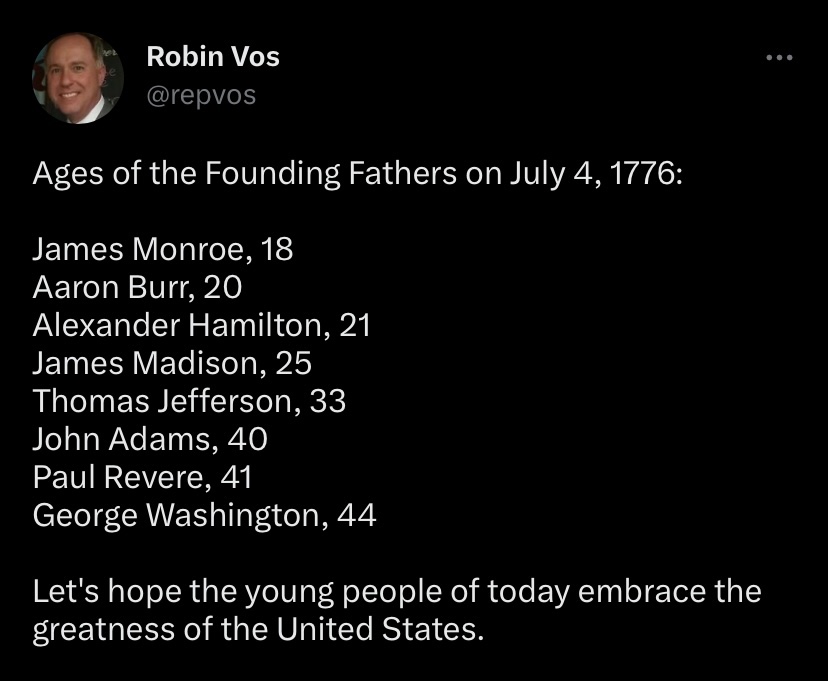
None of these guys knew what they were doing. But the Founding Fathers are always portrayed as paragons of virtue and certain in their destiny. I especially hated when John Adams meets George Washington. Why couldn’t Washington had been portrayed as an idiot who’s unfortunately the only man qualified to lead an army? That’s probably closer to the truth. But another thing that’s rarely discussed is how young these guys were:
No, I will not fact check Robin Vos’ claims
While Washington and Adams were what we could consider “middle aged”, a lot of these guys were far from it. That’s an aspect that’s rarely explored and it would undermine the audience’s expectations; the “Founding Fathers” weren’t enlightened old men…they were young, dumb rich kids (and apparently the Revolution wasn’t all that popular with the working class, but that’s a story for a different day).
I also have a theory that if you travel back in time, understand the language and customs of the era, and observe a famous historical event as an invisible fly on the wall, you would have no idea what’s going on or what’s about to happen. This is especially true for ancient times.
I tried exploring this idea last year with the story According to Simon (which I never finished). Much like the Founding Fathers, this story also centered around a (probably) real historical event that has been heavily mythologized: the death of Jesus Christ and the founding of Christianity told through the “Apostle” Peter. To go back to the AD 30s Jerusalem and watch these events unfold, they would look nothing like they are portrayed in the Gospels or Book of Acts: Jesus is called Yeshua (in fact, Peter had no idea what the Greeks were talking about when they referred to him as “Jesus”) , the Apostles are a bunch of stupid young kids, Judas steals and returns Jesus’s body to Nazareth, and Paul is a lunatic who confuses Jesus’s missing body with a real resurrection. And in the midst of this madness, confusion, and political strife, a new religion is born.
Do I think events actually happened that way? No. But I do think my interpretation is far more historically accurate…and therefore more engaging…than the mythologies that have been handed down to us. Because every historical figure is a living, breathing, shitting, human being , storytellers should approach the subject from that perspective rather than regurgitate the same old myths that we all know to be untrue (and are largely stale).
So here it is, the post that started it all. It was originally published in early August of 2021.
As the new year approaches, I just want to reflect on how I’ve changed as a person and as a writer. Which really isn’t a whole lot when you think about it.
So onto 2023! Have a Happy New Years and thank you to everyone who has followed me on this journey.
I love you 😘
They say Rome wasn’t built in a day.
They say you can’t count your chickens before they hatch.
They say you can’t shit where you eat.
They say I should seek therapy because everyone’s worried about me.
They say I have a drinking problem and that I shouldn’t mix downers with downers.
They say I have crippling debt and that I am months away from homelessness
Hi I’m James. And maybe they’re right. What do I know? Well let me tell you a little about myself.
I was born outside of a Denny’s in Scottsbluff, Nebraska in either late 1979 or 1981 depending on who you believe. I attended Norhwestern on an athletic scholarship, but was suspended for PED usage, and, in the words of the university, “cockfighting”.
So I hit the road. I hit up every strip club and drug den from Baton Rouge to New Orleans. I learned a lot about myself on that trip. I learned that sometimes growing up means putting your pants on one leg at a time. Sometimes it’s about changing your pants. Sometimes your pants just aren’t long enough and you accidentally expose your wiener.
But the most important thing in life is this: show up to court on time and pay all of your fines.
So I actually know quite a lot. And if you stick around, you might learn something too.

















 The Internet Ruined Everything