What happens next, Guy Hamilton calls a “snake pit” situation (or some shit like that): Bond finds himself in inescapable position and has to use his wits to get out of it. The most notable example of this is the “laser” situation in Goldfinger, also directed by Hamilton. I suppose that the “alligator jumping” sequence in Live And Let Die also counts. In Diamonds Are Forever, the snake pit situation is being burned alive in a coffin.
Arguably this is the most pants-shitting position anyone could find themselves in: after Bond deposits the diamonds in the mausoleum, he is knocked out cold and placed into a coffin to be incinerated. All things considered, Bond responds to this predicament fairly cooly. He doesn’t panic; his only move is an attempt to open the coffin. But right when you think it’s the end, Bond is rescued by Mr. Slumber and a pissed off comedian. “You dirty double-crossing limey fink!” the aged comedian yells, “your goddamn diamonds are phonies!”
Bond responds in the only sensible manner: “let me guess. You’re St. Peter?”
It’s a good exchange. To paraphrase Guy Hamilton, it’s a lovely bit of nonsense. But Bond gets out of this predicament by a switcheroo that wasn’t established to the audience: the diamonds that were shoved up Peter Franks’ ass were fake. We’re not told that until AFTER Bond escapes a fiery death. The more you think about it, it’s only by luck that Bond gets out of this alive, therefore making this the weakest of the “snake pit” situations directed by Guy Hamilton.
In the other two examples, Bond had to outthink his situation. In Goldfinger, he had to bluff. In Live And Let Die, 007 had to do one of the coolest stunts ever. In Diamonds Are Forever, it is by luck that Morton Slumber and the comedian discover that the diamonds are fake in time to stop the burning. Though he escaped by the skin of his teeth, Bond thinks on his feet: with thousands of dollars in his pocket, he knows they wouldn’t burn him up if the money was real. “Bring me the real money, I’ll bring you the real diamonds,” he tells them. Then he hops out of the coffin and strolls on over to Las Vegas.
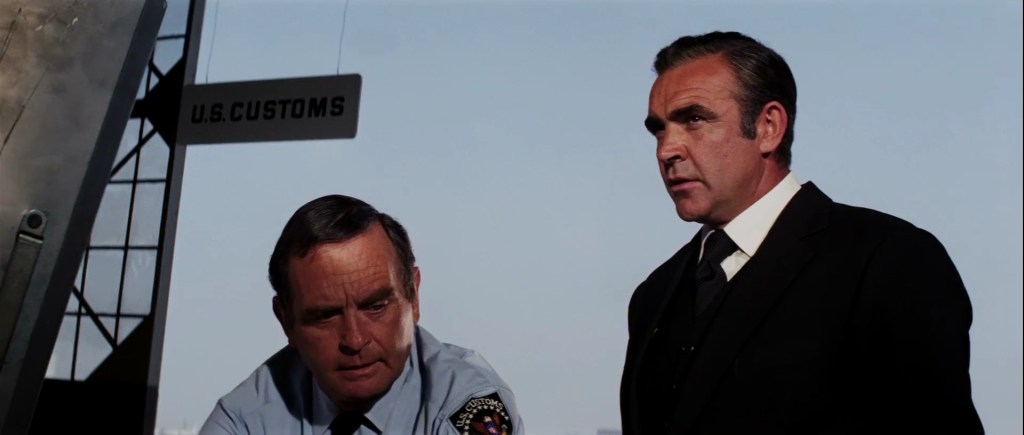
Tiffany Case and James Bond smuggle the body of Peter Franks, along with a literal assload of diamonds, into the United States via LAX. Bond is greeted at customs by none other than Felix Leiter.
Of all the actors to have played Felix, Norman Burton is among the least mentioned. This is a shame because he’s a good choice: he’s not built like an action star; he’s built like a normal schlubby guy doing his job. Burton plays him as a man who wants to do nothing more than go home and bitch to his wife about all the shit that the CIA puts him up to. That’s totally relatable. Say what you will about Guy Hamilton but the man knows how to cast movies.
But in this exchange between Bond and Leiter there comes the most controversial question of the film: who stuffed the fake diamonds into Peter Franks’ asshole? Tiffany Case or James Bond? This has been HOTLY debated for 53 years but the answer is obviously James Bond. Let me explain: Tiffany Case would have assumed they were smuggling REAL diamonds but, as it is revealed later, the diamonds extracted from Franks’ dead body were FAKE. Only James Bond, MI6, and the CIA could have known that. Ergo, James Bond shoved the diamonds into Franks’ rectum.
It really makes you think doesn’t it? Perhaps these are more thought provoking movies than people remember.
After Leiter’s inspection, the body is hauled away by three funeral home employees, who are clearly undercover mob guys, one of whom is played by Sid Haig (one of a few cult-favorite actors to appear in this film). Bond is convinced to ride in the front seat of the hearse all the way from Los Angeles to Las Vegas. So a few thoughts here: why? McCarran International Airport in Las Vegas is featured later in the movie. Why not fly directly there from Amsterdam? Did Amsterdam not have flights directly to Vegas in 1971? Would audiences have given a shit? As an American intimately familiar with the SoCal area, this has always bothered me.
So Bond and the mobsters arrive at Morton Slumber’s Funeral Home in Nevada. Mr. Slumber and Bond hilariously go through the motions of pretending to give a shit about the funeral process; Peter Franks’ body is burned up and in about two minutes the diamonds are retrieved from his colon and placed in an urn. Bond takes the urn into the mausoleum, retrieves some money, and is knocked out cold by Mr. Wint and Mr. Kidd.
Guy Hamilton cut his teeth as an assistant to legendary directors like Carol Reed and John Huston. The commentary tracks on all Hamilton-helmed Bond pictures remind audiences that he was a stand in for Orson Welles in The Third Man. In the 1950s, Hamilton was elevated to director where he made nine films before being offered the job in 1961 for Dr. No. He turned it down and producers instead went with Terence Young. However, when Young stepped away from the franchise after From Russia With Love, Hamilton came in for Goldfinger (1964). The third James Bond film is often cited for establishing the template for subsequent films in the franchise, to which Hamilton is frequently credited for. After George Lazenby left the role after one picture, Connery returned and producers felt like they needed to re-establish the Goldfinger tone. Enter Hamilton for Diamonds Are Forever.
I’d like to take a moment to praise Terence Young. While there’s the James Bond of the Ian Fleming novels, there’s also the James Bond of the movies. The difference between the two (if we don’t count Sean Connery) is Terence Young. Before being cast in the role, Connery was just a Scottish roughneck actor. Young shaped him, and thus James Bond, into the character we’ve come to love. And James Bond is very much the focus of the action in the first two films,particularly Dr. No. This is what made Red Grant such a formidable opponent in From Russia With Love, because he was essentially James Bond’s equal. Their confrontation, the train fight towards the end, is cited as one of the hallmarks of the series. Young really knew how to build up this character. While the Young-directed films are very much post-war male fantasies, he still manages to ground the picture thus making them feel raw.
Guy Hamilton changes that in Goldfinger. Hamilton’s conception of the character is essentially that of a comic book hero. This is where we see the introduction of over the top gadgets, cartoonish villains, and (let’s be honest) blatant misogynistic attitudes towards women. This is the point in the franchise where the series recognizes itself as a cultural phenomenon. It was an overwhelming success but for whatever reasons Hamilton didn’t return until DAF.
Connery’s biggest complaint for Goldfinger was that Bond was always one step behind the villain, which is a valid criticism. This is remedied in DAF thanks to Mankiewicz’s script and Hamilton mostly sidelines the misogyny, though not entirely (it will make a BIG comeback in Live and Let Die and The Man With The Golden Gun), but the plot still remains over the top.
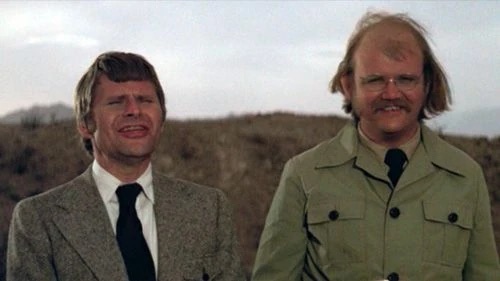
Mr. Wint and Mr. Kidd. Can you name a more iconic duo? These henchmen are played as clearly defined lovers which shows a great deal of progressive foresight by producers and author Ian Fleming. And it was a bit of inspired casting too. They’re played by Crispin Glover’s dad and the bassist to the Righteous Brothers. They’re definitely one of the more memorable characters in the James Bond universe.
But their introduction is a little strange to say the least. Sir Donald’s exposition to Bond and M is broken up by jump cuts to Mr. Wint and Mr. Kidd and their shenanigans. Their scenes are good, which includes blowing up helicopters and dropping scorpions down people’s shirts, but the narrative is very clunky. I kinda get the joke: as Sir Donald explains the situation and the “pride and devotion” of his employees, the audience is keyed into the actual corruption within the diamond industry while the stuffy Brit obliviously blabbers on. Additionally, these scenes establish the tone of the film as a campy joy ride. I get it. There’s a lot that needs to be explained in these scenes because we want to jump into the action as soon as possible.
I just think it could have been told better. So what would I have done?
Glad you asked.
Perhaps start with the dentist extracting a diamond from the tooth of one of the miners and stashing it away. Cut to Mr. Wint and Mr. Kidd philosophizing over a scorpion in the desert, meeting the dentist, killing him, then blowing up the helicopter to take the money. That takes what? Two minutes of screen time? This also streamlines the introduction to intrigue which is sorely missed in the films of the 70s. Then we cut to the exposition dump with Sir Donald, Bond, and M. After M tells Bond that he’s going to Holland, we cut to Mr. Wint and Mr. Kidd handing the diamonds off to the corrupt missionary where she’s told she’s going to Amsterdam. BAM! The plot begins.
M is a stone cold bastard. Think about his introduction from the perspective of On Her Majesty’s Secret Service. James Bond’s new wife is murdered. He goes on a rampage to kill Blofeld, does so, then comes back to work not long after. M blabbering to Bond about some stupid fucking diamond takes place what? Maybe a MONTH after his wife’s death?! M was at the wedding for Christ sake! Then the head of MI6 has the GALL to demand that Bond move on and provide some “plain, solid work”!
What an asshole!
Of course I don’t KNOW for a fact that this takes place immediately after OHMSS. Maybe Bond managed to squeeze in a couple of missions before deciding to take a holiday to pursue Blofeld. But I have a hard time believing that James Bond would watch his wife die, maybe take a grieving period before returning to work, wait for more information to trickle out about Blofeld’s whereabouts, then beg M to allow him to go after him, M refusing, then taking vacation time to enact vengeance. The more credible explanation is that after Tracy is killed, Bond…who was already on PTO for his wedding and honeymoon…immediately jumped into action. And this first interaction with M in Diamonds Are Forever takes place right after James Bond comes back from vacation because a minute later, Sir Donald, who provides an exposition dump for the plot, says to Bond “I hear you’ve been on holiday.” In other words, M is a fucking dickhead.
But maybe not!
As I’ve already (successfully) argued, part of the purpose behind the cold open was to erase OHMSS altogether. So in the world of DAF and Sean Connery, James Bond was never married. His beef with Blofeld stems from the events of You Only Live Twice, meaning the mission wasn’t finished. Bond had to take a “holiday” to complete the job. So from this perspective, M is somewhat justified in his annoyance with Bond. Although Blofeld got away at the conclusion of YOLT, his plan was thwarted which could mean the mission was a success. But James Bond wasn’t satisfied so M had to begrudgingly grant him time off (meaning he had to temporarily lose his best agent) even though killing Blofeld was a secondary objective. Yet Bond got his way and now he was back and all M wanted him to do was listen to him yammer on about diamonds. So it’s just another example of OHMSS erasure.
This can be the only plausible explanation for M’s behavior and not at all a result of a lack of attention from the writers.
The script was produced by longtime James Bond screenwriter Richard Maibaum and newcomer Tom Mankiewicz, son of legendary Hollywood director Joseph Mankiewicz. Maibaum wrote the initial drafts while Mankiewicz came in to polish it up. The latter was retained for the next two films: Live and Let Die and The Man With The Golden Gun. It’s unclear to me who wrote what but there’s little doubt about Mankiewicz’s influence as DAF is a marked departure from the previous films where Maibaum played a huge role (with the exception of YOLT which was written by Roald Dahl for some reason). The most obvious difference in the films written by Mankiewicz is that they feel more Americanized. This was probably a deliberate choice by Cubby Broccoli as American actor John Gavin was originally cast to play James Bond in DAF before Connery announced his return. But there’s another commonality between the three Mankiewicz-penned Bond films: they all introduce James Bond to the plot in the most mundane way.
In From Russia With Love, arguably the best in the series and one of the more unusually structured, there’s a solid 15 minute set up before 007 is introduced. This is an interesting device that establishes intrigue but is used intermittently throughout the series. It is almost entirely neglected for the films in the 70s, all of which Mankiewicz had a hand in writing (three credited with DAF, Live and Let Die, and The Man With The Golden Gun. Two uncredited with The Spy Who Loved Me and Moonraker). In all these films, intrigue is only established with set pieces lasting a minute or two, usually in the cold open. Neglecting an element of mystery in the introduction leads to a clumsy exposition dump post-main titles in Diamonds Are Forever, and it’s this trend that I think hampered the films of the 70s.
This may not be the fault of Mankiewicz, who would later unfairly criticize himself as being a Hollywood failson. But it was with the James Bond franchise where he cut his teeth and established a near legendary career as a script doctor and creative consultant. Instead I’d like to point the finger at director Guy Hamilton…
I’ve never had a bad word to say about 1971’s Diamonds Are Forever. To be honest, I classify it as an art form in and of itself. It’s not a movie; it remains a historical artifact of what happens when film producers have an infinite amount of money and zero fucks to give.
Even its leading man, the late great Sean Connery, couldn’t be bothered to lie about why he returned to the role. It was for the money, obviously, then a record sum. And when you watch the movie, it is obvious that no other person in the history of the planet made an easier $1 million. Producers and audiences didn’t care. They didn’t need Connery to act. They only needed him to show up.
So let’s hop right into the “film”:
If you think about it, this is actually a good cold open: James Bond throws a Japanese man through a paper wall, punches an Egyptian man in the face, and strangles a hooker with her bikini. And that brings us to roughly the minute and half mark. Now I know it sounds racist and misogynistic when I explain that way. But this is Connery’s Bond. I’m just telling you what happened.
As an interesting side note, if you notice in the Cairo casino scene, multiple people, including the man whom Bond punches, are wearing a hat called a fez. While the fez has historically been a popular piece of headgear in places like the Middle East and North Africa, where in the latter it was seen as a symbol of resistance against French occupation, something about its use in Diamonds Are Forever didn’t sit right with me. So I did a little digging and found out that the fez was actually banned in Egypt in 1958, 13 years before this movie was filmed. Insofar as I can tell the ban has been lifted but it is no longer a popular piece to wear in Egypt and it probably hasn’t been since 1958. However, the fez is still commonly worn in MOROCCO. It’s this little piece oversight and careless consideration that I really appreciate about this movie and the early Bond films as a whole.
But back to the hooker strangulation part, it’s important to point out that that Connery was roughly 4 years out from his previous Bond film You Only Live Twice. But it looks closer to 40 years. Usually when actors are cast in physically demanding roles, they do things like, you know, get in shape. But this is the genius of Connery: he didn’t. And good for him. He provided us with the greatest dad bod, the likes of which would not be seen again until Kelsey Grammar in Frasier. What’s more alarming is that Connery looked noticeably younger and fitter 12 years later in Never Say Never Again. So I applaud Connery. It’s nice to see him get in one more fuck you to Eon Productions before leaving them for good.
It was painfully obvious that Connery was in no way committed to the role. Again, back to the strangulation scene, this was where the actor reveals his face and reintroduces the character: my name’s Bond…James Bond. It’s important to note that everyone…audiences and producers alike…wanted Connery back. This introduction was to give the audience exactly what they wanted. But Connery and director Guy Hamilton zigged when perhaps they should have zagged. Instead of appearing as the cool and suave spy that we came to love, Bond introduces himself like he’s your new pervy neighbor. If I could go back in time and be a fly on the wall, I wouldn’t go see the Pyramids being built or Caesar crossing the Rubicon or any of that shit. I would go back in time to watch this scene be filmed. The reveal of Bond’s face seems like it was a first take. Maybe Connery refused to do a second. Now I’m no Steven Spielberg, but if I were Guy Hamilton, I would have taken the actor aside and said “hey, with this scene, we’re telling the audience that Sean Connery is BACK as James Bond. So when you walk down those steps in that godawful Terry cloth button-up, play it a little cool, ya know? Just like you did in Dr. No.” But that’s not what we got. Instead the whole presentation felt rushed and careless which was an ominous sign of things to come…
But on second thought, maybe Connery’s lackadaisical introduction was a deliberate one. At the time audiences felt that the prior film, On Her Majesty’s Secret Service, sorely missed the original Bond’s presence. Critics today are far more generous to George Lazenby’s first and only portrayal of 007, but being that this was the first time the character had been recast, audiences weren’t so sympathetic. With Connery lazily introducing Bond in the cold open, perhaps this was the filmmakers’ way of telling the audience that the Scottish actor had always been James Bond.
Yet this might not have been the only attempt at erasing On Her Majesty’s Secret Service within the first minute and a half. Obviously nowhere in the cold open or in the rest of the film is Tracy Bond’s death mentioned. But also, recall where the Diamonds Are Forever starts: (presumably) in Japan. And where did Connery’s prior Bond film, You Only Live Twice, end? That’s right: Japan. You Only Live Twice ends and Diamonds Are Forever begins with Bond chasing Ernst Stavro Blofeld in Japan. Coincidence? I think not. There’s obvious problems with my theory, namely James Bond looks 50 years older, but you could almost assume that Diamonds Are Forever picks up right where You Only Live Twice ends, therefore bypassing On Her Majesty’s Secret Service altogether.
Unfortunately none of this matters. The franchise is noticeably absent of continuity which has led to many asinine fan theories, the most egregious one being that James Bond is a “code name”. So allow me to digress a moment to dispel this dumb ass idea. First off, the death of Tracy Bond is a major event in the series. It is also referenced numerous times in other films staring four different Bond actors: Lazenby, Moore, Dalton, and Brosnan. This would lead us to assume that James Bond is the same man across all the Eon produced films. Additionally, it is nonsensical to believe that each secret agent that takes up the mantle of “James Bond” would ALSO have been married to a woman named Tracy who was later killed. What are the odds? Of course Lazenby infamously breaks the fourth wall in OHMSS by referring to Connery (“this never happened to the other fellow”) but later he is seen going through various trinkets seen in prior films, implying that he and Connery are in fact the same James Bond. Therefore all pre-Daniel Craig actors, from Connery to Brosnan, are the same James Bond. The Craig era is a hard reboot of the series and therefore exists in a timeline of its own. It would make zero sense for MI6 to assign various agents across the decades the same name and code. That’s fucking stupid and this theory needs to be put to bed.
Anyways, back to the erasure of On Her Majesty’s Secret Service. Now I have zero proof of what I’m about to allege, but it is well known that by this time, the relationship between producers Cubby Broccoli and Harry Salzman was on the fritz. At this point in production history, the two were alternating lead producer responsibilities from one film to the next. Saltzman produced On Her Majesty’s Secret Service. That means Broccoli produced Diamonds Are Forever. I know what you’re thinking: “so you’re saying Broccoli tried to fuck over Saltzman by trying to make audiences forget On Her Majesty’s Secret Service?”. And the answer is yes, that’s exactly what I’m saying.
And folks, I’ve only discussed the first minute and half of this film. Now’s let’s move on to the other hour and 58 minutes….
Truth be told, I don’t have much to say about Charles Gray’s Blofeld. His casting and acting choices encapsulate the movie perfectly. Counter balancing Connery’s carefree performance, Gray actually worked for his paycheck. He made his interpretation a marked difference from Donald Pleasence and Telly Savalas who preceded him in the role. It’s probably my favorite Blofeld. Gray’s acting may not be to everyone’s taste. In fact, some are even distracted by his casting given he played a Bond ally in the previous Connery outing, You Only Live Twice, as Mr. Henderson.
This further lends credence to my theory that Diamonds Are Forever is a direct sequel to You Only Live Twice. If true, then this would be a groundbreaking moment in the series that would not be seen again until Casino Royale/Quantum of Solace over 35 years later. Hear me out: after the events of You Only Live Twice, Blofeld changed his appearance to fit not just anyone, but Mr. Henderson specifically. Why Mr. Henderson? Who knows. To be honest, Roald Dahl’s script was so batshitthat I don’t recall if Mr. Henderson’s background was ever explained. I believe it was hinted that he knew of SPECTRE; so he appeared to be a well-connected guy. Perhaps he knew Willard Whyte? That might explain how Blofeld managed to infiltrate Whyte’s organization for DAF. But whatever the case, I’m sure there’s no need to inspect for holes in my theory as it is ironclad.
So I don’t have much to say on Gray’s Blofeld but I do have a lot to say about his introduction, specifically the set. Let me preface this by saying that Ken Adam might be the greatest production designer of all time. He’s certainly the most iconic of the James Bond franchise. But that set, where Bond confronts Blofeld for the first time in the film, looks like shit. Literally. Everything is dark and brown, right down to Connery’s suit. I’m willing to give Adam the benefit of the doubt. As you all know, I don’t do research. So it’s possible that this “set” isn’t a set at all but is actually someone’s house, specifically Guy Hamilton’s. I’m making this assumption based on no proof, but it feels like Cubby Broccoli went into Hamilton’s basement and said “this would be the perfect place to shoot a Bond film.” Hamilton, being the English gentleman that he is (or was), simply shrugged and said “whatever you say Cubby.” Meanwhile Adam, along with set decorator Peter Lamont, threw up a bunch of rock to conceal the dreariness of the room, leaving cinematographer Ted Moore with the unenviable task of lighting it. That is the only logical conclusion I can come to given the talent involved. Adam, Lamont, and Moore have all won Academy Awards.
But it’s in this scene where Connery has to do a little bit of work, probably the most he’ll do throughout the film. It appears he did his own stunt work by doing a front roll then pulling a switch that dumps a bunch of shit onto a guy pointing a gun at him. Then he briefly tangles with two guards before jumping slightly to the side to avoid a knife attack from Blofeld. I’m surprised they convinced Connery to do as much. It’s probably the laziest fight scene in the whole series.
With Blofeld “dead”, this leads us into the main title sequence…
I’ve never had a bad word to say about 1971’s Diamonds Are Forever. To be honest, I classify it as an art form in and of itself. It’s not a movie; it remains a historical artifact of what happens when film producers have an infinite amount of money and zero fucks to give.
Even its leading man, the late great Sean Connery, couldn’t be bothered to lie about why he returned to the role. It was for the money, obviously, then a record sum. And when you watch the movie, it is obvious that no other person in the history of the planet made an easier $1 million. Producers and audiences didn’t care. They didn’t need Connery to act. They only needed him to show up.
So let’s hop right into the “film”:
If you think about it, this is actually a good cold open: James Bond throws a Japanese man through a paper wall, punches an Egyptian man in the face, and strangles a hooker with her bikini. And that brings us to roughly the minute and half mark. Now I know it sounds racist and misogynistic when I explain that way. But this is Connery’s Bond. I’m just telling you what happened.
But back to the hooker strangulation part, it’s important to point out that that Connery was roughly 4 years out from his previous Bond film You Only Live Twice. But it looks closer to 40 years. Usually when actors are cast in physically demanding roles, they do things like, you know, get in shape. But this is the genius of Connery: he didn’t. And good for him. He provided us with the greatest dad bod, the likes of which would not be seen again until Kelsey Grammar in Frasier. What’s more alarming is that Connery looked noticeably younger and fitter 12 years later in Never Say Never Again. So I applaud Connery. It’s nice to see him get in one more fuck you to Eon Productions before leaving them for good.
It was painfully obvious that Connery was in no way committed to the role. Again, back to the strangulation scene, this was where the actor reveals his face and reintroduces the character: my name’s Bond…James Bond. It’s important to note that everyone…audiences and producers alike…wanted Connery back. This introduction was to give the audience exactly what they wanted. But Connery and director Guy Hamilton zigged when perhaps they should have zagged. Instead of appearing as the cool and suave spy that we came to love, Bond introduces himself like he’s your new pervy neighbor. If I could go back in time and be a fly on the wall, I wouldn’t go see the Pyramids being built or Caesar crossing the Rubicon or any of that shit. I would go back in time to watch this scene be filmed. The reveal of Bond’s face seems like it was a first take. Maybe Connery refused to do a second. Now I’m no Steven Spielberg, but if I were Guy Hamilton, I would have taken the actor aside and said “hey, with this scene, we’re telling the audience that Sean Connery is BACK as James Bond. So when you walk down those steps in that godawful Terry cloth button-up, play it a little cool, ya know? Just like you did in Dr. No.” But that’s not what we got. Instead the whole presentation felt rushed and careless which was an ominous sign of things to come…
When I was growing up, I wanted to be only one thing: the next Tom Mankiewicz. The man who brought you gems like Hart to Hart wrote three James Bond films early in his career. After Peter Hunt controversially changed the formula with On Her Majesty’s Secret Service, Mankiewicz was brought in to update the franchise for what is perhaps the greatest decade in cinema: the 1970s.
The results were a mixed bag: Diamonds Are Forever, Live and Let Die, and The Man With The Golden Gun. But I think Mankiewicz largely succeeded. While most films from the decade zigged into gritty realism, Bond movies zagged in favor of over-the-top campiness. While this is a controversial opinion, I truly think this helped save the franchise. While Roger Moore isn’t my favorite Bond (or second, or third), I wouldn’t trade his portrayal or Guy Hamilton and Lewis Gilbert’s directorial contributions for any other alternative that might’ve better suited the times. Most Bond fans would agree with that sentiment. And we largely have Tom Mankiewicz to thank for that.
Which leads me to our current times. James Bond is dead. Of course he’ll come back. But how?
News is slim. While initially I put weight into the rumor that Aaron Taylor Johnson would be the next Bond, that now seems unlikely. I don’t expect the announcement of a new James Bond actor anytime soon.
But more importantly, where should the series go from here? While Daniel Craig’s portrayal was universally praised, I think it is generally accepted that producers need to aim for a lighter tone in the next era. That means no more renegade agents hellbent on revenge. Fans and audiences want a return to basics: a spy on a mission fuckin and killin for England.
The series has been in this position before. The end of On Her Majesty’s Secret Service had James Bond nearly in tears over the death of his wife. Saltzman, Broccoli, and head of United Artist David Picker said ‘fuck this! Bring Connery and Guy Hamilton back!”. Enter Tom Mankiewicz to punch up the script and the result was Diamonds Are Forever. It was two hours of Sean Connery lazily walking through cheap sets and even cheaper SFXs as Bond attempts to thwart the latest stupid plot from Ernst Stavro Blofeld. It was insane and bordered on parody. It was genius (and the third highest grossing movie of 1971).
So my advice to Michael G. Wilson and Barbara Broccoli is this: go the Diamonds Are Forever route. Americanize the setting a bit, bring in a comical and/or over the top actor for the villain and let’s have some fun for christ sake! And no need to address Bond’s “death” in the previous film. There’s no continuity to these movies anyway! Just do what you did in DAF. While it is assumed that Bond was avenging his wife’s death in the cold open, Connery was playing it as though he just enjoyed throwing guys through walls and strangling women with their bikini tops. The events of OHMSS aren’t addressed at all! And that’s what needs to happen in the next film, which I have titled The Skin of Your Teeth. Because one of the coolest James Bond moments was in The Living Daylights when Timothy Dalton says “whoever she was I must have scared the living daylights out of her”.
That was dope.
So in the new cold open, Bond barely escapes and M says “you escaped by the skin of your teeth.” Then the screen fades into the title sequence with naked women spinning around in silhouette and Adele returning to sing the theme.





 The Internet Ruined Everything