Etienne Trocme’s “The formation of the Gospel According to Mark” again

The most goddamnedest thing happened to me the other day. So I was minding my own business walking along the Korean DMZ when suddenly I was captured, tortured, and subjected to Steven Soderbergh’s The Informant! on repeat by Kim Jung Un’s thugs. I don’t want to get bogged down in the details about why I was the there. The important thing is that I escaped by impaling the guards with a long makeshift shiv. Before killing the last one, he informed me that the plan was to clone me, brainwash my clone, then send him back to the US to infiltrate the government in some elaborate plan or some bullshit. I didn’t listen that closely because it was all very boring. So I killed the last guard by drowning him in the sink.

Thankfully I caught up with my clone at the top of Pyongyang Hotel. Before strangling him and throwing his body off the roof, he said that there are many clones of me that are fully brainwashed and are preparing to infiltrate governments around the world. So long story short, I’ll be globetrotting for awhile to seek and kill all my clones.

“Isn’t that murder? 😭😭😭” you might ask.

You’re goddamn right it is!

So if you see any posts where I tell my readers to “vote for Trump” or “invest in Ethereum” or “the moon landings are faked”, just know that wasn’t me (probably) and I’ll keep you updated on my whereabouts.

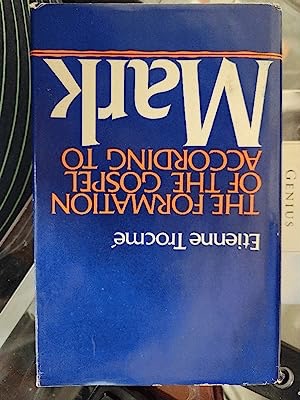
So in the meantime, here’s a post from last year where I discuss Etienne Trocme’s The formation of the Gospel According to Mark. I forgot how excited I was to find a copy of this rarity only to discover that an academic work translated from French makes poor reading. Additionally it kinda goes off the rails about halfway. I haven’t finished reading it to this day.

From June of last year, here Etienne Trocme’s “The formation of the Gospel According to Mark”
“Aren’t you an atheist?”

“Don’t you have anything better to do?”

“Have you considered professional counseling?”

These are just some of the questions I receive when others learn of my obsession with the Gospel According to Mark. Indeed, it’s hard to this passion of mine into words. In short, it’s one of the great mysteries of history. We don’t know who wrote it. And while we have some pretty safe assumptions about why it was written, even that is debated. Hell, we can’t even agree what genre Mark is. 

Moreover, there’s an aspect to it that I almost find comical. While Mark clearly has some artistic intentions behind it, it is not particularly well written. Additionally, due to the politics of its era, there is likely a polemical aspect to it that has been largely lost on modern audiences. So I find it funny that one of the most important texts in ancient history was written by some moderately educated dude trying to piss off his opponents over petty theological differences. Because in doing so, the author basically invented the story of Jesus which is the most important story in Western civilization. 

While I think the Gospel has kernels of historical truth regarding Jesus the man, it’s almost impossible to tell which one of them are facts which further confounds modern scholars. But honestly, I find the Gospel of Mark to be far more interesting than the historical Jesus due to its impact. So Jesus was an apocalyptic preacher who was nailed to the cross by the Romans. Big whoop. But, according to “Mark”, what if Jesus was the Son of God who died on the cross and rose again to save us from our sins? Now that’s show business!

But regarding the political dimensions of the early Jesus Movement, I find this aspect to be largely ignored by modern scholars. I think Monty Python’s Life of Brian is a bit more accurate than we care to admit. While this analogy is far from perfect, the Jesus Movement…specifically the one prior to Paul’s prevalence…was, in part, a response to the dominant Pax-Romana. In sum, this movement could be deemed a “left-populist” one in modern eyes. And if you’ve spent any amount of time with political radicals, you quickly learn that they HATE each other. While the main thrust behind Mark is to provide an unknown (but likely Greek-influenced) early church a coherent theological message, it’s who it’s aimed against that I find interesting.

This matter caught my attention while reading Etienne Trocme’s The Formation of the Gospel According to Mark. It’s a tough read, largely because it was written in French and doesn’t translate well into English, so I haven’t gotten very far. Additionally, I believe that Trocme’s controversial assertion in the work is that Mark originally ended at chapter 13. I do not accept that conclusion and it has been almost universally rejected by all scholars. Nevertheless, I picked up the book hoping to find some insight into Mark’s intentions. 

According to tradition, “Mark” was an interpreter of the Peter, arguably the most important of Jesus’s apostles. But unless you’re a Christian, there’s absolutely no reason to believe this is true. Not only that, but Mark kinda portrays Jesus’s inner-circle as a bunch of idiots that have no understanding what their leader is trying to say and do. Because of this portrayal, preachers today want us to believe that the Apostles were a bunch of well-meaning knuckleheads, but it is possible (in fact, more likely) that Mark had polemical angle here: he was undermining Apostolic authority. In fact, in Mark, the only people that seem to understand Jesus’s mission are just randos. If memory serves, the only person (other than the author and some demons) in the narrative to identify Jesus as “the Son of God” is a Roman centurion after Jesus died on the cross. Additionally, Mark ends at 16:8, when Mary Magdalene, Jesus’s mother Mary (simply referred to as “mother of James”) and Salome find Jesus’s tomb empty with a stranger inside telling them Jesus has risen. Instead of rejoicing at the news, the women fled in terror and told no one.

In short, according to Mark, Jesus’s followers during his time on earth didn’t understand his message and when confronted with the truth, they fled. 

As Trocme indicates, Mark doesn’t downplay Peter’s significance to Jesus but his authority is more or less stripped away. And James the brother of Jesus, who along with Paul and Peter was one of the most important figures in early church history, is essentially non-existent in the text. 

Using my understanding of radical movements, a different interpretation of Mark comes clear: the author was asserting his own theology (possibly influenced by Paul who had his own run-ins with the Apostles) while simultaneously extending the middle finger to Apostolic authority. 

Dennis R. “Old” McDonald

Every now and then an academic comes along with some wild ass theories that don’t find wide acceptance. They’re either ridiculed or ignored and sometimes, sadly, die in obscurity. Yet later they are found to be totally vindicated.

Dr. Dennis R. McDonald of the Claremont School of Theology and the Claremont Graduate University feels like a candidate for this distinction. He’s been making his rounds recently discussing his solution to “Synoptic Problem”…or how the first three canonical gospels are related…which he calls the “Q+\Papias” hypothesis. My interest in this supposed “lost gospel” theory, referred by historians as “Q”, has waned. There’s just too many unknowns to say anything definitive about it. But the most widely accepted theory is the “two source solution” to the “synoptic problem”: where Matthew and Luke relied on two sources, Mark and “Q”, to compose their gospels. McDonald’s “Q+\Papias Hypothesis” muddies the waters a bit (and is WAY too complicated to go into detail here), but it has been positively received, though not widely accepted.

But that’s not what makes McDonald controversial. He has argued, at times vehemently, that the gospels…most notably Mark…are heavily influenced by Homer. And I must admit, I find that some of his explanations stretch credulity. BUT, McDonald poses an interesting question and solution: no serious academic would mistake the gospels as accurate history even if there are REAL historical kernels contained within them. So where did Mark and others find the inspiration to rearrange the story to fit their needs? Homer seems as good of a candidate as any given his wide influence over the Greek-speaking world. If Mark was written for a Gentile audience, it would make sense to add themes and motifs that are recognizable to the reader/listener.

So while I might not find McDonald’s specific examples all that convincing, I think he’s touching on something important here. As he explained, if we can identify these Homeric influences, it adds another layer that can be stripped away from the text. In doing so, we come closer to what this “Q source” looked like, and as a result, we have a much greater understanding of the historical Jesus (at least in theory).

A few thoughts

Rest in peace Ryan Mallet. I hope that this is a reminder to kids that nothing good happens in Destin, Florida. But I’d like to take this opportunity to do what I do best: shit on Razorback fans.

I’m sure there will be a bevy of obituaries in the coming days naming Mallet as one of the greatest Razorbacks to play for the program. And I agree with that statement. But none of y’all can fool me. I would know. I was there during the thick of things. I was a student at the University of Arkansas while he was the starting quarterback, plus we shared the same major. It’s odd that we never crossed paths considering I had classes with plenty of football players, but I know what all ya’ll said about him. And you know what? You guys didn’t deserve Ryan Mallet.

And I’m proud to say I was his biggest fan. It was just too bad his receivers couldn’t hold on to his passes. So shame on you Razorback fans and the entire state of Arkansas. I hope your losing ways continue forever and ever.

RIP

Now thanks to Bart Ehrman and James Tabor, the Gospel of Mark is HOT right now. I mean SIZZLING. I guess the Bible as a whole is assumed to be a part of the great literature canon, but it’s refreshing to see Mark being independently recognized for the genius that it is, despite its flaws.

There’s no shortage of lectures regarding the text on YouTube, especially from Tabor and Ehrman. There’s also a large selection of scholarly articles and books on the subject. But what I’d like to see is a secular commentary on Mark.

I’m sure one exists, but it probably costs $900,000,000 and you have to purchase it from some secondhand dealer in Bosnia. One needs to be written for the common man, and I believe I’m halfway up for the task. I’m not going to do it because there’s obvious problems with me writing it: 1) I’m not a scholar 2) I don’t want to cite my work 3) I hardly know Koine Greek 4) Do I have to get permission to use a certain translation? If so, fuck that. And 5) Who would want to read something from a guy who’s essentially a troll with a blog (and ONE published book, I might add)?

So someone else, PLEASE write this commentary for me.

Was the Gospel of Mark written in Alexandria? (Or Rome? Or Antioch? Or Thessalonica? Or Crete? Or…)

I wasted the entire day yesterday going through Gospel of Mark and a bunch of scholarly texts trying to figure out where the Gospel could have been written. I learned a bunch of not shit. Well, that’s not entirely true. I did learn some things. But I ended up with more questions, which is usually the case when anyone reads Mark.

According to “scholarly consensus”, the Gospel was probably composed in Rome. Why do they think this? Because it was likely addressed to a gentile audience and, according to tradition, “Mark” was a companion to Peter who is presumed to have died in Rome. But as I discussed in my last post regarding the subject, Peter is portrayed as kinda a moron and a coward in Mark, which even if Peter portrayed himself in that light (for whatever reasons) I find it highly unlikely that an author who knew the Apostle would write about him that way. But that’s just one reason (among many) on why I’m not convinced that Mark is based on Peter’s DIRECT recollections. Therefore the Roman/Peter tradition is highly dubious.

Antioch is another serious candidate. Paul was heavily involved in the early church there and Mark, in my view, is heavily influenced by Pauline theology. Because Mark was likely widely distributed to Christian communities around the Mediterranean, and Antioch was the center for a lot of missionary work, this church should probably be considered the leading candidate.

The only issue I found with this is that Antioch is also considered the location where the Gospel of Matthew was written. I suppose it’s possible that both could have been composed there and it’s clear that Matthew was VERY influenced by Mark; apparently over 90% of Mark is in Matthew. But because Matthew seems at odds with Pauline theology, it appears as though his Gospel is a response to Mark’s, which would be odd if they hailed from the same church (unless Christians found Mark to be lacking and/or Pauline theology advanced to such a point in the ten or so years between the writing of these two Gospels that they felt Mark needed amending). With this under consideration, it actually appears as though Mark would have been more likely to have been written in Antioch as opposed to Matthew, but that’s a different story.

Another interesting candidate is North Africa, specifically Alexandria. This thought occurred to me while reading chapter 15, when Mark addresses Simon the Cyrene, who was the father of “Rufus and Alexander”. Who the fuck is Rufus and Alexander and why bring them up at all? There’s been attempts by scholars to link these names to others mentioned in the New Testament, but I should point out that unless you were rich or of nobility, you didn’t have a last name in those days. So just because the name “Rufus” appears in one of Paul’s epistles or in the Book of Acts, that doesn’t mean it’s the same Rufus son of Simon. I find Helen Bond’s explanation far more plausible, that Rufus and Alexander were members of the church that Mark was addressing. And where was Cyrene? That’s in modern day Libya.

Now that doesn’t mean shit in the whole scheme of things, but it did get me to consider the possibility that Mark was written in Alexandria, another center of early Christian activity. So with that hypothesis, it’s my obligation to disprove it. Therefore the obvious question should be: “if Mark was written in Egypt, why wasn’t it written in Coptic like the Gospel of Thomas, which was **possibly** written around the same time?”. Come to find out, Koine Greek (the language Mark was composed in) was widely used in Alexandria. For example, Philo, a first century Jewish philosopher based in Alexandria, wrote in Koine Greek. So the fact that Mark was written in Greek does not pose a problem to my Alexandrian theory. But I ran into another problem: Mark’s Jesus addresses the Pharisees a lot, which, according to Burton Mack, were only located in Judea and nowhere else. Philo, again a contemporary of Jesus, didn’t appear to know that they existed. I don’t find this argument from Mack convincing, but there it is.

Honestly, the best “evidence” for the Alexandrian theory is that the churches in Egypt claim Mark as their founder. Again, this historical Mark didn’t actually write the Gospel of Mark, but…if we squint our eyes…it might be easy to see how early church leaders attributed this gospel to Mark, especially if it came out of Alexandria.

Etienne Trocme’s ‘The Formation of the Gospel According to Mark’

“Aren’t you an atheist?”

“Don’t you have anything better to do?”

“Have you considered professional counseling?”

These are just some of the questions I receive when others learn of my obsession with the Gospel According to Mark. Indeed, it’s hard to this passion of mine into words. In short, it’s one of the great mysteries of history. We don’t know who wrote it. And while we have some pretty safe assumptions about why it was written, even that is debated. Hell, we can’t even agree what genre Mark is.

Moreover, there’s an aspect to it that I almost find comical. While Mark clearly has some artistic intentions behind it, it is not particularly well written. Additionally, due to the politics of its era, there is likely a polemical aspect to it that has been largely lost on modern audiences. So I find it funny that one of the most important texts in ancient history was written by some moderately educated dude trying to piss off his opponents over petty theological differences. Because in doing so, the author basically invented the story of Jesus which is the most important story in Western civilization.

While I think the Gospel has kernels of historical truth regarding Jesus the man, it’s almost impossible to tell which one of them are facts which further confounds modern scholars. But honestly, I find the Gospel of Mark to be far more interesting than the historical Jesus due to its impact. So Jesus was an apocalyptic preacher who was nailed to the cross by the Romans. Big whoop. But, according to “Mark”, what if Jesus was the Son of God who died on the cross and rose again to save us from our sins? Now that’s show business!

But regarding the political dimensions of the early Jesus Movement, I find this aspect to be largely ignored by modern scholars. I think Monty Python’s Life of Brian is a bit more accurate than we care to admit. While this analogy is far from perfect, the Jesus Movement…specifically the one prior to Paul’s prevalence…was, in part, a response to the dominant Pax-Romana. In sum, this movement could be deemed a “left-populist” one in modern eyes. And if you’ve spent any amount of time with political radicals, you quickly learn that they HATE each other. While the main thrust behind Mark is to provide an unknown (but likely Greek-influenced) early church a coherent theological message, it’s who it’s aimed against that I find interesting.

This matter caught my attention while reading Etienne Trocme’s The Formation of the Gospel According to Mark. It’s a tough read, largely because it was written in French and doesn’t translate well into English, so I haven’t gotten very far. Additionally, I believe that Trocme’s controversial assertion in the work is that Mark originally ended at chapter 13. I do not accept that conclusion and it has been almost universally rejected by all scholars. Nevertheless, I picked up the book hoping to find some insight into Mark’s intentions.

According to tradition, “Mark” was an interpreter of the Peter, arguably the most important of Jesus’s apostles. But unless you’re a Christian, there’s absolutely no reason to believe this is true. Not only that, but Mark kinda portrays Jesus’s inner-circle as a bunch of idiots that have no understanding what their leader is trying to say and do. Because of this portrayal, preachers today want us to believe that the Apostles were a bunch of well-meaning knuckleheads, but it is possible (in fact, more likely) that Mark had polemical angle here: he was undermining Apostolic authority. In fact, in Mark, the only people that seem to understand Jesus’s mission are just randos. If memory serves, the only person (other than the author and some demons) in the narrative to identify Jesus as “the Son of God” is a Roman centurion after Jesus died on the cross. Additionally, Mark ends at 16:8, when Mary Magdalene, Jesus’s mother Mary (simply referred to as “mother of James”) and Salome find Jesus’s tomb empty with a stranger inside telling them Jesus has risen. Instead of rejoicing at the news, the women fled in terror and told no one.

In short, according to Mark, Jesus’s followers during his time on earth didn’t understand his message and when confronted with the truth, they fled.

As Trocme indicates, Mark doesn’t downplay Peter’s significance to Jesus but his authority is more or less stripped away. And James the brother of Jesus, who along with Paul and Peter was one of the most important figures in early church history, is essentially non-existent in the text.

Using my understanding of radical movements, a different interpretation of Mark comes clear: the author was asserting his own theology (possibly influenced by Paul who had his own run-ins with the Apostles) while simultaneously extending the middle finger to Apostolic authority.

Whatnot n’ what-have-you

My obsession with the Gospel of Mark might seem odd at first glance. But consider this: it’s the most basic of the four canonical gospels, no one knows who wrote it, we don’t know why it was written, it is the oldest known narrative of Jesus, all other Gospels are based on it or are in some ways responding to it. Therefore, this Gospel essentially invented the story of Jesus, making it one of the most important documents of all time, literarily and/or historically.

This document is a mystery; a mystery that will almost certainly never be solved. But that doesn’t mean certain quack scholars like myself won’t give it a shot.

Unfortunately, when you spend an inordinate amount of time researching a specific topic, people tend to read more into it than what’s actually there. I try to keep that in mind while reading Mark. I don’t find this gospel to be a particularly brilliant document and whatever “themes” are there, I think, is just a reflection on the reader.

Case in point is the abrupt ending at 16:8 (the original ending, after Jesus’s death, when the women enter his tomb only to find a man in there telling them to go to Galilee):

Trembling and bewildered, the women went out and fled from the tomb. They said nothing to anyone, because they were afraid.”
‭‭Mark‬ ‭16‬:‭8‬ ‭NIV‬‬

What a weird way to end a story eh?

And maybe the author of Mark did have an “artistic” purpose for ending his or her story in that way. I just think he (or she) ended it there because why the hell not? I’m not saying it was a GOOD decision, just A decision.

So never read more into Mark than what’s actually there. But there does seem to be a growing consensus amongst scholars regarding its genre: it’s a Greco-Roman biography.

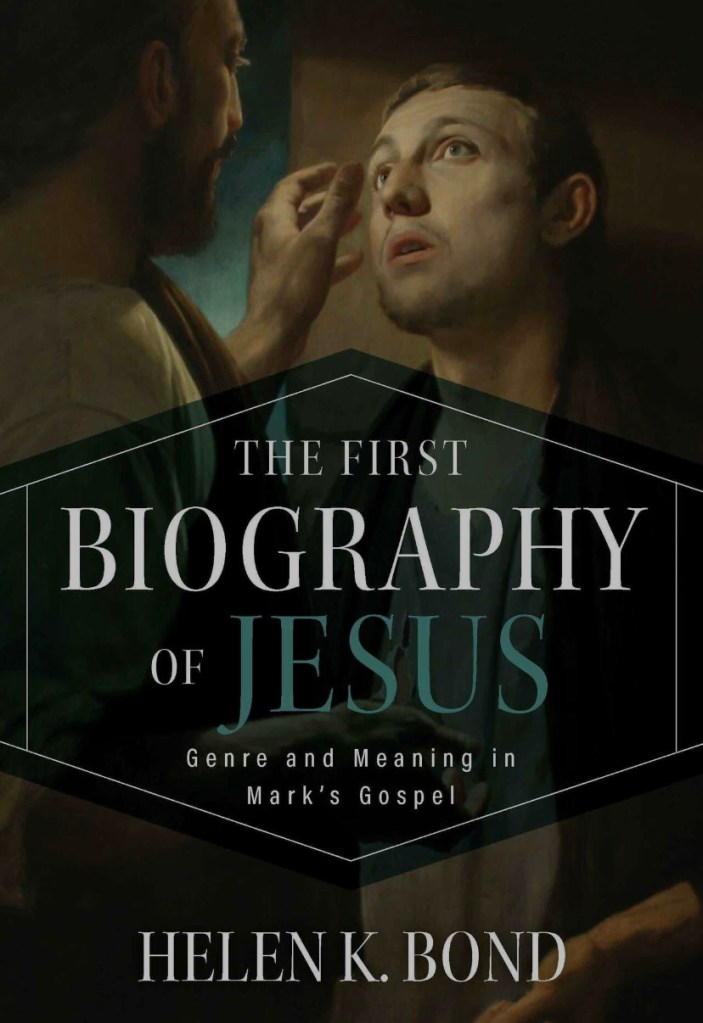
I think Helen K. Bond, in her book The First Biography of Jesus, makes a pretty good case for this. While Mark doesn’t fit perfectly with the biographical genre, it does share enough of its characteristics to possibly shed some light on the meaning behind this strange document.

But whatever Mark’s intention was, as Bond summarizes in her book, the story of Jesus IS, essentially, the Gospel of Mark. So whatever your beliefs are, there is a great deal of historical worth in that.

***

Personal update: my career at the toilet factory might be coming to a close. New management is taking over and, although they can’t fire me, they can make my life difficult which is how they treat veterans whenever they want a clean slate.

I don’t understand why new managers feel the need to do this, but so it goes.

So again, might be extremely busy for the next month while I find a new career. I may be writing A LOT or writing very little. Sucks, but life goes on.

“Rethinking the Dates of the New Testament” by Jonathan Bernier

New Testament scholarship has plenty of quacks. Not only from Christian apologists who argue that everything in the Bible is literal and true, but also from atheists who argue that Paul pulled the entirety of Christianity and Jesus out of his ass. Some argue that there’s no harm in arguing for such outrageous claims (which usually rely on mere conjecture) but that’s simply bad scholarship.

And bad scholarship is just that: bad scholarship. (And honestly, atheists, of which I consider myself, should know better)

Unfortunately there’s just too many holes in New Testament history, and given the nature of its study, it’s understandable that people are going to have some strong opinions. Moreover, new evidence is few and far in between, so scholars sometimes let their imaginations run wild with what scant data there is.

Nevertheless, MOST academics, ranging from the secular to the devoutly fundamental, can agree on a few things: 1st Thessalonians is probably the first Pauline epistle (likely written in 52AD) and the Gospel of Mark is the oldest gospel (likely written just after the destruction of Jerusalem in 70AD). In fact, I’d argue, from the perspective of academia, these dates could almost be deemed ironclad.

Few, if any, from the hardline atheist side (especially the “mythicist” school) would move these dates forward, largely to put as much distance between the (“alleged”) death of Jesus and the first written accounts. In fact, from this perspective, only the most ardent apologist would attempt to do so.

Then there’s Jonathon Bernier’s Rethinking the Dates of the New Testament.

The book was released this year, so I don’t know what it’s academic reception is. But a few armchair scholars are already labeling it a work of apologetics. And that’s a bit too harsh, in my opinion.

Nevertheless, when one pushes the dates of the gospels up by nearly 30 years, it should raise a few eyebrows. Much of this argument hinges on the dates of Luke (and by extension, the Book of Acts), which is largely agreed to be the last synoptic gospel written. I agree with Bernier that the “we” passages in Acts have been a difficult thing for scholars to explain, especially if we want to date Luke/Acts post 90AD. Additionally, Bernier makes a compelling (although not fully convincing) argument that the ending to Acts wouldn’t quite make sense to readers had it been completed sometime after Paul’s death.

Yes, Bernier is a professor at a theology school attached to the University of Toronto (but honestly, those are the only places you can find a job teaching about history of early Christianity and the New Testament). But he certainly doesn’t rely on “apologetics” to make his arguments. You may not find it compelling, but I think the importance of Bernier’s work is to highlight that an earlier dating for the New Testament is not entirely unfounded.

This book may not be a “paradigm shift” in New Testament studies, but the author does ask important questions and the knee jerk reaction shouldn’t be to label it apologetics.

Besides, doubt in god and Christianity shouldn’t hinge on Jesus’s existence or the dating of the New Testament. That’s a weird argument to make. So atheists, particularly ones like myself who can appreciate the New Testament for its historical and (at times) artistic value (as opposed to misusing it by believing it to be some holy document), should be open to reading Jonathon Bernier’s work.

The first coming (part II)

For the record, I feel disgusted for writing this.

Enjoy.

Meeting John was a welcome distraction for Alyssa. She managed to get close to him for a brief, fleeting moment. As she introduced herself, John held her hand firmly yet gently while their eyes locked. “It’s a pleasure to meet you, Alyssa,” he said.

Her heart fluttered.

That night, Alyssa treated herself to a bath. She prayed and thanked God for bringing John into her life. She needed something else to think about other than her parents, who were probably being waterboarded in some cold North Korean dungeon at that very moment. While laying in the warm water, Alyssa let her mind wander.

As she thought about John, she began exploring herself, starting with her bosom on down to her excitable parts below. Though almost 30, Alyssa had only been with one other man…a premarital mistake she hoped would never happen again. She was saving herself; saving herself for a man like John.

She was both relaxed yet enraptured by thoughts of John moving up and down her body with his large, steady hands. As she was nearing climax, Geoff slid in through the bathroom door.

“Don’t mind me,” he said, “I’m just grabbing my toothbrush.”

Startled, Alyssa sat up in the bathtub and covered herself. “Geoff!” she screamed, “do you mind?!”

“What’s the big deal?” he asked. “I’ve definitely seen a naked woman before. No need to sneak a peek of my sister in the bath.”

“Get out!”

“Were you masturbating?” Geoff asked. “You know that the Bible says we shouldn’t spill our seed.”

“I don’t have ‘seed’ you dolt!”

“Well God says we shouldn’t take pleasures in the body. So you better get out of the tub and get to bed. And never mind my erection. It’s a side effect of my blood pressure medication.”

“I’m a grown woman Geoff. You don’t have to tell me what to do.”

Geoff sighed and scratched his forehead. “Look Alyssa,” he said, “before mom and dad went to North Korea, they wanted me to look after you until God provided you with a husband. I’m sorry if I come across as a little protective. I hope you understand.”

“I do understand,” Alyssa said as she wrapped herself in a towel, “but I’m fine. We’re both grown adults. God will release mom and dad soon. I know He will. I know that none of this has been easy for you.”

“Indeed it hasn’t,” Geoff replied, then he extended out his arms. “Hug?”

“No. I’m good.”

***

Alyssa attended Wednesday Bible study in hopes that John would be there. She arrived 30 minutes early to help set up chairs and tables. As she took her seat, Brother Ted laid his hand on her shoulder. “I’m glad you’re here,” he said.

She gave him a faint smile then opened her Bible. As the clock struck 7pm, Brother Ted began the study. “Please turn to Mark chapter 4,” he said.

John was nowhere to be found.

Alyssa’s heart started to sink. Although she was ashamed to admit it, she began to regret coming to the meeting. Then, as Brother Ted was reading through the passage, a handsome figure walked through the door.

“Sorry I’m late,” John said, “a madman hijacked a school bus and threatened to kill everyone on board. So I had to storm the bus and strangle the man with my barehands in front of all of the children.”

“Amen Brother John,” Ted said, “glad you could make it.”

Alyssa breathed a sigh of relief and blushed a little when he gave her a glance. Brother Ted read Mark 4:30-32:

Again he said, “What shall we say the kingdom of God is like, or what parable shall we use to describe it? It is like a mustard seed, which is the smallest of all seeds on earth. Yet when planted, it grows and becomes the largest of all garden plants, with such big branches that the birds can perch in its shade,” Brother Ted read. “What does this passage mean to you?”

The room was silent for a few moments before John raised his hand. “What it means to me,” he began, “is that even though individually we are unimportant, collectively, if we are fruitful and multiply, we are powerful.”

The room nodded in agreement.

“Additionally,” John continued, “this is why it’s essential to preserve your seed. The more we waste, the less we can spread. That’s why I’m saving mine. So that one day I can plant mine into a fertile garden and have many offspring.”

He then looked over to Alyssa, who quickly looked away. But she knew. She knew right then that John was a part of God’s plan for her. As the study dragged on, Alyssa prayed for God to give her the strength to approach him.

When the study concluded, Alyssa started gathering her belongings. Then she heard a voice behind her. “Alyssa, right?” it asked. She turned around and there was John towering over her.

She nervously chuckled. “Yes,” she said.

“I heard about your parents, maybe I could fly to North Korea, take out my Bowie knife, and cut out the hearts of every commie bastard over there,” John joked.

“I’m sure you could,” Alyssa smiled, but the thought of him slaughtering millions made her loins quiver.

“I know that this is a difficult time for you,” John said, “Last night I prayed for God to return your parents home safely. So I’m sure that God will magically drop that $10.8 million into your lap at any moment. Either that, or the United States will nuke that godforsaken country right off the map. God Bless President Donald Trump, the REAL elected President. But until then, to get your mind off things, I want to invite you to a camping trip next week that I’ve organized with the church. Brother Ted will be there. And you can invite Geoff.”

“That sounds wonderful,” Alyssa replied.

A warm smile came over John’s face. “I guess I’ll see you then,” he said. She returned the smile.

Alyssa slowly walked out to her vehicle. When she climbed in, she turned up the radio and screamed for joy.

TO BE CONTINUED…


‭‭

‘The Secret Gospel of Mark’: The Art of BS

I’m old and my mind is going. Too much drugs, too much useless information clouds my brain. Which is why a lot of common knowledge straight up misses me.

As you are aware, I’m a nerd for New Testament/Early Christian history. Am I a Christian or a religious person? Not really, but I don’t understand the question enough to give a definitive answer (remember, my mind is going). I simply obsess over 1st Century Christianity because, as Bart Ehrman asserts, it might just be the most important era in Western History (I disagree. I think it’s the second most).

Unfortunately, there’s just not enough concrete information to definitely say what happened during Jesus’s real life ministry. Of course, speculating is part of the fun, but it’s also a curse. Because there’s so many gaps in the timeline, this invites a multitude of con artists and conspiracy mongers to perpetuate fabricated stories.

Which brings me to the “Secret Gospel of Mark”.

The actual Gospel of Mark, the one we have in the New Testament, is quietly the most important text in Western thought. I say this because the Gospels are certainly more widely read than something like Plato’s Republic, and Mark is the Gospel that Matthew and Luke based much of their texts on (the other source they both used, the hypothetical Q source, I would argue the author of Mark was familiar with as there are too many similarities…which would make Q the most important text. But Q remains hypothetical). Mark is therefore the oldest surviving account of Jesus’s life (the oldest surviving Christian writings, however, are the seven verified Epistles of Paul, with 1st Thessalonians being the oldest).

Now, there are A LOT of questions for Mark. Too many to recount here. It is the barest of the four canonical Gospels with plenty of peculiarities.

But what if someone credentialed allegedly came across evidence to fill in these gaps?

Enter Morton Smith, a Ph.D from Hebrew University and Th.D from Harvard Divinity, and professor of ancient history at Columbia University. Pretty impressive right?

I was made aware of this story when reading Ehrman’s Lost Christianities. I’ve never heard it before and I was shocked at my ignorance. Now Ehrman is probably the leading academic in the field of Early Christianity, and even he doesn’t quite know what to make of this story.

Briefly, Smith claimed to have found a lost letter from Clement of Alexandria, an early Christian theologian, which describes a variant of the Gospel of Mark and even provides a couple of passages. And boy oh boy! What passages they were!

The problem is that, allegedly, this lost letter was transcribed in the 18th Century, and Smith couldn’t provide the copy because it was property of a monastery in Jerusalem. He DID, however, provide photographs of the letter and scholars have determined that these writings were indeed in the style of Clement and Mark (and the handwriting was also of 18th Century style).

Additionally, Ehrman recalls a story of hearing another academic claiming to have seen the letter himself, despite the library still refusing to permit research into it. So, it’s safe to say that this letter genuinely existed.

Whether or not it was written in the 18th Century is a different story.

You see, because if there was one person on this planet that could have forged that document…well enough to fool many academics…Morton Smith was that man. And, apparently, he had a motive to do so (see Ehrman’s Lost Christianities).

For the record, I think the letter is a total, unambiguous forgery. Too good to be true+motive+means=bullshit. But I gotta tip my hat to Smith.

Every bullshit artist knows that eventually they’ll get caught in the lie. But the trick is to leave a shred of doubt. And Morton Smith either made the discovery of the millennium, or the greatest forgery of all time.

jesus the cynic?

It’s interesting to view Jesus scholarship over the last 50 years. Most of it seems to reflect more on the political climate of the era it was written rather than on the actual historical Jesus, i.e. by turning Jesus into “Jesus the Revolutionary”, “Jesus the Mystic”, “Jesus the Philosopher”,etc.

It’s an easy mistake to make. Arguably I make it when I refer to Jesus as a “populist” figure of the time (I don’t mean that as a compliment. I mean that in its most literal sense: Jesus was addressing working class problems in a religious/political context.) It’s very difficult to separate our biases from the subject being analyzed, especially one as controversial as the historicity of Jesus.

I think there’s a (growing) minority consensus that Jesus took some influence from the Cynics. Some quack scholars might even say he was an outright Cynic.

I think this is an interesting question. In my view, the majority of mainstream scholars, both Christian and secular, wish to paint Jesus as a figure that almost emerged from a vacuum. It makes sense actually. All of the earliest, independently attested documents (The hypothetical Q…which survives almost in its entirety between the Gospels of Matthew and Luke…the epistles of Paul, Gospel of Mark, and Josephus) make no mention of Jesus’s origins (Q and Mark both start with the Baptism of Jesus by John the Baptist). So an attempt to say anything about Jesus’s influences, other than that of John the Baptist, would be pure conjecture. But there are some interesting parallels between Jesus and the Cynics: Mark 6:8, the location of Nazareth and its proximity to an apparent hotbed of Cynicism, Jesus’s confrontational style and eschewing of fame and fortune, embracing of poverty, etc. etc.

But read the Cynic texts. To the Cynics, Diogenes was their “Christ figure”. They all tried to emulate him. And to be honest, he was a disgusting asshole. While Diogenes definitely had his influence, I doubt he would have accumulated very many personal followers. I mean, many might have tried to ACT like him, but there’s no way anyone could have spent more than 10 minutes around him. Jesus, meanwhile, was probably trying to do something entirely different and would have certainly disapproved of things like…I dunno…MASTURBATING and SHITTING in public.

In my humble view, the Cynic modus operandi was likely something that was in the air at the time which some itinerant and apocalyptic preachers might have adopted. But just because that aesthetic was in vogue at the moment doesn’t mean that they were practicing Cynics.

While it’s fun to speculate, the simplest explanation is probably the correct one: Jesus was an apocalyptic Jewish preacher preaching to a mostly Jewish audience.