
“How much did it cost to ship that box?” my wife asked.
“I dunno, $10.99?”
“Then they fucked you.”
“In the ass or in the mouth?”
“How much did it cost to ship that box?” my wife asked.
“I dunno, $10.99?”
“Then they fucked you.”
“In the ass or in the mouth?”

Nothing to talk about today.
So I was thinking about a conversation I had with my narcissist coworker. For the sake of this post, I’ll call him Dennis. It’s probably in my top 10 favorite conversations I’ve ever had.
The topic: some woman, Jane, who was allegedly a hoe-bag that once worked with Dennis (and always claimed he never messed around with).
The place: the toilet factory where we work. We use a lot of PPE, especially rubber gloves.
Of course, most of the conversation is paraphrased. But the parts said verbatim are in bold.
****
Dennis: I never fucked Jane.
Me: Did she suck your pp?
Dennis: No, but she sucked Tex’s pp, and Bob Dutch’s pp.
Me: But I thought you two worked on the same shift.
Dennis: yeah and one night I came in and she was sleeping naked on a cot we had back there. I turned the lights on and quickly turned them off. She said (mimicking a female voice) “oh sweetie don’t be embarrassed.” Then she asked me if I wanted to lay down with her and but I told her hell no.
Me: So you didn’t even fool around?
Dennis: she kept asking me if I wanted a blowjob, but because she sucked every guy off, I kept telling her no. Then she started badgering me, telling me that I wouldn’t know how to please her anyway. So finally I told her “alright, let me put some gloves on” and I went back to her cot.
Me: (laughing uncontrollably)
***
So Dennis started the convo initially denying he had sex with Jane, then a few moments later admitted to finger blasting her.
Moral of the story: Dennis’ story is probably completely fabricated, Jane probably wasn’t a hoe. Because I was such a good audience for Dennis, he probably thought he could take the story in any direction he wanted, despite the blatant contradictions, and he thought I would believe all of it.
That’s what a conversation with a narcissist looks like.
That’s it. That’s the story. Bye ✋

The career of William Friedkin is a reminder of how hard it is to make a good film.
He hit two films out of the fuckin park with The French Connection and The Exorcist then kinda floundered from there (he did have a few notable films afterwards, namely Sorcerer and To Live and Die in LA, the latter of which I haven’t seen).
Sure Friedkin won his accolades here and there, but he is truly the maestro of one specific thing: directing car chases.
Everyone remembers Gene Hackman just plowing through cars and walls while Friedkin neglected to obtain permits to film such a thing in the French Connection (and apparently there’s a good chase sequence in To Live and Die in LA), but Friedkin’s crowning achievement, in my view, is in Jade.
Before David Caruso was spitting out one liners while rocking a pair of sunglasses in CSI: Miami, he tried his hand at being a film star. Jade was the absolute highlight of this period.
In the film, after Angie Everhart gets totally destroyed by a Ford Thunderbird, Caruso pursuits the vehicle in his POS Ford during a delightful chase where vehicles fly through the air down the streets of San Francisco (and Caruso does his best Gene Hackman impersonation).
The best part is when the chase goes through some parade and pedestrians attack the vehicles using martial arts. I guess that would make sense if you learn about other cultures while binging on cocaine.
Take a look:
If you could bring one person back from the dead, who would it be?
For me? Easy:

Yeah yeah, he did a bunch of bad things. But that neck beard is unforgivable.

Show me somebody that has said that (the title of this post) and I’ll show you a liar.
Everyone cares about others think about them. If you don’t, then you’re a legit sociopath.
In fact, concern for what other people think is the cornerstone of civilization. We wear the clothes we wear because of this. Observe and obey laws. We have fucking language because of this!
But people say these things because they want to shield off their empathy, and by wearing the “i dont care what people think” badge, they believe they’re fooling you. Yet clearly they do care, because they tell you all the time. Obviously they want you to think something about them.
Unfortunately the human psyche just can’t shut off its concern for others, and the ego can’t lock out its concern for what others think of it. Our whole sense of self is based upon our relations to others.
Of course I’m not saying that we should be paralyzed by fear over other’s opinions. Perhaps a more accurate statement would be “I am who I am”, and coming to terms with the fact that it’s impossible to please everybody.
I think that’s a more honest assessment.
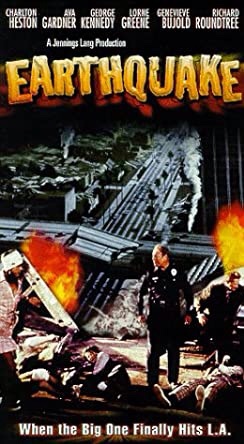
Los Angeles in the 1970s was a magical time. Actors quit caring about their physique. Producers were blasting cocaine into their brains. George Kennedy was a star. It’s a time that’s never been topped and it never will be.
Out of this era came Earthquake (1974) starring Charlton Heston and a bunch of actors in need of a paycheck (and co-written by Mario Puzo).
As disaster films go, there’s a long buildup to the “disaster”: Heston is bangin Genevieve Bujold, George Kennedy is an absolute asshole, Walter Matthau is a pimp drunk, and so on. It’s all standard stuff. Then comes the 4 hour earthquake where cardboard houses crumble and the people of LA forget how to handle such an event as they fall several stories out of high rises to their violent deaths. It’s delightful.
My only complaint about this sequence is that they didn’t do enough with Richard Roundtree’s part as a daredevil. It would have been pimp if he CRUSHED that obstacle course on his motorbike while buildings crumbled and people died all around him. Oh well.
Honestly, there’s a few good matte paintings here and there. But the standout is Marjoe Gortner’s performance as the sexually confused grocer/wannabe karate instructor/National Guardsman. It’s a performance that was ahead of its time.
The ending is good too: the city is in ruins and none of the personal drama gets resolved (of course, I was barely paying attention at this point).
I think this film provides a good insight into an era where Hollywood quit giving a shit, just as long as everyone made a fuck ton of money.

Obviously I’m going through a Bart D Ehrman phase. It’s not because I agree with him most of the time or that I find him a master debater (sorry, had to say it). It’s because he’s the only public intellectual that I can think of at the top of my head that has a genuine passion for teaching.
Because Ehrman’s area of expertise is the Bible, specifically the New Testament and early Christianity, people naturally have strong opinions about the subject. Some people, specifically atheists but a few Christians aren’t exempt, like to use this subject as a way to “trigger” their opponents.
This is a fad on YouTube. The “Intellectual Dark Web” (IDW), or guys that found fame on the internet during the “alt-Right” hay day (people like Sam Harris, Jordan Peterson, Ben Shapiro, etc.) perfected the science of “triggering” (also known as “owning the libs”) and many online personalities have attempted to emulate it, including leftists with varying degrees of success. It’s a way of weaponizing information.
This phenomenon is not exclusive to discussions on the Bible, religion, and politics, but even movies and fucking geography!
Because “owning the line” is currency on YouTube, this has led to many quaks pretending to be experts littering the platform and distracting us away from those trying to present information in good faith.
Just because an opinion triggers someone, that doesn’t give it more credence. But that appears to be sound logic in some circles. Even if the opinion is true, if presented in a way that’s designed to give offense, that doesn’t make the one with the opinion more noble or virtuous…it makes you an asshole.
Thankfully my man Ehrman avoids that.

The YouTube algorithm sucks sometimes. When you search certain people, you can’t rid their videos from your recommendations.
Bart D Ehrman, the distinguished James Gray professor of religious studies at the University of North Carolina at Chapel Hill, is one such person. Not that I hate Ehrman, quite the contrary. The man knows the Bible better than anyone. But I don’t find the subject of “God’s existence” to be particularly interesting.
Nevertheless, I watched him debate this with a professional snake oil salesman named Kyle Butt. The subject they were specifically debating was “God and suffering”. Ehrman’s fans swear up and down that he won the debate, but no one “wins” a debate. Everyone loses (and, sorry to say Christians, but agnostics/atheists have the much easier argument).
But I’m always intrigued by how the “problem of morality” gets tossed around like a hot potato in a debate. Maybe I’ve spent too much time of Twitter and Reddit forums, but it feels that in our political climate that all sides wish to enter into a “post moral” phase where one can gain points by accusing their opponent of “moralizing”. However, I have never once found this to be convincing.
Mostly because it makes no fucking sense. Even if we move past “good and evil”, new social mores become established which sets up a whole other paradigm of morality.
When viewed in this political climate, the Ehrman/Butt debate seems outdated (it took place in 2014). Butt believed that there are objective platonic forms of morality established by God of the Bible, while Ehrman simply took a sublime, “know right/wrong when I see it” approach. Naturally, I agreed with Ehrman (even though I didn’t find it philosophically consistent).
But I think what Ehrman was trying (or should have) focused on was the power of empathy in understanding the conditions of our fellow humans. From my understanding, empathy is a real scientifically falsifiable phenomenon that everyone (except psychopaths) feels. HOWEVER, the power of ideology does everything it can to undermine this.
Ideology can take many forms, from personal, to political, to religious.
In my view, individualist ideology, propagated by consumer culture, is the most prevalent. In fact, it even lays the foundation for current political/religious ideologies. When viewed in this light, it makes sense why online atheists and the Christian Right are suddenly bedfellows: Christians can rest easy knowing that God is invested in their individual lives, and the fate and suffering of everyone else is in His hands. And atheists become unburdened in believing that there’s a moralistic force binding the universe together, and can instead focus on their own truths.
Either way, they don’t have to show concern over the suffering of their fellow humans.
I guess that’s another reason why everyone wants to jump on the “post moral” train.

xXx is a film that came out 10 years too late. Bruce Willis would have fucking CRUSHED the role of Xander Cage.
Think about it: what if it xXx was directed by Renny Harlin or John McTiernan. Now those guys understand what action schlock is all about.
I don’t know why xXx sucks so much. Is it the script? The direction? Is it it’s leading actor?
Vin Diesel is proof that just because you look the part, doesn’t mean that you can play the part. Honestly, he is quietly one of the worst action stars I’ve ever seen. And it’s difficult to pinpoint why that is.
Is it because he’s not traditionally “good looking”? There are plenty of action stars that aren’t considered “good looking.”
Is it because he can’t act? To be a Hollywood leading man, having the ability to “act” is surprisingly low on the must-have list.
Is it because he doesn’t have a sense of humor? I think there’s something to this. I mean, Vin Diesel does have a sense of humor, but the joke is always on someone else and never on the absurdity of his character or the situation he’s in.
Being the butt of a joke is for other characters. Not for him.
Some action stars can get away with this. Steven Seagal for example. But the thing is that Seagal lacks the awareness to understand that he is the joke. Diesel is too smart for that.
So in xXx, Diesel comes across as a fucking asshole that I’m constantly rooting against.
Fuck this movie

I don’t always agree with Bart Ehrman.
He’s an excellent biblical scholar, but a little too conservative for my tastes as a historian. This occurred to me while I was watching him get ambushed by both Christians and atheists during a Zoom call.
If I’m correct in my understanding…and remember I’m a dumbass…then Ehrman’s argument regarding our access to the original intentions of the New Testament texts are completely lost. We cannot know what “Mark”, for example, originally wrote. Not only would this be true for all biblical texts, but virtually ALL ancient texts as well.
In my view, this is an extreme form of skepticism which throws our understanding of history out the window. The entire historical record would be in jeopardy, a point which Ehrman himself seemingly concedes (unless, of course, the record can be confirmed by other sources i.e. archeological, DNA, etc.)
I guess this sounds extreme-having to take the accuracy of ancient historical accounts basically on faith (especially when they sound plausible, but lack supporting evidence)-but what other option do we have until the facts prove otherwise?
I suppose this line of reasoning is how Ehrman can reconcile his certainty that Jesus existed with his extreme skepticism of the historical accuracy of the Gospels.
 The Internet Ruined Everything