Dissecting the Scene: Emotional Climax Moments From Star Trek Films (Part II)

Star Trek V: The Final Frontier- Release the Pain

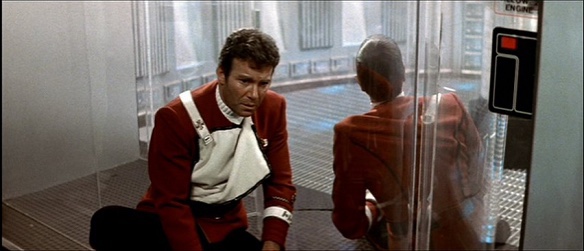
Sybok, played brilliantly by Lawrence Luckinbill (in a role originally intended for Sean Connery) is Spock’s half-brother turned religious charlatan. He amassed a following by tapping into the emotions of a down-trodden people who later helped him gain control of the Enterprise. In this scene, Sybok uses his emotional trickery to tear apart the the Original Series triumvirate…Kirk, Spock, and McCoy…and nearly succeeds: McCoy is forced to relive the pain of euthanizing his father, and Spock is reminded of his half-humanness that caused him to be a pariah in Vulcan society and feel less loved by his father.

Kirk, meanwhile, sees through this bullshit and reject’s Sybok’s offer to be “released from his pain.”

Regardless of how you feel about Kirk’s rationale for clinging on to his pain (to me, Sybok and Kirk seem to have the same philosophy of “deriving strength through pain,” it’s just that Kirk kept his eye on the ball…regaining control of the Enterprise…while everyone else succumbed to Sybok’s charisma) this is actually a very well directed and well written scene. And it just so happens to be in the worst Star Trek movie there is (personally, I think Insurrection, Nemesis, Into Darkness, and Beyond and WAY worse, but whatevs).

This is why I think director William Shatner isn’t to blame for STV. When it comes to the character interactions, this might be the best that Star Trek has to offer. By the time this film was made, the actors had been playing these characters for over 20 years and it certainly shines through in this scene.

Shatner made the right decision to not create an elaborate set design. It’s like an intimate theatrical production and it’s one of the highlights of the franchise.

Star Trek: First Contact- “The Line Must Be Drawn HERE”

The Enterprise follows the Borg back in time to the late 21st Century and it’s up to the TNG crew to save history. Meanwhile, the Borg take over the Enterprise and Picard goes on a warpath.

Now this might be the most famous example of an “emotional climax” moment in Star Trek, but it’s got some problems. While Alfre Woodard delivers an Oscar-worthy performance, as any Star Trek fan could tell you, it should have been Beverly Crusher who confronted Picard. Additionally, Picard is out of character. While Patrick Stewart is an incredible actor, in my opinion, he never quite understood Star Trek OR the appeal of his famous character. And it was Stewart’s push to make Picard more vengeful and heroic in this installment. While that doesn’t make a lick of difference to the average viewer, things like that DO matter to Trek fans, which is why First Contact has fallen out of favor with some.

That being said, everything is well executed. This is also director Jonathan Frakes’ (who plays William Riker) first motion picture and it doesn’t show. Star Trek seems to excel when one of the actors is allowed to direct.

Oddly enough, science fiction is somewhat secondary to Star Trek. First and foremost, the franchise is about HUMAN stories that uses science fiction as a backdrop. That’s why Trek is such fertile ground for actors. And I think the sequence above highlights that point.

While the stuff between Woodard and Stewart is incredible, I also like the mini-arc between Worf and Picard. The Captain’s judgment had clearly been clouded and Worf was absolutely correct in confronting him. Picard was in the wrong, plain and simple. Which is why I love the payoff when Captain Picard makes his apology and states his admiration for his longtime security officer.

It’s a small moment, but for longtime fans, it was an impactful one.
Dissecting A Scene: Emotional Climax Moments in Star Trek Films (Part I)

So over the Thanksgiving weekend, I made my family watch arguably the worst Star Trek film, Star Trek V: The Final Frontier. When the Sybok interrogation scene of Kirk, Spock, and McCoy came up, it occurred to me: “Star Trek is REALLY good at doing this.”

Doing what exactly?

They’re good at creating emotional climax scenes where character arcs come full circle. Trek films may not be the flashiest of the science fiction genre, but that’s not really their intention. Star Trek is at its best when it’s theatrical, or allowing the actors to fully explore their characters. Two of the franchise’s most notable faces, William Shatner and Patrick Stewart, are quite effective stage actors and that’s where Star Trek is at its strongest: being character driven.

So you have to let the actors ACT.

Star Trek II: The Wrath of Khan: Mutara Battle/Death of Spock

This is probably one of the most famous and most parodied death scene in all of film. But this sequence is quite remarkable on multiple levels.

It’s a shame that William Shatner didn’t get any accolades for his performance in Star Trek II. His portrayal of Captain/Admiral Kirk is often viewed as hammy, but in truth, Shatner was quite nuanced in his approach. Director Nicholas Meyer figured out that his leading man was far more effective when doing more takes, which caused the actor to slowly dial back his performance. In short, Meyer wore out Shatner, which perfectly suited a beat down and aging Kirk at the beginning of the film. Obviously, Meyer let Shatner return to form at the end which had a huge emotional payoff.

Not only does the villain Khan get his comeuppance by succumbing to his own wrath but…in pursuit of vengeance…he ends up becoming a force for creation. Spock, of course, delivers the ultimate sacrifice, but Kirk finally faces the very thing he’s cheated his way out of throughout his illustrious career: a no-win scenario.

Thus, everything comes full circle.

Of course, it also helps that there’s exceptional editing and the score that made James Horner a sought after composer is playing in the background.

Star Trek III: The Search for Spock: Stealing the Enterprise

James Horner is typically given credit for the success of this scene. But you have to tip your hat to the editing and, again, the performances.

While we can criticize Shatner’s acting choices all we want, he always makes it perfectly clear what his characters are feeling. And James B Sikking’s arrogant-ass performance almost makes you forget how shitty the Excelsior bridge set is.

It’s a shame that Leonard Nimoy didn’t direct more movies. While he directed some television before, it’s hard to believe that this was his first motion picture because he REALLY elevated this scene. If you pay attention, not much happens here: the Enterprise slowly backs up to the space doors before they magically open and then the Excelsior begins its failed pursuit. But it’s fucking intense! The hairs on my neck always stand when the Enterprise clears space doors and Kirk orders warp speed. That’s a testament to Nimoy’s superb direction of an otherwise ‘meh’ script.

While this isn’t the “emotional climax” to the film, it is an emotional highlight for the Original Series crew; they’re sacrificing EVERYTHING to save Spock. Now Star Trek III isn’t the best Trek film, but the “stealing the Enterprise” scene is one of the best in the franchise.

skinned alive & the reflecting skin

I’m a completionist. I hate to give up on a film because it’s so shitty but that’s what happened while watching Abel Ferrara’s The Driller Killer. So take it from me, that film is only good for two things: reminding you 1.) that it must’ve sucked to have lived in NYC during the late 70s and 2.) first wave punk was GODAWFUL.

Thankfully, Tubi saved the day with two BANGERS, both with ‘skin’ in the title and both released in 1990.

Skinned Alive (1990)

I low-key loved this movie. So much so that I might add it to my Tubi Hall of Fame. It possesses many of the qualities I look for in a film, chiefly having a short runtime.

I almost certainly wasn’t the only one taken with the film. One of the many grotesque deaths bears a strong resemblance to Hitler’s death in Inglourious Basterds because Quentin Tarantino is a senseless hack (so am I, btw).

There’s also a striptease scene that made me absolutely sick to my stomach 👍

But what I find most charming about this movie is how it absolutely shits on the state of Ohio. Now I might’ve spent a grand total of 20 minutes in that state, but goddamnit, there’s something funny about that place.

What’s Skinned Alive about? Some insane family stops in a small town and raises hell. In case you couldn’t guess, this family skins people alive. Only a drunken, pathetic, ex-cop stands in their way.

The Reflecting Skin (1990)

I’m not sure that I would call this a ‘horror’ film, but I can see why many do. If you take the time to think about it, the story is absolutely terrifying and depressing.

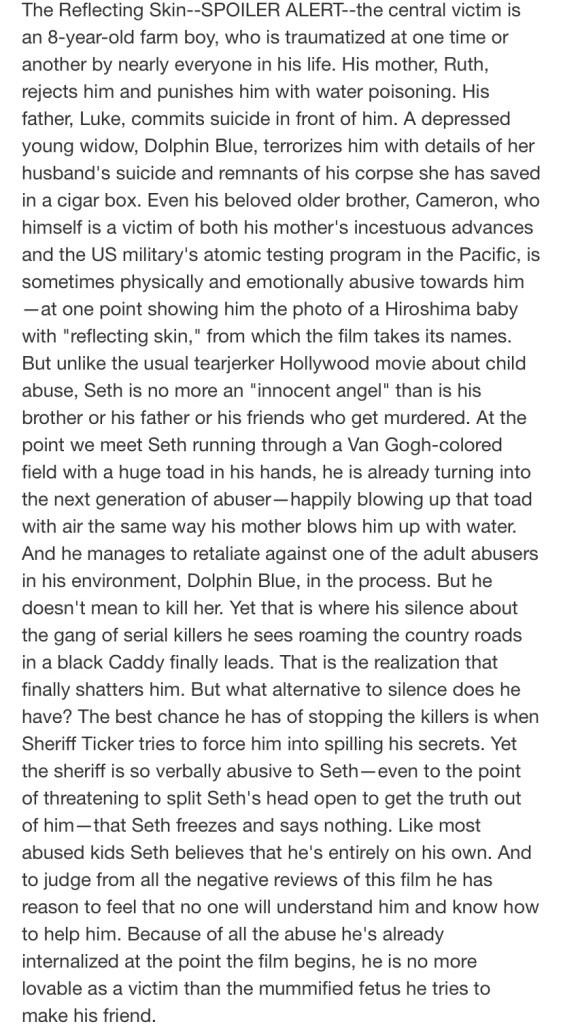
An 8-year-old boy growing up somewhere in the midwest post-WWII gets verbally, emotionally, and physically abused while the bigoted police department investigate the deaths of local children. Meanwhile, the boy’s older brother, who’s probably dying from radiation poisoning, (and played by Viggo Mortensen), engages in a relationship with a woman that the boy believes to be a witch.

There’s no gore, few frightening images (worst of which is Viggo Mortensen’s ass cheeks), and no supernatural elements to speak of. So this might not satisfy all tastes. But it does have one thing going for it: NOTHING gets resolved and the movie ends with the boy screaming into the sunset.

I wasn’t quite sure what to make of The Reflecting Skin. I had to turn to IMDB to find answers, and that’s when I found this review, written by an abuse psychologist who found this to be the “most accurate depiction of abuse” he/she/them has ever seen:

I’ve always wondered how well horror and drama would mix. The only well-known example of this would be The Exorcist. But much like We Are The Flesh, answers don’t come easy and what you find might be depressing AF.

*****

But you know what’s NOT depressing?

5% off your next purchase at Dead Star Press when you use my promo code ‘BM5’.

In fact, throw all your anti-depressants in the trash because no drug can compete with the high you will feel when you read a book from Joseph D. Newcomer and the many talented writers from Dead Star Press.

Plus, they got dope-ass merch

So get your head out of the gas stove and head on over to Dead Star Press and save 5% on your next purchase when you use the promo code ‘BM5’!

Dead Star Press: Be a Fucking Weirdo 👍

enema at the gates (and why I go to bat for Dances With Wolves)

Most nights I can’t sleep. Most nights I can’t sleep because I can’t stop thinking about a film. Usually, it’s not a great film that’s keeping me up. It’s a film that could have been great, but everyone fucked up.

One such movie is Enemy at the Gates (2001).

It’s a shame. This movie could have been dope. So what happened?

Now forgive me, it’s been a few weeks since I’ve watched it so I won’t go into plot details. But the screenwriters shouldn’t have committed to telling a love story AND a game of cat and mouse.

Individually these stories could have been interesting on their own. The Battle of Stalingrad was such a test of the human spirit that it provides an interesting backdrop to any story.

But Enemy at the Gates falls victim to a very serious problem…a problem that plagued so, so many movies of the era: it tries to have it both ways. It wants to be a gritty war film AND appeal to 90s sentimentality.

“But it’s based on a real historical account,” you might say.

And lo and behold, this is largely true. Of course, it takes a few creative liberties. I doubt Joseph Fiennes’ character was real. Same with Ron Perlman’s…a character that I hated so much because it seems to have been included for expositional purposes only. Because the film takes such liberties…it is a movie after all, and not a documentary…then pick a lane.

If I were making this movie, I would have focused exclusively on the chase between Ed Harris and Jude Law. But there’s no sense in crying over spilled milk.

Enemy at the Gates appears to have been one of the last of the so-called “90s, mediocre, sentimental historical dramas.” I don’t hate all of these movies. In fact, I go to bat for perhaps the greatest example of this genre: Dances With Wolves.

“Can you believe that Kevin Costner beat Martin Scorsese at the Oscars?” everyone says to me.

No. That’s not surprising at all. Have you seen the movie? I will pound the table every chance I get: Kevin Costner DESERVED his Oscar.

Quote me on that.

Honestly, as much as it pains me to say this, if there’s a flaw with the movie, it’s the screenplay. That’s a big one. This might not have been obvious to audiences then, but it’s clear 32 years later. BUT, it appears to me that Costner was involved in the project from the moment of its inception, so the script was suited to his strengths.

Could anyone else have made Dances With Wolves?

No.

And here’s where Costner excels: every character…EVERY last character…has their moment, however brief, to shine. When Stone Calf is killed, you feel it. Even when LT. Elgin is killed, one of the “villains”, there’s a shred of sympathy for him. This helps you become immersed in this lovely, bloody world.

Costner approaches the subject matter, much like his character, in a child-like, gentle manner. Not a detail is missed. It felt genuine, and not at all like it was trying “to have it both ways”.

It worked. It worked so well that nobody was able to emulate that style. They tried. But where every mediocre 90s historical drama failed, only Kevin Costner succeeded.

(Yes, I’m including Braveheart)

(Not sure about Saving Private Ryan)

the joker sucks II: suck with a vengeance

Furthermore, I’m not some postmodern lunatic claiming that real truth doesn’t exist and therefore it’s pointless to speculate on the nature of it.

What I AM saying is that Immanuel Kant was RIGHT. And philosophers from his day onward have been pissed off because of it.

Kant claimed we can’t know things “in themselves”. Meaning we can’t perceive objects and nature in their true form. We can only perceive “phenomena”, or nature though the prism of the human mind. In other words, the human mind is VERY active in shaping our reality.

No one likes this.

And they don’t like it because they know it’s true.

To perceive objects and nature without the human mind would mean to transcend the human mind. OR, ceasing to become human altogether.

As it currently stands, that’s impossible and we run into many metaphysical holes when we try to speculate on that.

Now, that isn’t to say we are “cut off” from external reality. But we are hobbled by our own physical brains. The universe is seemingly infinite, but our brains are finite.

We are like a small hole in the bottom of a beach, where only one grain of sand can pass through at any one moment.

Lame example, I know. But that’s how it feels.

But my larger point is how the Internet affects all of this. Is our logical faculties, rooted in a material brain, designed to handle this shock load?

In our evolutionary development, we developed our facilities to handle immediate needs. Tools and complex communication emerged from this, leading to advanced society and advanced technologies that have seemingly advanced passed our understanding.

I often like to think that art is an unintended byproduct of this development. Literature, drama, paintings, etc. got spat out and reabsorbed back into the machinery. It became an integral part of our language.

Along came the internet and telecommunications where we are bombarded by intellectual work. Now we can’t help but see the archetypal dramatic progression written in the fabric of the universe.

In other words, the internet permits us to live in our own fantasy world….a fantasy that objectively doesn’t exist….it’s a prism on top of a prism.

Are we made to sit behind a computer?

And is it worth tearing the world down because of Jon Gruden’s emails?

These are the questions worth asking.

Ok, BYE ✋