
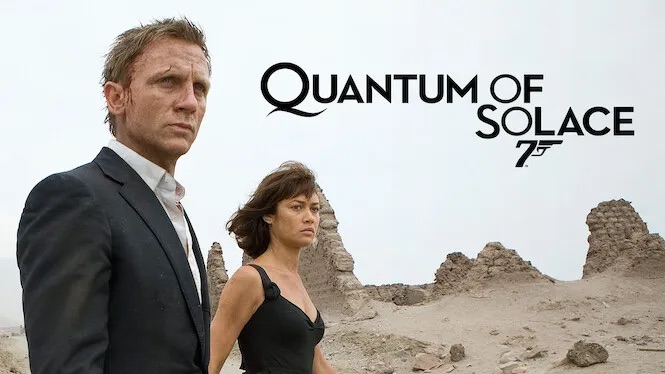
I don’t think there was a soul on this planet that wasn’t disappointed with Quantum of Solace upon its release, especially after the Bond franchise was riding high with Casino Royale two years earlier. But I have since changed my view. While I’d never argue that it’s the best Bond film, I will certainly argue that it might be the most interesting one.
But we should get this out of the way: the editing is atrocious. While the action makes more sense on second or third viewing , it presents itself as a mess on the first. Which is a shame because Quantum of Solace is a very fine looking film. It’s up there with one of the best in the franchise. While I think the filmmakers were going for a more rugged and frantic style that I think was in vogue at the time, they did themselves a disservice. Even by 2008, that look had overstayed its welcome. My biggest complaint with the movie is that they didn’t let shots linger and worse yet I hated some of the clunky transitions. Some have often wondered if there is missing material that, to my knowledge at least, has not been shown to the public. If that’s the case, then Marc Forster deserves to have his director’s cut.
But most of the complaints from the time were with the script and the rather low stakes that Bond finds himself in compared to other films. It’s not about world domination this time. The villain just wants control of Bolivia’s water supply. That’s pretty unsexy all things considered. But in retrospect, it’s the script (that I think was “hampered” due to a writer’s strike) that I quite like. Bond doesn’t go to his usual uppity Mediterranean stomping grounds. This time he’s in often overlooked locations like Port Au Prince and the aforementioned Bolivia. And I think that these unusual places (for Bond) works in the movie’s favor. This isn’t the usual travel log that we’re used to seeing. One thing that was never explored in these movies is the often cynical and political nature of clandestine operations. We’re only shown the sexy side. So I think Marc Forster did an excellent job at contrasting the luxurious high life of James Bond with the poverty stricken lives of real, discarded nations that we typically want to ignore.
But this leads me to a problem: should James Bond be political? While I don’t have an issue with the film itself being political, I could argue that it would be somewhat out of character for James Bond to be cognizant of these issues. As I’ve always said, James Bond is a dangerous man who’s found a profession that works for him. There shouldn’t be a political bone in his body. Obviously they wanted to expand the character under Daniel Craig, which I think was a rousing success. But some of the issues brought up in the script sounded like they were from Craig personally (I believe during the writer’s strike he had some input into the screenplay) and not something organically from Bond. But I digress. I can see both sides of the issue.
But what I liked best about Quantum is how many of the trends in Bond pictures are bucked. Despite killing numerous people, Bond doesn’t directly kill the bad guy OR the object of his revenge. Additionally, he doesn’t sleep with the leading lady (a very underrated Bond girl in my opinion) and the one woman he does sleep with, he later gets yelled at by M for taking advantage of her. There are many times where this outright doesn’t feel like a 007 picture and it works for me.
I think the best way to view Quantum of Solace is to see it as an extension of Casino Royale. In fact, watch it immediately after Casino Royale. While I praise Marc Forster, I think it was a shame that Martin Campbell didn’t return for Quantum. I think that would have added a degree of stylistic continuity that viewers missed in 2008. But as it is, I think Quantum of Solace deserves a rewatch.

 The Internet Ruined Everything