I tried to do one of those challenges where people write a book in a month. It didn’t work.
It’s a good story too: about some dumbass that works at a toilet factory whose boss gets kidnapped. All of this causes uproar in this small town. As the situation grows more absurd and contrived, our dumbass has to rescue his boss. I was exploring my contempt for politics and storytelling in general.
While I think about it, contempt is actually the driving force behind all of my writing. Whenever I begin to write, I have to hold back my urge to say “im gay suck my penis lolz.”
If I did ever write a finished work, it would go something like this:
“Chapter 1: Fuck you
Chapter 2: my dick is small
Chapter 3: my balls are too
Chapter 4: I’ve definitely had sex before
The eND“
Now if I read that, I’d think “that’s a damn good book.” But it would have an audience of exactly one person. Most people expect a novel to be “good”, and “have a story”, or whatever.
My style just doesn’t transfer into long form, immersive storytelling.
Nor into short form really. My way into writing a story consists of how many times I can say “penis”, “gay sex”, “cum”, and have people actually read it. That’s why “A Shot at the Title” is my finest short story. Honestly it’s a banger. Someone should probably give me an award for it. But most times, when the author doesn’t give a shit and hates their audience, the work’s just not gonna be good. Ya know?
That’s why I’ll probably never go back to writing on Medium or any other platform for that matter. I don’t think the shit I want to do would transfer over there. I have complete creative control over here. If I want to post a video of me spreading my ass and saying “this is what I think of Denmark”, no one can tell me no.
I watched two movies back-to-back (unintentionally) that had helicopter chases.
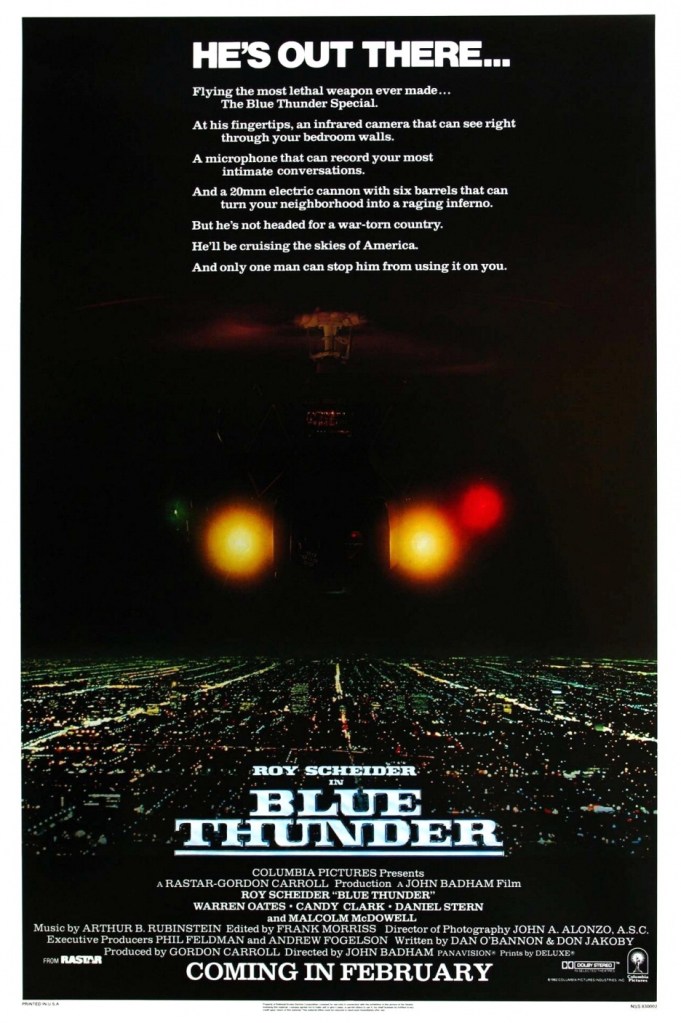
The first was Blue Thunder, staring the greatest leading man of all time…Roy Scheider. It is also the greatest movie that Paul Verhoeven never made.
No disrespect to the highly competent John Badham, but Verhoeven would have crushed the shit out of this material. The film takes place in 1980s LA and is about a police pilot and Vietnam vet, played by Scheider, who gets introduced to a military-style helicopter that the city wants to use for patrol. The villain is Malcolm McDowell, a British man that somehow became a Lt. Colonel in the US Army, who for some contrived reason wants to kill Scheider. The fascistic overtones are right up Verhoeven’s alley, and even some of the story beats would be echoed in Robocop four years later.
But the movie looks incredible. John A. Alonzo is really an unsung hero in the field of cinematography. The handheld work is really ahead of its time, and masterfully done. After watching the first scene of Scheider walking out to his helicopter, I was shocked that this came out in 1983. It’s a natural look that even films today have trouble emulating.
And that final helicopter chase was incredible. All of the concerns that Scheider’s character had regarding public safety goes out the window once when he gets hunted by fighter jets and Malcolm McDowell. Chicken factories and buildings get blown up while debris falls on the people below. Meanwhile, Candy Clark drives like a bat out of hell down the streets of LA. As far as 80s action movies go, I’m not saying that it’s up there with the Schwarzenegger, Verhoeven, and John McTiernan classics, but it is very good. In fact, I would say it was a prototype for subsequent 80s flicks.
The other film was less of a banger but no less interesting (for various reasons). It was Dennis Hopper’s Backtrack (or Catchfire, idk). There are apparently two versions: theatrical cut and a directors cut. I guess I watched the director’s cut.
Hopper himself was apparently dissatisfied with the original version and had his “directed by” credit given to Alan Smithee. Honestly, he should have taken his name off the director’s cut as well.
What’s it about? Not sure.
I think Jodie Foster accidentally sees a mob hit by Joe Pesci and Pesci tries to track her down by hiring Hopper and Hopper falls in love with her (and she with him).
Now I’ll say this because I’ve said enough about dude’s bodies in this blog and it’s time women get their due: Jodie Foster is fiiiiiiiiiiiine as hell in this movie. You could say that I was “sexually attracted” to her. It made me uncomfortable (in my pants specifically). I could understand why Hopper didn’t want to kill her.
But the problem with this movie (one of many) is that Dennis Hopper is, I’m sorry to say, not fit for the role. Hopper is at least 25 years older than Foster. There’s nothing romantic about their scenes together. They’re downright creepy. It’s a role that someone like Nicholas Cage, Mickey Rourke, or Sean Penn could have aced at that time.
That being said, Hopper REALLY makes some decisions in this movie, both in front of and behind the camera. To be honest, I don’t even know what he’s trying to do. Is that accent New York or Cajun? Does he know his lines or is he just making shit up? Now no one on God’s green earth could have saved this screenplay, but Hopper’s visual flair and strange acting decisions steal the show…almost to the point where you forget that heavy hitters like Joe Pesci and Vincent Price are also in the movie.
I normally watch 42,000 movies a week. Few of them stick with me.
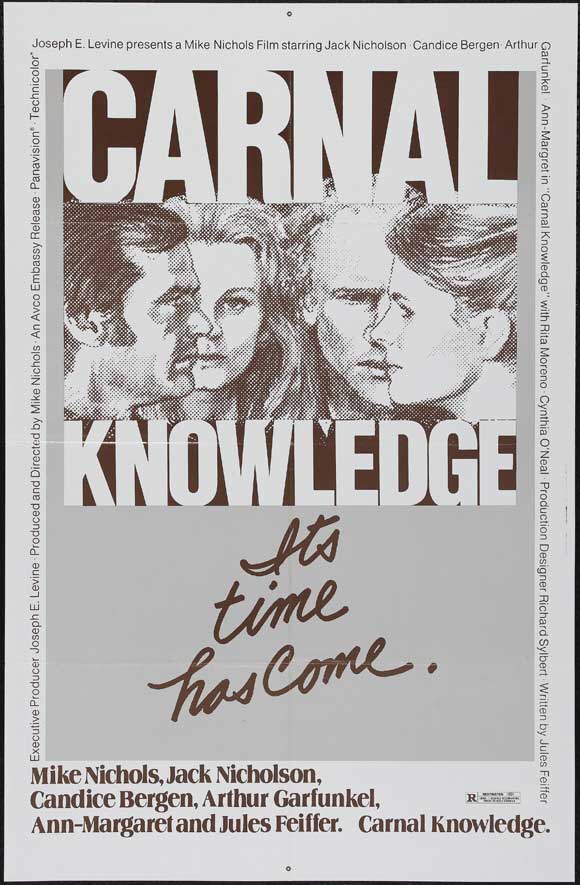
Carnal Knowledge, directed by Mike Nichols and starring Jack Nicholson and Art Garfunkel’s pubic hair, has.
It’s a movie I could’ve written back in my college days. Particularly the first act, about two college guys that know next to nothing about women who try to score with Candice Bergen. Of course, Mike Nichols aces the direction by presenting the two characters in all their pathetic glory. Bergen is also handled nicely as she plays a confused girl torn between these two dorks. Imagine watching a dramatized version of Beavis and Butthead in college, that’s the first act of the film.
Naturally, this romantic interaction has long term consequences, especially for Nicholson’s character. The second half explores his inability to connect with and emotionally abuse Ann-Margret.
Carnal Knowledge really makes you wonder why women love men at all.
Before Jack Nicholson became the Jack Nicholson we know and love today, he specialized in these character studies. Other notable examples are his collaborations with Bob Rafelson (Five Easy Pieces and The King of Marvin Gardens) and The Passenger. He was (is) truly an unusual leading man.
Is Carnal Knowledge a great film? Not particularly. In it’s simplicity, it would probably work better on the stage than on the screen. But it is the highlight of Nicholson’s career from 1969 to 1974, a brief window from when he was still an actor, before he became better known as Jack Nicholson the film star.
I once knew a psychopath that loved saying “why do tomorrow what can be done today?”
Nah.
More like “why do today what can be done tomorrow?”
As my father always said: “if you want something done right, get someone else to do it.”
Allegedly William James said “act as if what you do makes a difference.” But the truth is you should “act as if what you do makes absolutely NO difference.” Because it doesn’t.
You’re only here for a small blip in humanity’s history. And humans will only be around for a very short time in comparison to the immensity of the universe. So don’t worry about it, nothing we do here matters 😎
Even the history books will return to dust.
“Falling down is an accident. Staying down is a choice.”
The Last Temptation of Christ unsurprisingly stuck with me. Usually when I complete a novel, I think “hmm, that was nice” and I move on to the next thing. But Kazantzakis’s interpretation of “the Greatest Story Ever Told” is rewarding and leaves a lot to think about, especially if you’re obsessed with early Christian history.
I mean, obviously it’s not historically accurate. That’s not the point. The point is that the book brings these familiar characters to life. Jesus begins the book as a sickly carpenter before transforming into the messianic figure we’ve come to know and love. However, his humanity is emphasized. At times, Jesus comes across as a jerk with megalomaniac fantasies. This helps contextualize Jesus the man and the era he lived in.
This is best demonstrated by his relationship with Judas Iscariot. Judas is a true revolutionary with a hatred for the Romans and is often frustrated by Jesus and his message of love. Jesus feels that Judas’s revolutionary ideals don’t go far enough: the concerns for the body are temporary, Jesus wants to bring salvation to the world…Jew and gentile alike.
The various characters are often puzzled by this. This universalism is too lofty, too radical to ever be realized.
And this sort of remains true today. I’ve expressed my admiration for John Dominic Crossan views: Jesus was responding to the imperial authority of the Romans. Jesus and his followers might not thought of it in that way, but that was effectively what he was doing. I don’t think enough scholars, both Christian and secular, stop to appreciate this. Not even Bart Ehrman.
I think this is best demonstrated by the cross as the official symbol of Christianity. Jesus unquestionably died by crucifixion, perhaps the most ruthless form of punishment by the Romans. And none of the early Christian apologists deny that it happened. Stop and think about that: their very leader got “owned” by the Romans. In fact, it HAD to have happened so that he could be resurrected. So Christians took this event and chalked it up as a win for their beliefs, and a loss for the ruthless rule of the Romans.
Scholars often wonder how Paul was able to convince so many pagans to convert to Christianity (or, to be more historically accurate, his form of Christian Judaism, as Paul still thought of himself as a Jew), well maybe here’s an answer: Roman rule under the Pax Romana pissed off enough people that when they heard of a man who was resurrected after a crucifixion, conversion was a way to subtly stick it to the Romans. This could be why Paul put so much emphasis on death and resurrection in his theology.
Yes, I know there are plenty of problems with this theory, chief among these is how little the Romans are criticized in the New Testament. In fact, the Gospels explicitly blame the Jews for Jesus’s death and not the Romans, even though the Romans certainly DID execute Jesus. My response to this is that you don’t have to spend more than two minutes following populist/leftist politics before realizing that they hate each other more than they hate their opposition. It is my opinion (maybe more on that at another time) that this is fundamentally rooted in these kinds of movements. Even though the Romans were THE existential threat to life in the Mediterranean world, it would have been mainstream Judaism that were the primary theological/ideological opponents of early Christianity…even if the Jews were as much under the thumb of Roman rule as they were. This is heresy in the world of radical movements, what leftists might call “class traitors” today, and it wouldn’t take much for Christian writers to switch out Romans for the Jews in regards to who was guilty for Jesus’s death.
It is this narcissism of small differences that plague radical movements, religious and political alike, and I doubt early Christianity was any different. (See Monty Python’s Life of Brian)
It is difficult to tell if the real Jesus actually preached this message of universalism, or a peaceful coexistence of all people under one God. Crossan might, but it’s more likely this was extracted by later thinkers and is now considered the ethical message of Christianity IF people could move past their short-sightedness (maybe not under “one god”, but you get the idea).
Anyways, I’ve spent too much time on this post, forgot where I was going. The end.
“Narcissistic personality disorder” is HOT right now. I think it’s surpassed “borderline personality disorder” as the cool thing to have.
In all seriousness though, I think there’s been a turn in the psychological community. “Pop psychology” has turned disorders into badges of honor, or an identity, to the point where individuals no longer concern themselves with improvement and instead use their “disorder” as an excuse to continue shitty behavior then expect society to deal with it.
Of course, I’m speaking from personal experience. Obviously I’m an insane person that’s maladapted to society and require the services of doctors and therapists to help me. That has been the case since I was a teenager. When I first started seeking medical attention for my behavioral ailments, psychiatrists and therapists were in a mad dash to “diagnose” me into a neat category. Now, 93 years later, they don’t give a shit about that. It doesn’t matter. They just want to make sure that I don’t jump into traffic whenever I’m out in the public. That’s the important thing.
Anyways, personal anecdote aside, I’m fascinated by narcissism and the nature of mental disorders. I won’t get into that because it’s a lot of armchair philosophizing on my part, but is the prevalence of “narcissism” and “narcissistic personality disorder” a reflection of societal shifts?
I reckon that “narcissism” and “narcissistic personality disorder” are not synonymous, but I do think they share a link with the rise of radical individualism and consumer culture.
I’m not a psychologist. Thank god. But I can say with near certainty that I’ve been blessed with having not one, but two people very close to me have NPD. Crazy people have a tendency to attract other crazy people. Go figure. (I may say more about this at another time)
One was charismatic and the other a complete fucking moron, but they shared this commonality: when most people have an interaction with somebody, say someone they just met, all sorts of assumptions are being made. Most of these assumptions, by both parties, are not expressed and are usually rationalized as being just ASSUMPTIONS. Nothing more. There’s a wall of rationality between perception and reality, and most people are good at distinguishing between the two. A narcissist, at least the ones I’ve met, don’t have that ability.
The narcissist’s perceptions get projected onto the reality at hand, and they’re not able to tell where their emotions end and where objective reality begins. In my instances, both individuals reacted harshly against being labeled a liar. It was obvious that they had difficulty with the truth, but in their mind, they weren’t lying.
What this has to do with society at large, I don’t know. It’s merely conjecture on my part.
For whatever reasons, I’ve recently went through a David Fincher binge. And it occurred to me: I’m not a fan of his work.
That being said, The Game and Panic Room are his two best movies. Alien 3 is probably better than you remember. Se7en is alright.
Everything else is overrated. This includes Fight Club.
But The Game surprised me. It reminded me of one of my other favorite films: Roman Polanski’s Frantic. It’s hard to pull off these kinds of movies…watching a character descend into madness while information about what’s actually going on slowly leaks out.
Honestly, The Game doesn’t completely pull it off. Fincher’s visual style and Michael Douglas’s performance carry the film. But to completely enjoy it, one must ignore large plot holes and read more into subtext than what was probably intended (I assume).
I thought that Douglas’ character was suffering from the same madness that his father had and the ending indicated that “the game” was still being played. But I have the suspicion that this open ended interpretation bails out the script. In other words, Fincher’s direction saves the day.
As for everything else on Fincher’s resume, he seems to suffer from the same problem that Ridley Scott has: all style and the substance is overstated.
Why I obsess over Jesus and the New Testament, I don’t know. Just do. Get off my ass.
But I just started reading The Last Temptation of Christ by Nikos Kazantzakis. I’m only about halfway through it, it’s a long book. I don’t expect any twists and turns to a story that I’m already familiar with.
But the book is nothing like the film, let’s just get that out of the way.
I couldn’t have written in a million years. It reads like an extended version of the Gospels. But it weaves between perspectives-from Jesus (Son of Mary, as he’s often called), to Judas, to Mary (wife of Joseph) to Mary Magdalene, to the Apostles, etc-to create a rich tapestry of these events. Because Kazantzakis writes like the authors of the Gospels, the book actually breaths life into the books of Matthew, Mark, Luke, and John.
While reading it, I honestly forget that this book was deemed “controversial”. Of course, I haven’t gotten to the “last temptation” part, which might understandably piss some people off, but as Kazantzakis explains in his prologue, Jesus (at least if you’re Christian) was both full divine and fully human. Can you imagine the burden of having to live with that? Everyone hears about the “divine” part. But no one wants to confront the “fully human” part. So Kazantzakis takes that perspective and runs with it.
Anyways, finished taking a shit. Gotta get back to work.
He’s an excellent biblical scholar, but a little too conservative for my tastes as a historian. This occurred to me while I was watching him get ambushed by both Christians and atheists during a Zoom call.
If I’m correct in my understanding…and remember I’m a dumbass…then Ehrman’s argument regarding our access to the original intentions of the New Testament texts are completely lost. We cannot know what “Mark”, for example, originally wrote. Not only would this be true for all biblical texts, but virtually ALL ancient texts as well.
In my view, this is an extreme form of skepticism which throws our understanding of history out the window. The entire historical record would be in jeopardy, a point which Ehrman himself seemingly concedes (unless, of course, the record can be confirmed by other sources i.e. archeological, DNA, etc.)
I guess this sounds extreme-having to take the accuracy of ancient historical accounts basically on faith (especially when they sound plausible, but lack supporting evidence)-but what other option do we have until the facts prove otherwise?
I suppose this line of reasoning is how Ehrman can reconcile his certainty that Jesus existed with his extreme skepticism of the historical accuracy of the Gospels.
So I was eating a bag of skittles when the phone rang.
“What do you want?” I asked.
The woman over the phone spoke. “Hi, this is Arianna. We talked last week. Just want to know that I’ve been fantasizing about you. I’m really, REALLY horny. I want to come over, sit you down, take you in my mouth then ride you as you slide in and out. I want to taste you. I want to feel you inside me. Just the thought of your cock makes me quiver with excitement. Please let me come over. Please PLEASE have your way with me.”









 The Internet Ruined Everything