another shot at the title (part iiI)

This Tastes Like Ass is obviously a modern classic,” said Bryce Howard Dallas Antonio, the screenwriter, “but I think it lacks the nuances of some of the earlier postmodern classics from David Lynch and Martin Scorsese.”

Dallas showed up to the pre-production meetings wearing a tweed jacket, a derby, and a walking cane. I wanted to smash that cane right onto his dick.

Sets were going up. I had enough on my plate. But Dallas insisted on following me around.

“Do you like David Lean?” he asked.

“Yeah, he was hott.”

“What’s your biggest influence?”

“I don’t know. Alcohol?”

I was signing papers left and right. I was too busy to listen to this shit. After Dallas called Smokey and the Bandit the most overrated movie of the 70s, I grabbed him by the jacket.

“Listen here shitwad,” I said, “you’re right out of film school. You know who I am? Google my name. I may have diabetes, cirrhosis of the liver, and a venereal disease that doesn’t have a name, but I can still kick your ass. So listen to my advice grasshopper, watch your ass!”

The executive in charge of production, Jimmy Greco, saw what was happening and rushed out of his office. He waddled his fat, Jerry Stiller-lookin ass right up to my face. “You can’t touch the screenwriter!” he screamed. “That’s against WGA rules!”

He then straightened out Dallas’ jacket and ran a hand through his hair. Afterwards, he pointed his finger at me. “Listen here buster,” Jimmy said, “if you pull a stunt like that again, I’ll have your ass!”

“Oh you want my ass?” I replied. I dropped my pants. “You want my cock too?” I turned around and started twirling my penis.

“You’re a fool,” Jimmy said.

“I’M the fool? The only fool here is that idiot screenwriter!”

Jimmy escorted Dallas away. The cast and crew stood around gawking.

“Everyone back to work!” I yelled and pulled up my pants.

I took out a cigarette and walked up to Pablo. “Take it easy, James,” he said.

I lit up the cigarette. “How did the contract negotiations go?” I asked.

“Great!” Pablo replied. “You’ll be pleased to know that you’ll move up the billionaire’s list.”

“I’m a billionaire?”

“James, you’re one of the richest men in the world. You have real estate holdings all across the globe. You even own the deed to the Kremlin for fuck’s sake!”

“Isn’t that a bar in Tallahassee?”

***

I was having brunch with Brett Ratner when Kat slapped down a newspaper. The article read “NOTORIOUS FILM DIRECTOR EXPOSES PENIS…AND ASS…TO CAST AND CREW.”

I looked up to Kat and she began speaking in a monotonous, scripted voice. “The board wanted me to tell you that if you do that again, they will remove you from the project. Please be more considerate of the crew,” she said.

She never made eye contact.

“Kat,” I replied, “as you know, I run my sets a little differently. Besides, per our agreement, I was allowed to change the script so that the entire jury would be nude throughout production. Bare cock will be all over the set. What difference does one more make?”

“This is the position of the board and the production team,” she said, still refusing to make eye contact.

I shrugged. “Very well, will that be all?”

“That is all,” Kat replied and began walking away. Then she stopped. “There is one other thing…”

She turned around and looked me in the eye.

“We are already running over budget,” she continued. “We are having trouble securing funds from the European market. Would you be considerate enough to loan $900,000,000 to help cover pre-production costs?”

I thought for a moment.

“Sure I’d be happy to give you nearly a billion dollars,” I said. “But in return, I want to make more changes to the script.”

TO BE CONTINUED

Another shot at the title (part ii)

Pablo and I made the journey to Trainwreck Studios in Burbank. What a god-forsaken place. I swore to myself that I would never return.

“We’re here to see Kathleen Kennedy,” Pablo told the receptionist.

“And you are?”

“I’m Pablo Dunbar, the agent of James…”

The receptionist’s eyes widened when she saw my face. “You mean, James…”

“Yes, THAT James,” I interjected. “Tell Kat we’re here so that we can get this over with.”

“I thought you were retired…” she began to say as she stumbled through her words. “Anyway, she’s waiting for you. Fourth floor. The only way up there is through the air ducts. Elevator’s broken.”

So we climbed up the ducts into Kathleen’s office. “Damn it Kat,” I said, “when are you going to get that fucking elevator fixed?”

She turned around and was wearing sunglasses. She appeared to be somber over something.

“Hello James,” she said.

“Hello Kat.”

“Can I offer you gentlemen a glass of scotch?”

“I’ll take the bottle please.”

Kat sat down behind her desk and began to shuffle through some paperwork. Pablo and I plopped down in the leather chairs.

“So, what did you think of Antonio’s script?” she asked.

“To be honest Kat,” I said, “it needs some work. Too much talk. Film is a visual medium. ‘Show, don’t tell’ as they say. If I can do a second draft and clean up the dialogue…”

“James,” Kat interrupted, “Fart in a Windstorm is a court drama, there’s going to be a lot of dialogue. Besides, I already promised Antonio that he would get final say in the script.”

“Fine, whatever. But I need to put my stamp on it if this is going to be a film by James…”

“Look, I get what you’re saying,” Kat said. “But in agreement with the writer’s guild, he must get sole screenwriting credit. That’s going to put a limit on what you can do.”

I just stared at her.

“You don’t want to relinquish creative control to me,” I said. Out of my periphery, I could see Pablo getting uncomfortable.

“Don’t be ridiculous,” Kat replied, “the studio is willing to put $1.5 billion into this project ONLY if YOU are signed on to direct. Once when this meeting is made public, Hollywood will be in a tizzy over the return of its most famous director.”

“Kat, you know I can’t make a small scale courtroom drama for anything less than $2 billion.”

She learned forward on her desk as she began rubbing her temples. She appeared as though she was about to be sick. I took a big gulp from the bottle of scotch.

“What’s with the sunglasses?” I asked her. “Did you have eye surgery? Did your husband beat you?”

Kat removed the glasses, revealing her puffy red eyes and makeup smeared from crying.

“Jesus fucking Christ,” I said.

“We haven’t had a hit since This Taste Like Ass,” she said as tears rolled down her face. “The board wants me out. I’ve become the laughingstock of this town.”

“It’s no fun when the rabbit has the gun, eh?”

“James,” Pablo said. “Mrs. Kennedy, James and I are both in agreement that this script is doable. Sure, there are problems that need ironing out, but we are committed to making this work. Right James?”

I just shrugged.

“Really?” Kat said.

“Absolutely, the gang’s back together. Let’s have a drink on it!”

We all stood up and Pablo forced a group hug. Kat’s spirits seemed to have been lifted slightly.

As we were climbing back down the air ducts, I grabbed Pablo by the ankle. “You better not fuck me out of this contract like you did last time!” I told him.

TO BE CONTINUED

Another shot at the title (part I)

“Get the fuck out of my house,” I told Pablo.

“At least read the script!” he replied.

“Pablo, I have everything I want. I’m happily married to a Vietnamese hooker I met in Van Nuys. I’ve got a son and a house in the hills. I’ve got more money than god thanks to This Taste Like Ass. I’m done with Hollywood. Fuck Kathleen, fuck the studios. I’m retired.”

Pablo shook his head and looked down at his beer. “You know what they say about you?” he asked. “They say you’re a one-hit wonder. That you got lucky with This Tastes Like Ass, and lightening doesn’t strike twice.”

“And they’re right!” I replied.

“I can’t believe I’m hearing this,” Pablo said. “I remember when I first read your script years ago. I said ‘this guy is going places’ and I thought it was a privilege to represent you.”

He stood up and looked at my three Oscars mounted proudly behind a glass case. “When we first met, you told me that the worst fate someone could have in this town is to have a career like Michael Cimino,” Pablo continued. Then he turned around and looked me in the eye. “Do what Cimino couldn’t do. Prove Hollywood wrong: make another great film.”

I looked away. “Like I said: I’m retired,” I replied.

Pablo stood up straight and laid the script down on the coffee table. “I’ll leave this here with you,” he said then showed himself out the door.

I picked up the script.

Like a Fart in a Windstorm by Dallas Austin Antonio,” it read.

***

Later that night, my son put on a film streaming on Amazonian Prime. I don’t remember what it was called. “Big Gay Ted’s Excellent Adventure,” or something. I was too drunk to care.

But my blood began to boil during the sex scenes. The action was not much better. Finally I had enough and in a drunken rage, I slammed my foot into the TV.

“What the fuck is this shit?!” I yelled.

“Dad you’re drunk! Go to bed!” my son, Slick Rick, said.

“Fuck you asshole! My creativity built this house! I own Hollywood! Back in my day, we showed rock hard cock, full frontal nudity, and absurdly graphic violence! Not this pussy shit! No tits, no penis? Why is there a plot? We never cared about that crap! What happened to kids these days!?Hollywood just ain’t the same anymore Slick Rick, I’m tellin ya.”

“Dad, you need to get a hobby,” he replied.

I sat down next to Rick and patted him on the knee. “You’re a good son,” I said. “Now go help your mother.”

I then wrapped my bottle of Evan Williams in a paper bag and began wondering the streets Laurel Canyon.

The next morning, when I woke up in my neighbor’s backyard, I began to ponder Pablo’s words. I took out my cellphone and called him up.

“James, where the hell have you been?” he said. “Your wife’s been frantically calling me, wondering if I knew where you were!”

“Nevermind that,” I replied. “Get me a meeting with Kathleen Kennedy (not THAT Kathleen Kennedy, the other one).”

“So you read the script?” Pablo asked.

“Yes, I took your advice. We’re back in business.”

TO BE CONTINUED

i’ll never write a book

I tried to do one of those challenges where people write a book in a month. It didn’t work.

It’s a good story too: about some dumbass that works at a toilet factory whose boss gets kidnapped. All of this causes uproar in this small town. As the situation grows more absurd and contrived, our dumbass has to rescue his boss. I was exploring my contempt for politics and storytelling in general.

While I think about it, contempt is actually the driving force behind all of my writing. Whenever I begin to write, I have to hold back my urge to say “im gay suck my penis lolz.”

If I did ever write a finished work, it would go something like this:

“Chapter 1: Fuck you

Chapter 2: my dick is small

Chapter 3: my balls are too

Chapter 4: I’ve definitely had sex before

The eND“

Now if I read that, I’d think “that’s a damn good book.” But it would have an audience of exactly one person. Most people expect a novel to be “good”, and “have a story”, or whatever.

My style just doesn’t transfer into long form, immersive storytelling.

Nor into short form really. My way into writing a story consists of how many times I can say “penis”, “gay sex”, “cum”, and have people actually read it. That’s why “A Shot at the Title” is my finest short story. Honestly it’s a banger. Someone should probably give me an award for it. But most times, when the author doesn’t give a shit and hates their audience, the work’s just not gonna be good. Ya know?

That’s why I’ll probably never go back to writing on Medium or any other platform for that matter. I don’t think the shit I want to do would transfer over there. I have complete creative control over here. If I want to post a video of me spreading my ass and saying “this is what I think of Denmark”, no one can tell me no.

I’m a blogger. That’s all I’ll ever be.

“blue thunder” and “backtrack” (aka Catchfire”)

I watched two movies back-to-back (unintentionally) that had helicopter chases.

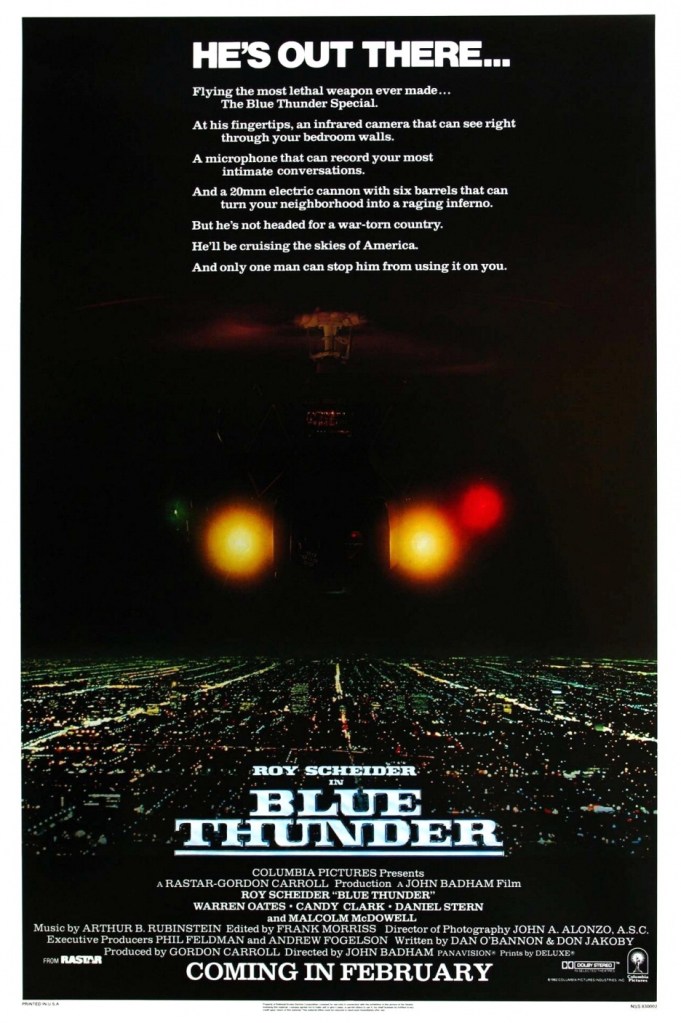
The first was Blue Thunder, staring the greatest leading man of all time…Roy Scheider. It is also the greatest movie that Paul Verhoeven never made.

No disrespect to the highly competent John Badham, but Verhoeven would have crushed the shit out of this material. The film takes place in 1980s LA and is about a police pilot and Vietnam vet, played by Scheider, who gets introduced to a military-style helicopter that the city wants to use for patrol. The villain is Malcolm McDowell, a British man that somehow became a Lt. Colonel in the US Army, who for some contrived reason wants to kill Scheider. The fascistic overtones are right up Verhoeven’s alley, and even some of the story beats would be echoed in Robocop four years later.

But the movie looks incredible. John A. Alonzo is really an unsung hero in the field of cinematography. The handheld work is really ahead of its time, and masterfully done. After watching the first scene of Scheider walking out to his helicopter, I was shocked that this came out in 1983. It’s a natural look that even films today have trouble emulating.

And that final helicopter chase was incredible. All of the concerns that Scheider’s character had regarding public safety goes out the window once when he gets hunted by fighter jets and Malcolm McDowell. Chicken factories and buildings get blown up while debris falls on the people below. Meanwhile, Candy Clark drives like a bat out of hell down the streets of LA. As far as 80s action movies go, I’m not saying that it’s up there with the Schwarzenegger, Verhoeven, and John McTiernan classics, but it is very good. In fact, I would say it was a prototype for subsequent 80s flicks.

The other film was less of a banger but no less interesting (for various reasons). It was Dennis Hopper’s Backtrack (or Catchfire, idk). There are apparently two versions: theatrical cut and a directors cut. I guess I watched the director’s cut.

Hopper himself was apparently dissatisfied with the original version and had his “directed by” credit given to Alan Smithee. Honestly, he should have taken his name off the director’s cut as well.

What’s it about? Not sure.

I think Jodie Foster accidentally sees a mob hit by Joe Pesci and Pesci tries to track her down by hiring Hopper and Hopper falls in love with her (and she with him).

Now I’ll say this because I’ve said enough about dude’s bodies in this blog and it’s time women get their due: Jodie Foster is fiiiiiiiiiiiine as hell in this movie. You could say that I was “sexually attracted” to her. It made me uncomfortable (in my pants specifically). I could understand why Hopper didn’t want to kill her.

But the problem with this movie (one of many) is that Dennis Hopper is, I’m sorry to say, not fit for the role. Hopper is at least 25 years older than Foster. There’s nothing romantic about their scenes together. They’re downright creepy. It’s a role that someone like Nicholas Cage, Mickey Rourke, or Sean Penn could have aced at that time.

That being said, Hopper REALLY makes some decisions in this movie, both in front of and behind the camera. To be honest, I don’t even know what he’s trying to do. Is that accent New York or Cajun? Does he know his lines or is he just making shit up? Now no one on God’s green earth could have saved this screenplay, but Hopper’s visual flair and strange acting decisions steal the show…almost to the point where you forget that heavy hitters like Joe Pesci and Vincent Price are also in the movie.

RIP Dennis Hopper and Roy Scheider 😔

cynics and stoics

The post-Socratics get a bad rap for being not nearly as good as Socrates, Plato, and Aristotle.

Stoicism in particular has been much maligned over the last few years. It reentered the public consciousness recently, which irked some in the philosophical community. I guess in our post-Enlightenment era, there’s a resistance to schools of thought that seemingly promote individuals to rise above their political realities. This makes sense to a certain extent, especially given our reality after the Great Recession. However, this in turn irks me because the intellectual community is unwilling to divorce the bad from the good in these philosophies, but they’ll gladly do so for Plato and Aristotle (and as I mentioned in an earlier post, for Marx).

Many claim to find stoicism to be too rigid in its determinism, which in turn means we should almost remain passive or unattached to the obstacles we find in our daily lives. But that’s an over simplistic reading, in my view. To be honest, I don’t know if this was the intention of noted stoic thinkers like Epictetus, Seneca, and Marcus Aurelius, but I think we can infer from them that we have to exercise our best judgments and restraint to remain above the madness in everyday life. If we fail to do so, then we are no better than that madness. Through logic and reasoning, we actually find our free will, then subsequently, our happiness. Through this interpretation, Stoicism actually isn’t deterministic at all (though this might run contrary to actual Stoic metaphysics. I don’t know 🤷‍♂️).

I understand why Stoicism would have had detractors in its heyday as it seemed to have caught on with the Roman elite, who had the security to explore such lofty idealism while the proles weren’t afforded that luxury. But that seems like a lazy, bad faith criticism of it today, which comes across like an attempt to deflect personal responsibility and agency (especially given that proletarian-centered philosophies like Marxism is way more complicated, lofty, and at times hypocritical).

But I’ve always been more partial to Cynicism. Not that I condone it, it’s just way more in-your-face. It’s impossible to be a Cynic today (you’d be arrested for a being a public nuisance), but it does ask you to question common sense. Diogenes of Sinope was its most prominent thinker. He apparently jacked off and relieved himself in public, gave no shit about social status, and extolled the virtues of what amounted to homelessness. I agree with the leftist critics of Diogenes’ form of Cynicism in that his fetishism of poverty undermines how dehumanizing it actually is. But the real reason why I think Cynicism is unpalatable to modern thinking is it’s rejection of material wealth and its promotion of “cosmopolitanism”. While I find the Cynicism of Diogenes to be somewhat individualistic, his form of individualism runs completely contrary to its modern form.

While I wouldn’t call Cynicism’s version of cosmopolitanism to be sophisticated, it was rather forward thinking in its rejection of “imagined communities” (see Benedict Anderson). Diogenes allegedly called himself a “citizen of the world”, this coming at a time when the city state dominated political thinking. Cosmopolitanism is widely rejected by ideologies across the spectrum, from Nazi’s, traditional conservatism, and even Marxism (depending on your interpretation), despite its inevitability.

So I don’t know, maybe I’m asking you to reassess these schools of thought because they piss off the right people.

what dreams may come

I’m a hard sleeper.

Nothing can, nothing will, wake me up. Construction, gun shots, home invasions, house fires, nuclear holocausts…nothing.

So I get to have incredible dreams. Last night, for example, I dreamt that I was a football player buried deep down the depth chart. The team boarded a plane en route to a game with the pilot both coked up and drunk. The pilot thought it would be cool to do a barrel roll in a passenger plane which caused some concern. I brushed it off and took a nap. When I awoke, the plane had to make an emergency landing onto a road but ended up crashing into an apartment building. No one was killed,miraculously, and the people in the building didn’t think anything unusual about it because it was in Mississippi and apparently things like that happen all the time. Nevertheless, one player thought this was the perfect opportunity to exact revenge…for whatever reasons…on the head coach and a few other players. So it was up to me, some nobody, to save the team.

Once when that was done, I had to book a flight home but chose to fly to London, England instead. The price came to $20,000 and I didn’t have the money. Then the dream ended.

There were dreams on the periphery, one which includes me fighting a rabbit in Monument Valley and sending it to a highly mechanized version of hell.

I guess dreams are just a hodgepodge of shit stored in our heads and when we sleep, our brains randomly throw things together which we later attempt to make sense of (or in my case, project a story onto). Does it ever mean anything? Probably not.

At least not most of the time.

But I do have recurring dreams. Not dreams where the exact same things happen, but they share similar themes, people, places, etc. I suppose that there are shreds of truth in these kinds of dreams: a revelation of regret, dread, loss, and so on.

I find the subject of dreams fascinating. It reveals the chaos that exists in our own minds. Even the purest of people will experience a gruesome nightmare. Despite their outward practices in real life, even in their minds they will produce true horror. That emanates completely from them. We try to project some sense onto our dreams, but the fact is that there isn’t any whatsoever.

We do the same thing to our reality.

😎Midsommar 😎

I like to talk about movies that people usually know but have somewhat forgotten about.

That being said, Midsommar is relatively recent and probably still discussed.

Oh well 🤷‍♂️

I’m not really a horror fan, so I haven’t seen Hereditary, Ari Aster’s other film. But Midsommar caught my attention because someone mentioned that it was a horror film that lacked any of the tropes found in such movies.

People aren’t as big of a fan of Midsommar as they are of Hereditary. Was Hereditary really that good?

Many have said that the subtext of this movie is dissolution of the relationship between the two leads. If that was the case, then I hardly noticed (or cared). For me, what was terrifying about the movie was how it kinda reminded me of Salo: Or the 120 Days of Sodom, albeit far more emotionally engaging. In fact, if Midsommer is a “horror” film, then Salo is as well.

But Aster uses the “horror” elements wisely. Much of the film is actually pleasant to look at: pleasant locations, pleasant faces. Naturally, this pleasantness is used to lower your guard.

Except for one dream sequence, all of the horror takes place during the day. The most noted example is the suicide scene with the two elderly people. If you watch a lot of movies, you’ve definitely seen gorier shit, but this one hits different. It’s a beautiful scene juxtaposed against two old people getting their faces smashed in. Additionally, for the two groups present for this ritual, one finds the scene beautiful while the other is utterly horrified.

And it happens relatively late in the film, long after you get adapted to the tone. Usually horror films do something like that early, just to tell the audience what it’s capable of.

Many have discussed why this movie is terrifying, and none of it works as an explanation for me. The most common is “it’s an American perspective on a foreign culture and how we find them terrifying “ blah blah blah. That never once occurred to me. What I found terrifying is the passiveness of the characters and the bullshit myths that the cult had to justify itself.

And the film does call bullshit on it (some guy argued that the film has a neutral take on the cult, which is partly why some find it scary. But that’s definitely not true).

Case in point is in the euthanasia scene, after the old man jumps off the cliff, breaks his leg, and lays there in pain. After the scene, the male lead tries to justify it by saying something like the “community might find our methods of elderly care barbaric”, but that old man met a truly barbaric end (his face later gets smashed in). I’d take a nursing home any day of the week.

The other example is at the end when the temple gets set on fire. Two members of the cult volunteer for the burning and are given a drug so that they won’t feel the pain of burning. However, one guy watches his friend, the last image he’ll ever see, scream in horror as he burns alive! All the drugs and nonsense clearly did him no good.

So to me, this film was kinda a commentary on the cult mindset and how people can be persuaded to do unusual things in the name of nonsense (and a lot of drugs). OR how people use these rituals to mask truly horrific things. That explains Florence Pugh’s smile at the end: she was an emotionally unbalanced person that’s suddenly found her place.

To me, the most terrifying thing was the brief moment when the male lead opens his eyes and sees a smiling face telling him that he is drugged, can’t move, can’t talk, and that’s that. Bye!

But what this film also does effectively is give you a solid sense of geography. You get used to the nice setting and that’s when bad things start happening. It plays out like a dream that suddenly turns into a helpless nightmare. Just as in a dream, the actors don’t know what’s going on but they play along nonetheless.

Ideology works the same way.

carnal Knowledge (1971)

I normally watch 42,000 movies a week. Few of them stick with me.

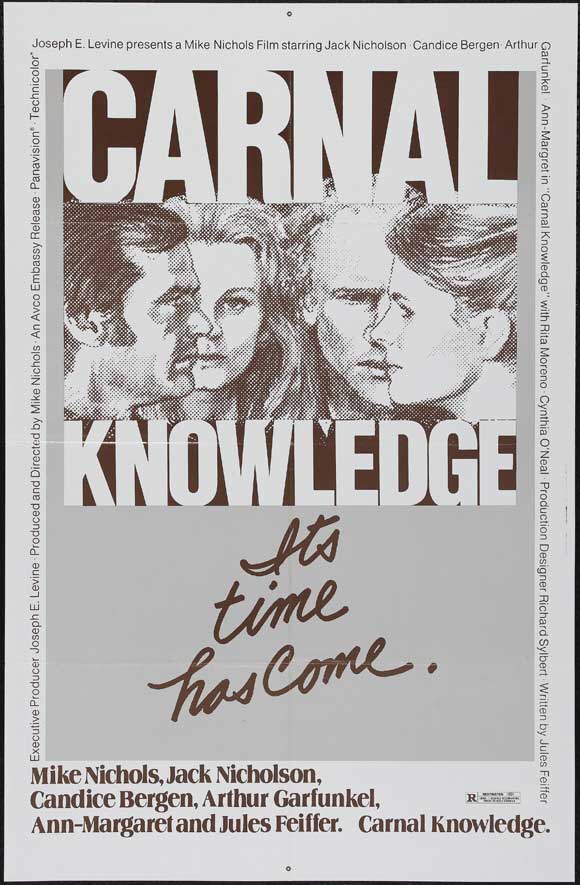
Carnal Knowledge, directed by Mike Nichols and starring Jack Nicholson and Art Garfunkel’s pubic hair, has.

It’s a movie I could’ve written back in my college days. Particularly the first act, about two college guys that know next to nothing about women who try to score with Candice Bergen. Of course, Mike Nichols aces the direction by presenting the two characters in all their pathetic glory. Bergen is also handled nicely as she plays a confused girl torn between these two dorks. Imagine watching a dramatized version of Beavis and Butthead in college, that’s the first act of the film.

Naturally, this romantic interaction has long term consequences, especially for Nicholson’s character. The second half explores his inability to connect with and emotionally abuse Ann-Margret.

Carnal Knowledge really makes you wonder why women love men at all.

Before Jack Nicholson became the Jack Nicholson we know and love today, he specialized in these character studies. Other notable examples are his collaborations with Bob Rafelson (Five Easy Pieces and The King of Marvin Gardens) and The Passenger. He was (is) truly an unusual leading man.

Is Carnal Knowledge a great film? Not particularly. In it’s simplicity, it would probably work better on the stage than on the screen. But it is the highlight of Nicholson’s career from 1969 to 1974, a brief window from when he was still an actor, before he became better known as Jack Nicholson the film star.