Death of a theater

There’s a lot of bitching about the supposed death of movie theaters. The argument goes that the only way to appreciate filmmaking is on the silver screen with a fellow audience. Because of the proliferation of internet streaming, the communal experience cinema has fallen by the wayside.

Do I agree with this assessment?

Yes.

Do I give a shit?

No.

Perhaps I became a cinephile at the wrong time. I mean, I get it. I really do. But the dynamics of the filmgoing experience has changed. And that’s alright. EVERYTHING changes at some time or another.

But I quit caring about movie theaters a long time ago. Long before COVID even. The last time I’ve been to a theater was in 2017 to see Star Wars: The Last Jedi. This is largely because I have truthfully never bought into the “communal experience” of watching a movie.

I remember watching Joe Dirt in theaters long ago. I realized it was funny before everyone else did; before it became a cult classic. When Joe Dirt threatened to blow up the Grand Canyon and got poop spilled all over him, I laughed hysterically. Everyone else sat in their seats stone-faced. Audiences (except for me, of course) wouldn’t know what was funny if it bit them in the nuts. So fuck what other people think.

My argument is this: if you want to enjoy a movie, it has to be just YOU and the film. My love of cinema didn’t start in the theater. It started at 11 years old, after midnight, while watching Taxi Driver on Cinemax. Of course I was watching Cinemax at that hour to see some gratuitous T&A. At least initially. In fact, if anyone caught me, I would have probably quickly switched to porn and denied I was watching the classics of cinema. The first time I watched 2001: A Space Odyssey, it was with some friends and, to be cool, I had to say it was the most boring thing I’ve ever seen. But in my heart, I knew it was genius. At 12 years old, I stayed up late to watch The Deer Hunter and cried myself to sleep. I never told anyone that until years later. Enjoying a movie, to me, should be an intimate experience; it should reveal things about yourself both good and bad…things that you may never tell another living soul. THAT’S the power of filmmaking.

This isn’t to say that theaters don’t have their purpose. But I’d argue that theaters simply offer the spectacle of film. They serve a similar purpose to churches. Sure, everyone can come together and listen to a sermon, but to have a truly transcendental religious experience, one must transcend the spectacle and enter a state of gnosis; of opening one’s mind to things unseen. Movies can be more than a spectacle. They can be a revelation.

Honestly, the slow death of movie theaters probably started with VHS.
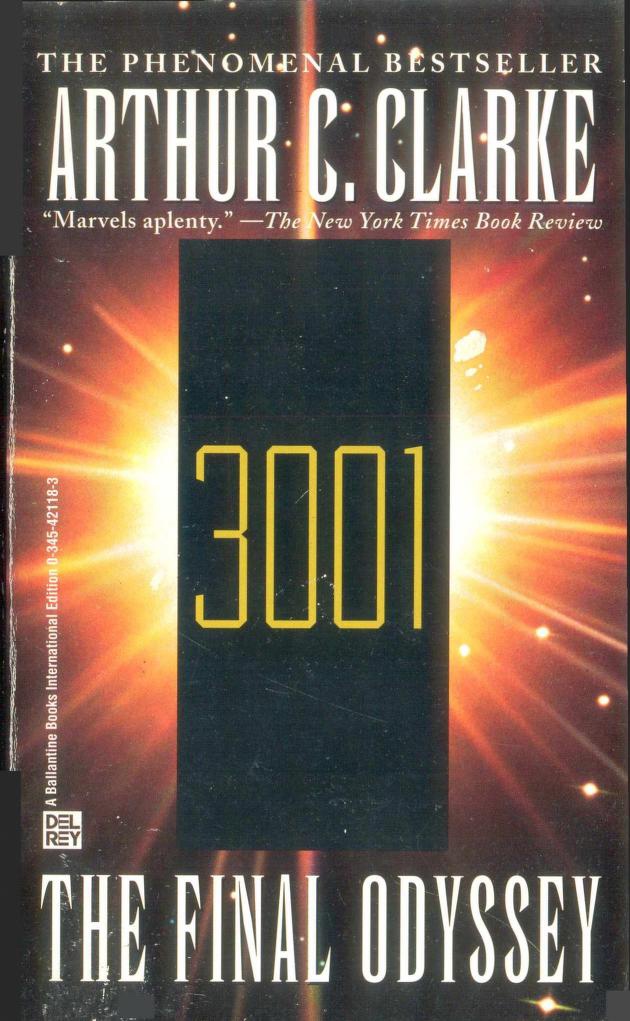
3001: The Final Odyssey

I don’t usually do book reviews as I’m not a big fan of them. So I’m not sure that this is a review. It’s probably closer to a commentary on 3001 and Arthur C. Clarke’s work as a whole.

As a film buff, I find 2001: A Space Odyssey to be the most ambitious movie ever made. I also think Peter Hyams’ 2010 is an underrated gem that doesn’t detract from its predecessor at all. What both these films do is ask more questions of humanity than it answers. However, it is typical for both film and book series to provide a sense of closure.

Which is why I was somewhat disappointed with Clarke’s 2061 and 3001. In fact, I found 2061 to be entirely superfluous. I enjoyed 3001 far more but even then I found the final entry to the Odyssey series to be wanting.

That is, until I read Clarke’s “valediction” at the end of 3001, where he reiterates what he stated in the introduction to 2061:

“Just as 2010: Odyssey Two was not a direct sequel to 2001: A Space Odyssey, so this book is not a linear sequel to 2010. They must all be considered as variations on the same theme, involving many of the same characters and situations, but not necessarily happening in the same universe.”

Excerpt From
3001
Arthur C. Clarke

While in a certain sense I found this explanation to be a cop out, it does stand to reason when you evaluate Clarke’s work as a whole. In fact, I totally bought this same explanation for his Rama series. Rendezvous with Rama is one of the greatest works of hard science fiction and one one of my personal favorites. Yet its sequels are far friendlier to popular audiences. While I found the sequels to be a guilty pleasure, their perspectives don’t quite mesh with the original. To account for this, I too have to adopt Clarke’s rationale in his 3001 valediction.

Plus, the conclusion to the Odyssey series is in keeping with the themes found in his other works. From what books I’ve read from Clarke (I haven’t read them all), he rarely offer easy answers. In fact, that’s part of the reason why Rendezvous with Rama is so effective: there’s no clear explanation, merely speculation, for what the Rama craft is and why it visited the Solar System.

I think there’s an assumption that when we make contact with an intelligent, spacefaring extraterrestrial species, everything will be absolutely clear. At least that is what’s presented in mass entertainment. But that’s never the conclusion that Clarke reaches.

Space is unimaginably huge. And insofar as scientists can tell, there’s a limit to how fast information can travel. In all likelihood, when the first positive confirmation of intelligent life is found, it will likely be centuries before contact is made. Humanity, as a result, will be flipped on its head where entire theories will be obsolete and new fields of speculation will be established. Where humanity stands presently, it is unlikely that we have the language and understanding to fully grasp the final answers. That’s what it means to come face to face with “God”.

So to me, it’s these steps in human evolution…on our ultimate path towards the infinite…where Clarke found his fascination. That’s why he rarely provided answers: because we aren’t ready for them.

‘the internet ruined everything’s’ canon of greatest films ever made

You know what the internet needs? Another list of greatest movies.

So, in no particular order:

The Deer Hunter (1978): I’ve discussed this movie at length numerous times. I think it’s the greatest example of the power of filmmaking.

Robocop (1987): For the simpletons, this is just another 80s action film. For those that know better, it’s the greatest satire ever made. But each time I watch it, the more horrified I become. The idea of “Robocop” is terrifying. Imagine getting killed in the most violent way, then you get revived and made property of an evil corporation and begin to struggle to understand who or what you are. Hollywood is a lesser place without Paul Verhoeven.

-The Thin Blue Line (1988): This, along with Errol Morris’ (currently known for directing Chipotle commercials) Vernon, Florida are my two favorite documentaries. This is the story about a killing of a Dallas cop and a man getting rear ended by the justice system. I love Randall Dale Adams. He’s an everyday dude that took an unfortunate trip to Texas. We’ve all been there.

Star Trek II: The Wrath of Khan (1982): Yes, I’m a Trek fan. While every nerd has seen this movie dozens of time, I don’t think it gets the credit it deserves. It’s not really sci-fi, it’s more of a Shakespearean tragedy in space. In many ways, this film revived Trek. And director/writer Nicholas Meyer, who knew nothing of Star Trek prior to this, deserves credit.

Dances With Wolves (1990): I will go to my grave saying Kevin Costner deserved his Oscar. Fuck Martin Scorsese.

Taxi Driver (1976): We all know Martin Scorsese is a genius. And Paul Schrader may be the greatest screenwriter of all time. In the era of angry, lonely young men roaming the internet, this movie was well ahead of its time.

2001: A Space Odyssey (1968): if you’re gonna do science fiction, do it right. Everybody knows this movie. And because this movie rightfully gets the credit it deserves, we take it for granted. But, to this very day, it is the most ambitious film ever made.

The Taking of Pelham One Two Three (1974): I love movies that satirize a very serious situation. It’s kinda like Dr. Strangelove, albeit this film is dealing with a much less serious subject: the taking of hostages. Every actor is great, but Walter Matthau was an unusual talent. His face alone could carry a film.

No Country For Old Men (2007): The best movie made in the last 20 years. Cormac McCarthy may be the greatest living author and it ain’t easy adapting his work for the big screen. The nihilism, the existential themes, Javier Bardem, the vast, empty Texas landscape… “okay, I’ll be a part of this world.”

Blood Diner (1987): Most fans of the B-movie, cult genre are familiar with this film but it should be more widely known with general audiences. Probably the funniest fucking movie I’ve ever seen.